How Quickly Changing Climates And Landscapes Affect Bird Diversity

Greg Howard
30th August, 2025

How Quickly Changing Climates And Landscapes Affect Bird Diversity

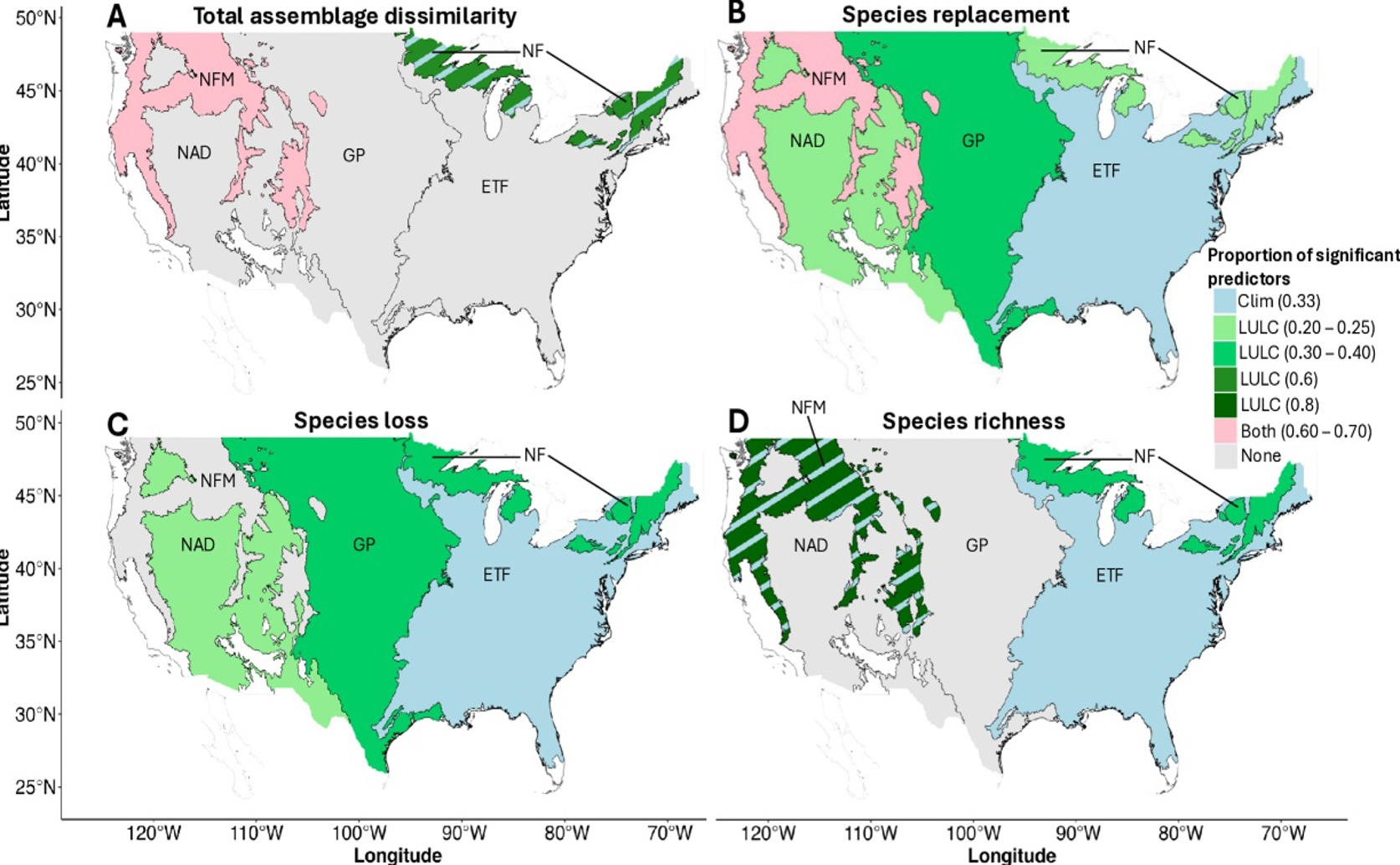
The analysis of total assemblage dissimilarity (a), species replacement (b), species loss (c), and species richness (d) demonstrates that while the dominant driver is ecoregion-dependent—with climate driving changes in the Eastern Temperate Forests—land use and land cover (LULC) change was generally a stronger predictor of avian biodiversity trends across the United States than climate change.

Image adapted from: Alamo et al. / CC BY (Source)

Key Findings

  • This us study examined bird populations across the united states over 30 years to understand how quickly species are changing due to environmental factors
  • Changes in land use, such as deforestation and urbanization, had a greater impact on bird community shifts than climate change alone, though both factors played a role
  • Examining how bird species are gained and lost (assemblage dissimilarity) provides a more detailed understanding of ecosystem changes than simply counting species
Changes to the environment, both through climate shifts and alterations to land use, pose a significant threat to the variety of life in natural areas. Species react differently to these changes, leading to shifts in which species are found together in an ecosystem – its ‘assemblage’ – and potentially impacting the ecosystem’s health and ability to recover from disturbances. A recent study[1] conducted by researchers at City University of New York and Oklahoma State University investigated how quickly bird species are being lost or replaced, and how this relates to changes in climate and land cover across the United States over a 30-year period. The research focused on five distinct ecological regions – ‘ecoregions’ – within the US, examining changes in both the number of bird species (species richness) and the overall similarity or dissimilarity of the bird communities over time. Dissimilarity refers to how much the composition of species changes; a high dissimilarity score means the bird communities are becoming very different. The study aimed to determine whether changes in climate or changes in land use (such as deforestation or urbanization) were more strongly driving these shifts in bird communities. The findings revealed that areas experiencing the most rapid environmental change – particularly at higher elevations and latitudes – showed the most significant alterations in bird assemblages. Interestingly, the rate at which species were lost was inversely related to the rate at which new species appeared. This suggests that environmental changes aren’t simply adding new species, but are actively causing some species to disappear while others move in. Crucially, the study found that changes in land use land cover were a stronger predictor of these biodiversity changes than changes in climate, although both factors played a role. This contrasts with some previous research which has highlighted climate change as the primary driver of species shifts[2]. That earlier work, focusing on North Atlantic groundfish, observed a ‘homogenization’ of species – where northern and southern areas became more similar in their fish communities due to warming temperatures. However, the new study suggests that, at least for bird communities in the US, land use changes are currently having a more immediate and substantial impact. This doesn’t negate the importance of climate change, but indicates that its effects may be unfolding differently for different groups of organisms and in different regions. The researchers also emphasized the importance of looking at multiple measures of biodiversity, rather than focusing solely on species richness. While species richness – the simple count of species – is a useful metric, it doesn’t capture the full picture of how ecosystems are changing. Examining ‘assemblage dissimilarity’ provides a more nuanced understanding of the shifts occurring within communities. This aligns with findings from research on British breeding birds[3], which demonstrated that taxonomic changes (which species are present) don’t always translate into functional changes (how those species interact within the ecosystem). The study’s findings also have implications for conservation efforts. Understanding that land use changes are a major driver of biodiversity loss can help prioritize conservation strategies. For example, protecting existing habitats from further development and restoring degraded landscapes could be particularly effective in preserving bird communities. The research also highlights the importance of considering the velocity of climate change[4], particularly in vulnerable areas like mountains, when planning for long-term conservation. While the current study found land use to be more impactful, the long-term effects of climate change are likely to become increasingly significant.

EnvironmentWildlifeEcology

References

Main Study

1) The speed of change in climate and land cover is associated with the speed of biodiversity changes in avian assemblages of the United States

Published 29th August, 2025

https://doi.org/10.1371/journal.pone.0330153


Related Studies

2) Rapid biotic homogenization of marine fish assemblages.

https://doi.org/10.1038/ncomms9405


3) Does functional homogenization accompany taxonomic homogenization of British birds and how do biotic factors and climate affect these processes?

https://doi.org/10.1002/ece3.4267


4) The velocity of climate change.

https://doi.org/10.1038/nature08649


Related Articles

An unhandled error has occurred. Reload 🗙