How Coal Pores Change Under Pressure in Mountainous Terrain

Jenn Hoskins
29th August, 2025

How Coal Pores Change Under Pressure in Mountainous Terrain

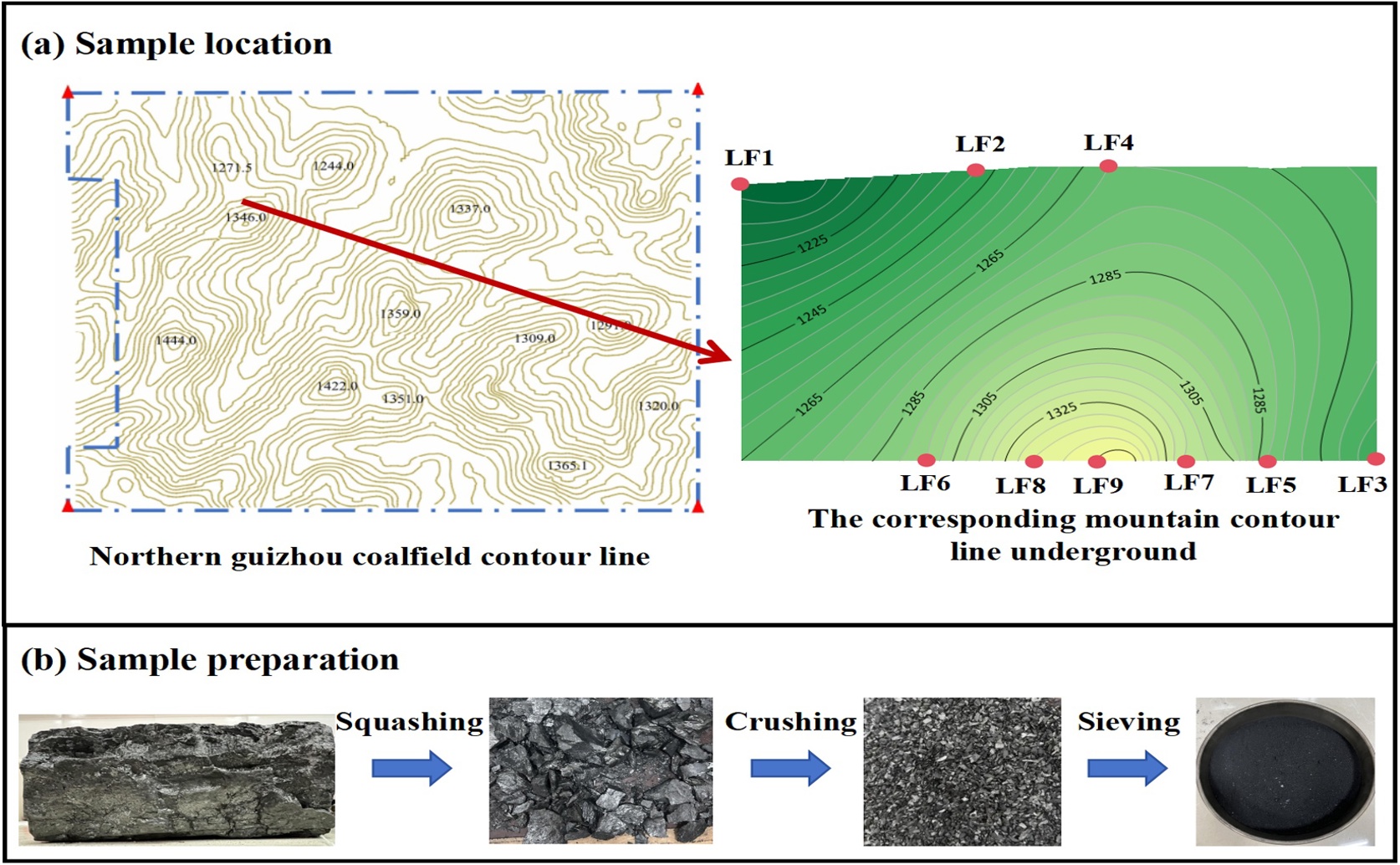
Coal samples collected from varying mountain elevations provide the necessary vertical principal stress gradient to demonstrate how peak cluster landforms significantly alter pore structure and gas adsorption capacity.

Image adapted from: Wang et al. / CC BY (Source)

Key Findings

  • This study, conducted in China’s Longfeng Coal Mine, investigated how unique landforms affect coal’s ability to store gas like methane
  • Varying stress from peak cluster landforms alters coal pore structure—specifically pore volume and surface area—with the most significant changes occurring at lower stress levels
  • The roughness of pore surfaces, measured by fractal dimension, strongly influences gas adsorption capacity, and is primarily affected by vertical stress
Coal is a complex material with a microscopic structure that significantly impacts its ability to store gases like methane. Understanding this structure is crucial for safely and efficiently extracting coalbed methane (CBM) and mitigating risks like coal and gas outbursts. A recent study conducted by researchers at Guizhou University[1] investigates how the unique geological formations known as “peak cluster landforms” affect the pore structure of coal and, consequently, its gas storage capacity. These peak cluster landforms are characterized by varying vertical stresses – forces exerted on the coal due to the weight of overlying rock – creating a ‘multi-peak’ stress environment. The study aimed to determine how these fluctuating stresses alter the pores within the coal, and how this impacts gas adsorption. Pores are tiny spaces within the coal where gas molecules can be stored. The researchers collected coal samples from nine different elevations within a peak cluster landform. They then used two primary techniques to analyze the pore structure: high-pressure mercury intrusion and low-temperature nitrogen adsorption. Mercury intrusion measures the size and connectivity of larger pores, while nitrogen adsorption focuses on smaller pores and the surface area within them. The findings revealed that the pore structure – including the total pore content, specific surface area (the total area of the pore surfaces), and pore volume – changes in response to the varying vertical stresses. Importantly, the magnitude of these changes decreased with increasing stress levels, suggesting that the initial impact of the landform is most significant. Specifically, the differences in adsorption pore volume between peak stress levels were substantial, ranging from 1.53 to 2.30 times greater than the minimum values. The study also highlighted the importance of pore surface roughness. This roughness, quantified by a parameter called the fractal dimension (D1), significantly influences the coal’s ability to adsorb gas. The vertical principal stress predominantly influences this fractal dimension. Gas adsorption capacity is directly linked to both the volume of adsorption pores and the roughness of their surfaces. These findings build upon earlier research demonstrating that fracturing coal seams alters their structure and enhances methane recovery[2]. Fracturing, like the stresses in peak cluster landforms, creates new pores and modifies existing ones. The Guizhou University study adds a layer of complexity by showing that the pattern of stress – the multi-peak nature – is critical, not just the presence of stress itself. Furthermore, the research connects to studies on coal and gas outbursts, where coal strength and gas pressure are key factors[3]. Alterations to the pore structure, as observed in this study, can influence both coal strength and the pathways for gas flow, potentially impacting the risk of outbursts. The study’s findings could help mines assess the gas accumulation capacity of coal in these peaked cluster landforms and proactively implement preventative measures. The research also touches upon the complexities of gas adsorption within coal pores, a phenomenon known to exhibit hysteresis – a dependence on the history of pressure changes[4]. While this study doesn’t directly address hysteresis, understanding the pore structure is a fundamental step towards unraveling the mechanisms behind it. The pore characteristics identified in this study – volume, surface area, and roughness – are all factors that could influence the adsorption-desorption behavior of methane.

AgricultureEnvironment

References

Main Study

1) Study on deformation law of coal pore mechanism characteristics under peak cluster landform

Published 28th August, 2025

https://doi.org/10.1371/journal.pone.0330388


Related Studies

2) Influence of Fracturing on a Coal Structure during Coalbed Methane Stimulation.

https://doi.org/10.1021/acsomega.3c08601


3) Experimental Study on the Determinant Factors and Energy Criterion of Coal and Gas Outbursts.

https://doi.org/10.1021/acsomega.3c05072


4) Lattice Boltzmann Simulation of the Kinetics Process of Methane Diffusion with the Adsorption-Desorption Hysteresis Effect in Coal.

https://doi.org/10.1021/acsomega.3c03095


Related Articles

An unhandled error has occurred. Reload 🗙