New Approach to Detecting Wind Turbine Blade Icing Using Advanced Algorithms

Jenn Hoskins
29th August, 2025

New Approach to Detecting Wind Turbine Blade Icing Using Advanced Algorithms

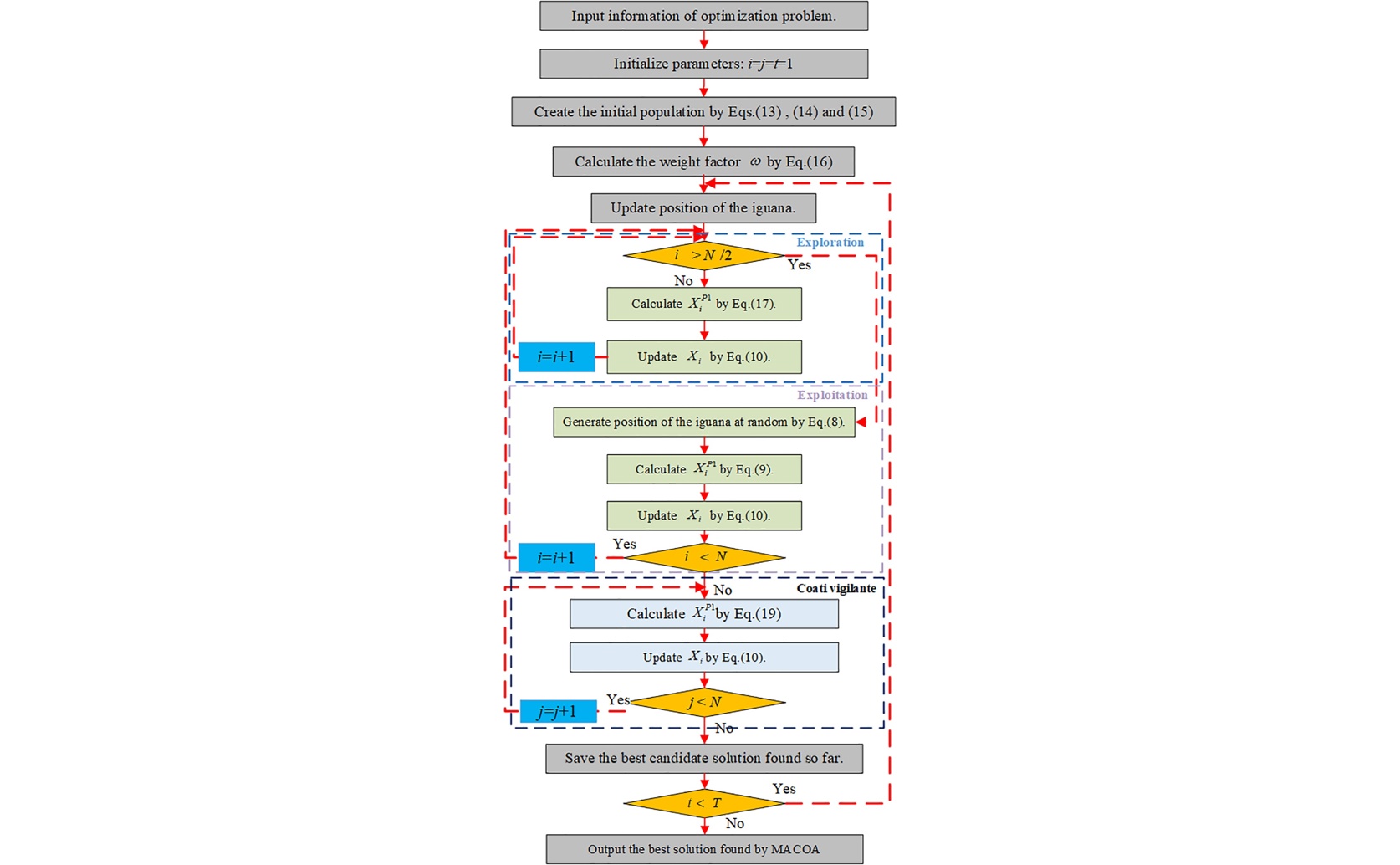
The Multi-strategy Adaptive Coati Optimization Algorithm (MACOA) integrates chaotic mapping Lévy flights and a sparrow vigilante mechanism to enhance global search capabilities, ensuring precise parameter optimization for the wind turbine blade icing fault diagnosis model.

Image adapted from: Wu et al. / CC BY (Source)

Key Findings

  • This study, conducted with data from wind turbines, developed a new diagnostic model (MACOA-IWKELM) to more accurately detect ice build-up on turbine blades, a problem that reduces energy production
  • The model improves upon existing techniques by using a sophisticated optimization algorithm (MACOA) and weighted parameters, addressing challenges with imbalanced datasets where icing events are rare
  • Testing with real-world turbine data showed the MACOA-IWKELM model achieved high accuracy (up to 96.94%) and reliability, outperforming traditional methods in identifying icing faults
Icing on wind turbine blades is a significant problem, reducing energy production and potentially causing safety issues. The build-up of ice changes the aerodynamic properties of the blades, decreasing their efficiency and increasing stress. Accurate and rapid detection of icing is therefore crucial for maintaining reliable wind energy generation. Traditional methods often struggle with the complexities of real-world conditions, leading to delayed or inaccurate diagnoses. Researchers at Shanghai Dianji University, State Grid Shanghai, Sheffield Hallam University, Aimsn Biomedical Technologies, and Yalova University have developed a new approach to address this challenge[1]. Their work focuses on improving the speed and accuracy of icing detection on wind turbine blades using a combination of advanced algorithms. The core of their system is a diagnostic model called MACOA-IWKELM – Multi-strategy Adaptive Coati Optimization algorithm optimized Improved Weighted Kernel Extreme Learning Machine. The problem of accurately diagnosing faults in complex systems like wind turbines is often hampered by imbalanced datasets, where normal operating conditions are far more prevalent than fault states. This is similar to challenges faced in diagnosing faults in on-load tap changers[2], where the scarcity of fault data necessitates techniques to effectively model these imbalances. The new study addresses this by incorporating weighted parameters into the diagnostic model, giving greater importance to the limited fault data available. The MACOA-IWKELM model builds upon existing machine learning techniques. Extreme Learning Machines (ELMs) are known for their fast training speeds, but their performance can be limited. The researchers improved upon this by using a Weighted Kernel ELM (WKELM), which considers the distribution of data points when making predictions. To further enhance the model, they employed a sophisticated optimization algorithm called Multi-strategy Adaptive Coati Optimization (MACOA). Optimization algorithms are used to find the best possible settings for a machine learning model. MACOA is an improved version of the Coati Optimization Algorithm (COA), which is inspired by the foraging behavior of coatis – a type of mammal. The researchers enhanced COA by incorporating several strategies: chaotic mapping Lévy flights for better exploration of the search space, nonlinear inertial step factors to balance exploration and exploitation, and an improved coati vigilante mechanism to enhance the algorithm’s ability to avoid getting stuck in suboptimal solutions. They also refined the objective function to better guide the optimization process. This builds on previous work to improve the COA algorithm, such as the TNTWCOA algorithm which also introduced chaotic sequences and adaptive strategies to improve performance[3]. Before the MACOA algorithm optimizes the WKELM, a Random Forest (RF) dimensionality reduction technique is applied. This simplifies the data by reducing the number of input variables, making the model more efficient and less prone to overfitting. The effectiveness of the MACOA-IWKELM model was tested using real-world data collected from two sets of Supervisory Control and Data Acquisition (SCADA) systems monitoring wind turbine blade icing. SCADA systems collect data from various sensors on the turbine, providing a comprehensive view of its operating conditions. The results showed high accuracy, reaching 92.22% and 96.94% for the two datasets, with low standard deviations (2.53% and 1.92% respectively) across multiple runs. This indicates the model is both accurate and reliable. The need for robust fault diagnosis in power systems is well established[4], and the application of advanced techniques like deep learning and knowledge graphs is becoming increasingly common. While the current study doesn’t directly employ these techniques, it shares the same goal of improving the reliability and efficiency of power generation infrastructure. Similarly, the challenges of extracting meaningful features from noisy data, as seen in rolling bearing fault diagnosis[5], are addressed in this study through the use of dimensionality reduction and weighted parameters, which help to filter out irrelevant information and focus on the most important indicators of icing.

AgricultureEnvironmentBiotech

References

Main Study

1) Fault diagnosis model based on multi-strategy adaptive COA and improved weighted kernel ELM: A case study on wind turbine blade icing

Published 28th August, 2025

https://doi.org/10.1371/journal.pone.0329332


Related Studies

2) Research on imbalanced data fault diagnosis of on-load tap changers based on IGWO-WELM.

https://doi.org/10.3934/mbe.2023226


3) An improved Coati Optimization Algorithm with multiple strategies for engineering design optimization problems.

https://doi.org/10.1038/s41598-024-70575-4


4) Fast fault diagnosis of smart grid equipment based on deep neural network model based on knowledge graph.

https://doi.org/10.1371/journal.pone.0315143


5) A fault diagnosis method based on Auxiliary Classifier Generative Adversarial Network for rolling bearing.

https://doi.org/10.1371/journal.pone.0246905


Related Articles

An unhandled error has occurred. Reload 🗙