How A Rice Virus Forces Cells To Die To Boost Its Spread

Jenn Hoskins
20th August, 2025

How A Rice Virus Forces Cells To Die To Boost Its Spread

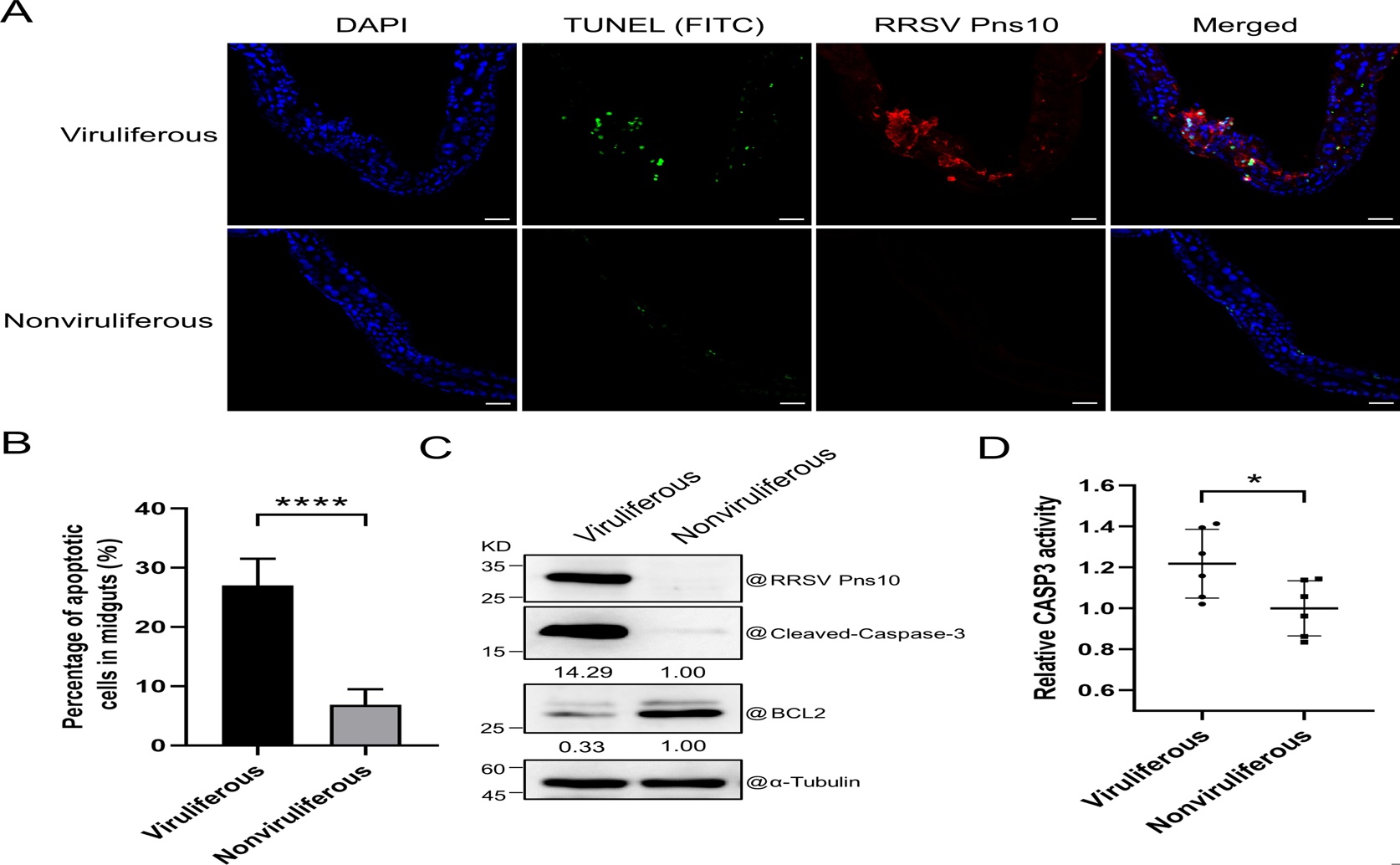
Rice ragged stunt virus infection activates apoptosis in the midgut of the insect vector Nilaparvata lugens, as evidenced by a significant increase in apoptotic cells (a, b) and the corresponding elevation of cleaved-caspase-3 activity with reduced anti-apoptotic BCL2 protein levels (c, d).

Image adapted from: Zheng et al. / CC BY (Source)

Key Findings

  • Researchers at Zhejiang University and partners discovered that the Rice Ragged Stunt Virus (RRSV) causes specific cells in its insect carrier, the brown planthopper, to die
  • This cell death is triggered by a viral protein, Pns10, which disrupts the insect's cellular energy factories, leading to a breakdown in normal cell function
  • Surprisingly, this virus-induced cell death actually helps RRSV multiply and spread more effectively within the planthopper and to new rice plants
Plant viruses pose a significant threat to global agriculture, causing substantial crop losses worldwide. Many of these viruses rely on insect vectors, such as planthoppers, to spread from one plant to another. Understanding the intricate ways these viruses interact with their insect hosts at a cellular level is crucial for developing effective strategies to prevent disease transmission. One key cellular process involved in these interactions is apoptosis, often referred to as programmed cell death. Apoptosis is a fundamental biological process where cells self-destruct in a controlled, orderly manner. It plays a vital role in tissue development, maintaining cellular balance, and can also act as a defense mechanism, eliminating infected cells to prevent the spread of pathogens. However, viruses are known to manipulate or even exploit this process for their own benefit, making the relationship complex. Recent research conducted by scientists at Zhejiang University, Zhejiang Lab, CAAS, and CSIC-UPV has shed new light on this complex interplay, specifically focusing on the Rice Ragged Stunt Virus (RRSV) and its insect vector, the brown planthopper (Nilaparvata lugens)[1]. This study addresses the previously unclear mechanisms by which plant viruses induce apoptosis in their insect vectors. The researchers discovered that RRSV actively promotes its own infection within the brown planthopper by inducing apoptosis in the insect's cells. The core of their discovery lies with a specific viral protein, RRSV-encoded Pns10. This nonstructural protein, meaning it's not part of the virus's physical structure but plays a crucial role in its replication, was found to be the key inducer of apoptosis in the brown planthopper. The team found that Pns10 interacts directly with a host protein called NlNDUFS1. NlNDUFS1 is a crucial component of mitochondrial complex I. Mitochondria are often called the "powerhouses" of the cell because they are responsible for generating most of the cell's energy in the form of ATP (adenosine triphosphate). Mitochondrial complex I is a large protein complex embedded in the inner membrane of mitochondria, essential for this energy production. When RRSV Pns10 interacts with NlNDUFS1, it impairs the activity of mitochondrial complex I. This disruption leads to a decrease in ATP production, effectively reducing the cell's energy supply. Simultaneously, it causes an increase in the accumulation of mitochondrial Reactive Oxygen Species (ROS). ROS are highly reactive molecules that, in excessive amounts, can damage cellular components, including DNA. This dysregulation—reduced energy and increased damaging ROS—triggers the apoptotic response, which paradoxically benefits RRSV infection in the brown planthopper. This finding resonates with earlier research on other plant viruses. For instance, a previous study on the rice gall dwarf virus (RGDV), another plant reovirus, also found that its nonstructural protein, Pns11, induced a typical apoptotic response in its leafhopper vector[2]. Similar to RRSV Pns10, RGDV Pns11 targeted the outer membrane of mitochondria, leading to mitochondrial degeneration and a decrease in membrane potential, which are characteristic signs of apoptosis. In both cases, the virus exploited this caspase-dependent apoptotic response to promote its own infection and transmission by the insect vectors[2]. Caspases are a family of enzymes that play essential roles in programmed cell death. This suggests a common strategy employed by different plant viruses to manipulate their insect hosts. Further reinforcing this theme, another study investigating Rice Stripe Virus (RSV) and Rice Black-Streaked Dwarf Virus (RBSDV) in the small brown planthopper revealed a different pathway leading to a similar outcome[3]. In that research, viral infection activated the JAK-STAT pathway, a signaling pathway involved in various cellular processes like cell growth and immune response. This activation led to the accumulation of SOCS5, a protein that then accelerated the degradation of BCL2, an anti-apoptotic protein. The result was an activation of apoptosis, which again facilitated persistent viral infection in the vector[3]. These studies collectively highlight that plant viruses have evolved diverse molecular mechanisms to induce apoptosis, all serving to promote their successful infection and spread within their insect carriers. However, the relationship between apoptosis and viral infection is not always straightforward. While RRSV, RGDV[2], and RSV/RBSDV[3] appear to exploit apoptosis for their benefit, other research indicates a more nuanced interaction. A study on the southern rice black-streaked dwarf virus (SRBSDV) in Sogatella furcifera planthoppers found that exposure to the virus activated innate immune responses in the insects, including apoptosis[4]. Innate immunity is the body's first line of defense against pathogens. Interestingly, a key gene in apoptosis, caspase 1, was significantly upregulated, especially in females that failed to acquire the virus[4]. This suggests that in some scenarios, apoptosis may function as a host defense mechanism, potentially limiting virus acquisition or spread, rather than always being exploited by the virus. This duality underscores the complexity of virus-host interactions, where the outcome of apoptosis can depend on the specific virus, host, and even the timing of the cellular response. The RRSV study further elucidated the precise molecular steps. They found that RRSV Pns10 not only interacts with NlNDUFS1 but also disrupts its interaction with another host protein, NlProhibitin 2 (NlPHB2). This disruption further impairs mitochondrial complex I activity, leading to an even greater decrease in ATP production and an excessive accumulation of mitochondrial ROS. This cascade of events culminates in genomic DNA fragmentation, a definitive sign of apoptosis. In summary, the findings from Zhejiang University, Zhejiang Lab, CAAS, and CSIC-UPV provide a novel and detailed understanding of how a plant virus, RRSV, manipulates its insect vector's cellular machinery. By targeting mitochondrial complex I through its Pns10 protein, RRSV triggers apoptosis, creating an environment within the host that is conducive to its own replication and persistence. This research, building upon and complementing earlier findings that show both viral exploitation[2][3] and host defense roles[4] for apoptosis, offers critical insights into the intricate dynamics of plant virus transmission. Such detailed knowledge is invaluable for developing future interventions aimed at blocking the spread of these agriculturally damaging viruses.

BiochemPlant ScienceAnimal Science

References

Main Study

1) Rice ragged stunt virus Pns10 induces mitochondrial-mediated apoptosis to promote viral infection in Nilaparvata lugens through disrupting the NlNDUFS1-NlPHB2 interaction

Published 19th August, 2025

https://doi.org/10.1371/journal.ppat.1013415


Related Studies

2) Fibrillar structures induced by a plant reovirus target mitochondria to activate typical apoptotic response and promote viral infection in insect vectors.

https://doi.org/10.1371/journal.ppat.1007510


3) The JAK-STAT pathway promotes persistent viral infection by activating apoptosis in insect vectors.

https://doi.org/10.1371/journal.ppat.1011266


4) Comparison of Transcriptome Responses between Sogatella furcifera Females That Acquired Southern Rice Black-Streaked Dwarf Virus and Not.

https://doi.org/10.3390/insects13020182


Related Articles

An unhandled error has occurred. Reload đź—™