Common Chemical Causes Major Changes in Development

Jim Crocker
19th August, 2025

Common Chemical Causes Major Changes in Development

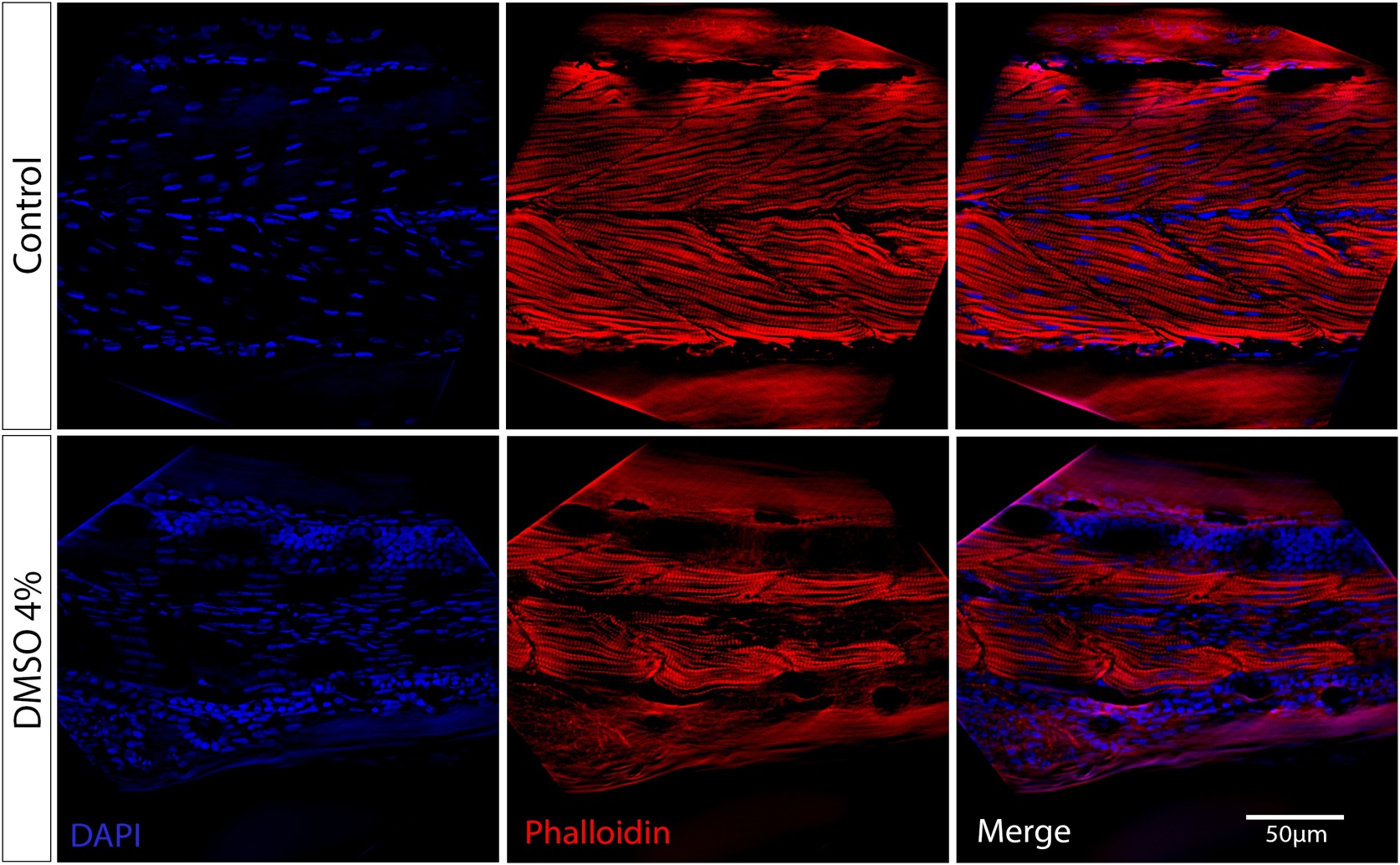
Confocal analysis demonstrates that exposure to 4% DMSO disrupts skeletal muscle architecture in Danio rerio larvae, resulting in the significant misalignment of striated myofibrils compared to the orderly arrangement found in untreated controls.

Image adapted from: Gomes et al. / CC BY (Source)

Key Findings

  • A study in Brazil and China found that the common lab solvent DMSO is lethal to zebrafish embryos above 5% and causes significant harm at lower concentrations
  • Even at 1-4% concentrations, DMSO caused severe developmental issues in zebrafish, including curved tails, heart problems, muscle defects, and changes in other organs
  • This research challenges the long-held belief that DMSO is safe for developmental studies at concentrations up to 1%, urging caution in future experiments
Zebrafish, small freshwater fish native to South Asia, have become an incredibly valuable tool in scientific research[2][3][4]. Their rapid development, transparent embryos, and ability to produce many offspring make them ideal for studying how genes and chemicals affect development and disease[2]. They also share many genetic similarities with humans, making them a useful model for understanding human conditions, including metabolic diseases and various forms of toxicity[3][4]. Because of these qualities, zebrafish are widely used in drug discovery and to test the safety of chemicals. A common substance used in laboratories worldwide, particularly in pharmaceutical development and basic biological research, is dimethyl sulfoxide, or DMSO. This liquid is excellent at dissolving a wide range of compounds, both those that mix well with water and those that don't, and it blends easily with many other liquids, including water itself. Its versatility makes it indispensable for preparing experimental solutions. However, despite its widespread use, fundamental questions about how different concentrations of DMSO might affect the developing zebrafish, specifically their physical structure (morphology) and bodily functions (physiology), have not been thoroughly investigated. Previous assumptions often suggested that DMSO concentrations up to 1% were generally safe for use in zebrafish embryo development studies. A recent study conducted by researchers at Universidade Federal do Rio de Janeiro and Jiangsu University[1] aimed to address this gap, providing a detailed analysis of DMSO's effects on developing zebrafish. The team used advanced techniques, including high-resolution optical microscopy and real-time video-microscopy, to observe whole embryos, as well as specific organs and tissues, throughout their development. This allowed for a precise look at any changes induced by DMSO exposure. Their findings revealed a spectrum of effects depending on the concentration of DMSO. The study found that concentrations above 5% were lethal to zebrafish embryos, meaning they caused death. More critically, concentrations between 1% and 4% induced a variety of significant alterations in the embryos. These changes included a noticeable up-curved tail, changes in heart beating frequency, and the development of heart edema (swelling around the heart). The researchers also observed alterations in the size of somites, which are blocks of developing muscle, and issues with the alignment of myofibrils, the basic units of muscle. Pigment cells, called melanocytes, also showed changes in size, and there were structural abnormalities in the notochord, a rod-like support structure in the embryo, and the swim bladder, an organ that helps fish control their buoyancy. These results are significant because they challenge the long-held assumption that DMSO is safe at concentrations up to 1% for developmental studies. The study clearly demonstrates that even at 1%, and certainly at higher concentrations within the 1-4% range, DMSO can induce substantial morphological and physiological changes. This calls for increased caution and careful consideration of DMSO concentrations in both basic and applied research using zebrafish. The findings of this new study build upon and complement earlier research into the effects of common laboratory solvents. For instance, a previous study[5] investigated whether sub-lethal exposures to DMSO, methanol, or methylene blue could influence the behavior of larval zebrafish. That research found that DMSO concentrations as low as 0.55% significantly affected larval behavior, specifically their movement in a simple light/dark test. While the earlier study focused on behavioral endpoints, the new research from Universidade Federal do Rio de Janeiro and Jiangsu University extends this understanding by revealing the underlying structural and functional defects that occur at slightly higher concentrations. This indicates that DMSO can affect zebrafish across a range of biological levels, from subtle behavioral changes at lower doses to significant developmental abnormalities and even lethality at higher concentrations. Given the increasing reliance on zebrafish as a model for studying human diseases, toxicology, and drug discovery[2][3][4], understanding the precise effects of commonly used solvents like DMSO is paramount. The transparency of zebrafish embryos, a key advantage highlighted in earlier reviews[2], was crucial for the high-resolution microscopy employed in the new study, allowing researchers to visualize these subtle yet significant developmental defects. As the zebrafish research community continues to leverage powerful resources like the sequenced genome and advanced gene-editing technologies[3], ensuring the reliability and accuracy of experimental conditions, including the effects of solvents, becomes even more critical. This detailed analysis of DMSO's impact provides essential guidance for researchers worldwide, ensuring more accurate and reliable outcomes in future zebrafish studies.

MedicineBiochemAnimal Science

References

Main Study

1) DMSO induces major morphological and physiological alterations in zebrafish embryos

Published 18th August, 2025

https://doi.org/10.1371/journal.pone.0330348


Related Studies

2) Dissecting metabolism using zebrafish models of disease.

https://doi.org/10.1042/BST20180335


3) The emerging use of zebrafish to model metabolic disease.

https://doi.org/10.1242/dmm.011346


4) Zebrafish as a model vertebrate for investigating chemical toxicity.

Journal: Toxicological sciences : an official journal of the Society of Toxicology, Issue: Vol 86, Issue 1, Jul 2005


5) DMSO effects larval zebrafish (Danio rerio) behavior, with additive and interaction effects when combined with positive controls.

https://doi.org/10.1016/j.scitotenv.2019.134490


Related Articles

An unhandled error has occurred. Reload 🗙