Glucokinase Regulation Confirms Potential for Diabetes Treatment

Jim Crocker
25th November, 2024

Glucokinase Regulation Confirms Potential for Diabetes Treatment

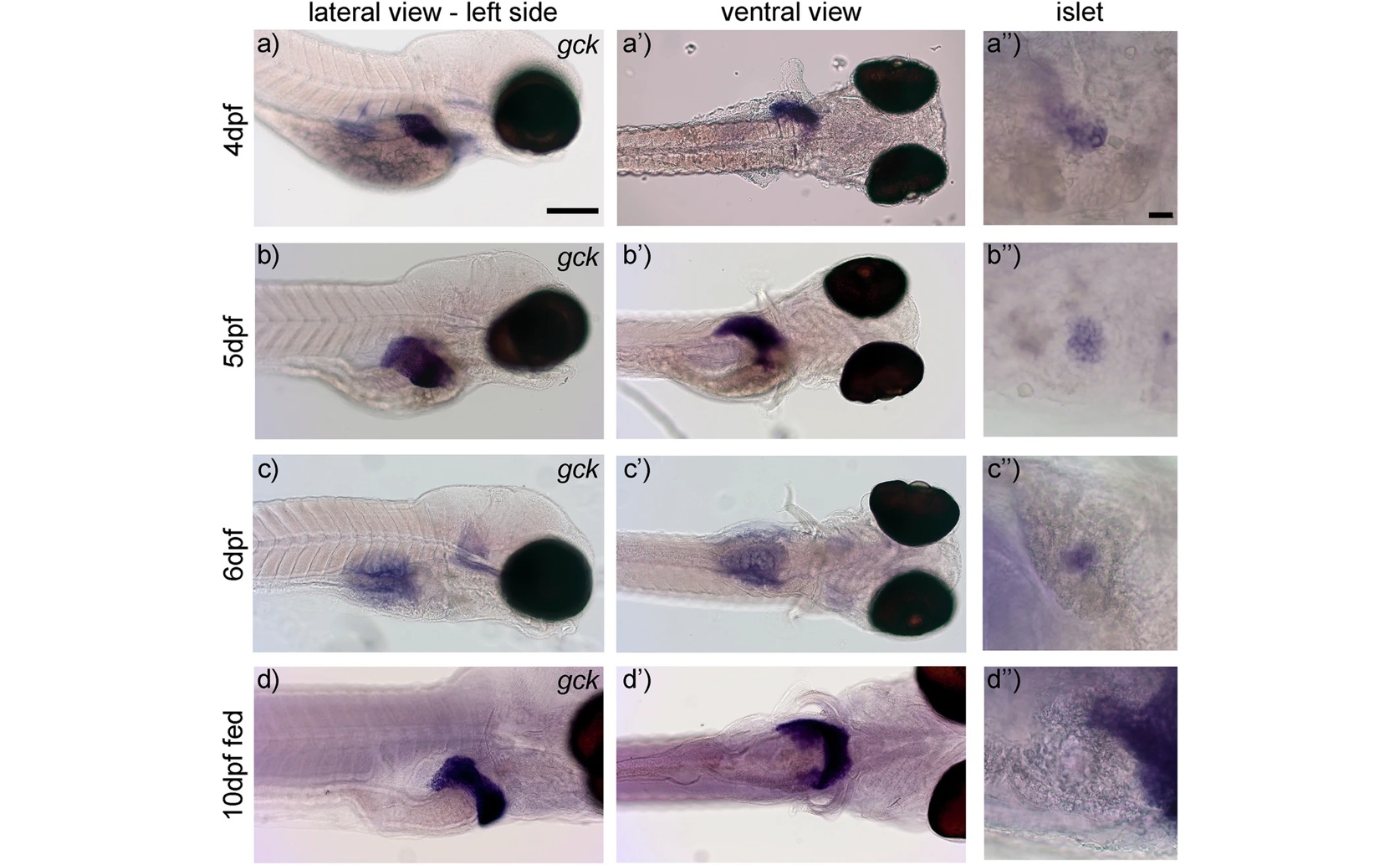
In zebrafish (Danio rerio) larvae, gck gene expression is consistently maintained in the pancreatic islet (a”, b”, c”) but is dynamically regulated by nutritional status in the liver, where it is present during early development (a-b’), disappears upon fasting (c, c’), and is strongly induced after feeding (d, d’), demonstrating a conserved regulatory pattern essential for glucose homeostasis.

Image adapted from: Schmitner et al. / CC BY (Source)

Key Findings

  • The study by the University of Innsbruck used zebrafish to explore the regulation and effects of glucokinase (GCK) modulation
  • Researchers found that GCK expression in zebrafish islet cells remains constant, while in the liver it is regulated by nutritional status, similar to mammals
  • Activating GCK significantly reduced high blood sugar in diabetic zebrafish without causing liver or islet oxidative stress, suggesting a potential therapeutic approach for diabetes
Glucokinase (GCK) is a critical enzyme involved in blood glucose regulation, making it an attractive target for the development of antidiabetic drugs. Despite extensive research, a viable therapeutic agent targeting GCK has yet to emerge. Recent research conducted by the University of Innsbruck using zebrafish as a model organism has provided new insights into the regulation and effects of GCK modulation, which could inform future drug development efforts[1]. Previous studies have established the importance of GCK in glucose metabolism. For instance, GCK phosphorylates glucose to glucose-6-phosphate, a key step in regulating blood glucose levels[2]. Genetic studies have shown that mutations in the GCK gene can lead to diabetes, highlighting its potential as a drug target[3]. However, attempts to develop GCK activators have faced challenges, including loss of efficacy over time and potential beta-cell failure due to excessive glycolysis[2]. The recent study by the University of Innsbruck aimed to address these challenges by using zebrafish, a vertebrate model organism that shares many metabolic similarities with humans. The researchers found that GCK expression in zebrafish islet cells is constitutive, meaning it remains constant, whereas GCK expression in the liver is regulated by nutritional status, similar to the mammalian system. This finding confirms the relevance of using zebrafish to study GCK regulation and its potential as a drug target. The researchers utilized transgenic GCK reporter lines and a diabetes model, the pdx1 mutant, to monitor GCK expression under pathological conditions. They observed reduced GCK expression and activity in the liver of pdx1 mutants, which was unresponsive to nutrient stimulation. Additionally, there was decreased GCK expression in the islet due to a reduced number of β-cells. This aligns with earlier findings that glucose-induced changes in GCK and its regulator GCKR can impact glucose uptake and phosphate homeostasis in the liver[4]. Importantly, the study demonstrated that GCK activation significantly ameliorated hyperglycemia in pdx1 mutants without inducing oxidative stress responses in the liver or islet. This suggests that targeting GCK could be a viable therapeutic approach for diabetes, provided that the regulation of GCK activity is carefully managed to avoid adverse effects such as beta-cell failure[2]. In summary, the study conducted by the University of Innsbruck using zebrafish has provided valuable insights into the regulation and effects of GCK modulation. By confirming the similarity of GCK regulation in zebrafish and mammals, the research supports the use of zebrafish as a model for studying GCK-targeted therapies. The findings also highlight the potential of GCK activation to ameliorate hyperglycemia without causing oxidative stress, addressing some of the challenges faced in previous drug development efforts. This research paves the way for further studies to develop effective and safe GCK-targeted therapies for diabetes.

MedicineBiochemAnimal Science

References

Main Study

1) Conserved glucokinase regulation in zebrafish confirms therapeutic utility for pharmacologic modulation in diabetes.

Published 23rd November, 2024

https://doi.org/10.1038/s42003-024-07264-5


Related Studies

2) Glucokinase activation or inactivation: Which will lead to the treatment of type 2 diabetes?

https://doi.org/10.1111/dom.14459


3) Molecular physiology of mammalian glucokinase.

https://doi.org/10.1007/s00018-008-8322-9


4) Elevated glucose represses liver glucokinase and induces its regulatory protein to safeguard hepatic phosphate homeostasis.

https://doi.org/10.2337/db11-0061


Related Articles

An unhandled error has occurred. Reload 🗙