How Branched DNA Forms And Stays Stable In Its Environment

Greg Howard
19th August, 2025

How Branched DNA Forms And Stays Stable In Its Environment

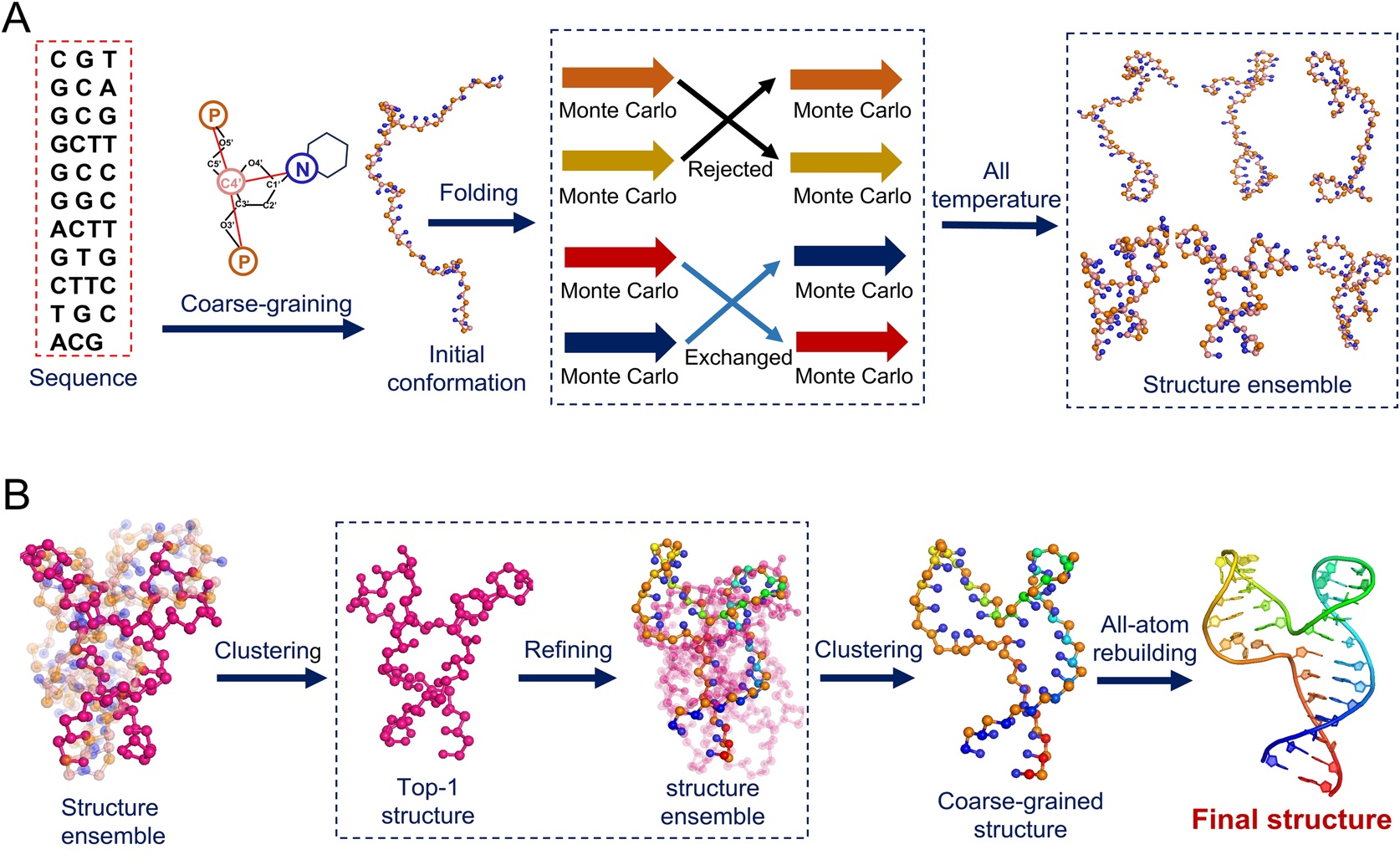
The presented ab initio modeling framework predicts DNA 3D structures directly from sequence by employing coarse-grained replica-exchange Monte Carlo simulations to sample conformational diversity (A) and subsequently refining selected low-energy states into all-atom models (B).

Image adapted from: Wang et al. / CC BY (Source)

Key Findings

  • Researchers from Guizhou Medical, Wuhan Textile, and Kansas developed an advanced computer model that accurately predicts the complex 3D shapes of DNA, especially those with multi-way junctions
  • This new model precisely determines how these intricate DNA structures unfold when heated, even under various salt conditions, providing crucial insights into their stability
  • The ability to predict these complex DNA behaviors helps scientists better understand DNA's biological roles and design new materials for nanotechnology and medicine
The intricate three-dimensional (3D) structure of DNA is fundamental to its biological roles, from gene expression to replication. Understanding and predicting these complex shapes is crucial for deciphering how DNA functions within living systems and for designing new drugs that interact specifically with DNA. However, accurately predicting the precise 3D arrangement of DNA, especially for more elaborate forms, has long presented a significant challenge. Addressing this challenge, researchers from Guizhou Medical, Wuhan Textile, and Kansas have developed an improved computational model for predicting DNA folding[1]. This new model offers a robust framework for determining the complex architectures of DNA directly from its genetic sequence, providing valuable insights into its folding mechanisms and biological functions. The study centers on a computational approach known as a coarse-grained (CG) model. Unlike methods that attempt to simulate every single atom, a coarse-grained model simplifies the DNA molecule by representing groups of atoms as larger, interacting "beads." This simplification significantly reduces the computational effort required, allowing for the simulation of larger and more complex DNA structures over longer periods. The researchers refined their model by incorporating an improved understanding of electrostatic potential—the distribution of electrical charges around the DNA molecule, which dictates how different parts interact and how it responds to ions in its environment. They also integrated advanced simulation techniques, specifically replica-exchange Monte Carlo simulations coupled with weighted histogram analysis. Monte Carlo simulations use random sampling to explore various possible shapes a molecule can adopt, while replica-exchange enhances this process by allowing the simulation to efficiently navigate complex energy landscapes, ensuring a thorough exploration of stable structures. Weighted histogram analysis then combines data from these simulations to accurately calculate the probabilities of different shapes and their stabilities. This work builds upon previous efforts to develop computational models for DNA. For instance, an earlier coarse-grained model demonstrated success in predicting the 3D structures and stability of both double-stranded (dsDNA) and single-stranded (ssDNA) molecules from their sequences[2]. That model could fold DNA segments up to 74 nucleotides long into native-like structures with a mean accuracy of about 3.4 Ångstroms (a unit of length, roughly the size of an atom) when compared to experimental structures, and predict melting temperatures within approximately 2.0°C of experimental values. The new model represents a significant leap forward, particularly in its ability to handle more complex DNA architectures. A key achievement of the improved model is its accurate prediction of DNA structures featuring "multi-way junctions." These are points where more than two DNA strands branch off from a central hub, such as three- or four-way junctions. Such junctions are fundamental building blocks in the field of structural DNA nanotechnology, which has seen remarkable evolution over the past 35 years[3]. This field focuses on creating artificial nanoscale shapes and complex assemblies using DNA as a building material. The ability to precisely predict the 3D structure of these junctions is critical for designing stable and predictable DNA nanostructures. For example, the new model successfully predicted the 3D structures of DNA with three- or four-way junctions with an average accuracy of approximately 8.8 Ångstroms for the most probable structures. While this RMSD (Root Mean Square Deviation, a measure of structural similarity) value appears higher than the earlier model[2], it reflects the significantly increased complexity of the structures being predicted, which often pose greater computational challenges. The model also accurately reproduced the thermal stability of these junctions across a variety of DNA sequences and lengths, with predicted melting temperatures deviating by less than 5°C from experimental measurements. This accuracy held true under different ionic conditions, including the presence of monovalent ions like sodium (Na⁺) and divalent ions like magnesium (Mg²⁺), both of which influence DNA structure and stability. The capacity to accurately model multi-way junctions is particularly relevant given their use in creating complex molecular topologies. For instance, single-stranded DNA knots and links have been successfully created by strategically utilizing the inherent topological properties of DNA four-way junctions[4]. These intricate structures, essentially DNA molecules tied into specific knots or links, have been used to study fundamental biological processes, such as how DNA topoisomerase enzymes untangle DNA or how DNA replication occurs under physical constraints. The predictive power of the new model directly supports such endeavors by enabling researchers to design and understand these complex topological DNA structures more effectively. Furthermore, the analysis of how these complex DNA junctions unfold when heated (their thermal unfolding pathways) provided crucial insights. The study revealed that the overall stability of these multi-way junctions is primarily determined by the relative energies of key intermediate states that the DNA passes through during the unfolding process. Understanding these intermediate steps is vital for comprehending the complete picture of DNA folding and stability. This enhanced computational model provides a powerful tool for the scientific community. By accurately predicting the 3D structures and stability of complex DNA architectures, it not only deepens our understanding of DNA's biological functions but also accelerates the development of novel materials and therapeutic agents. The ability to design and predict the behavior of complex DNA structures, from simple junctions to intricate knots, is a cornerstone for advancing fields like DNA nanotechnology, leading to new synergistic designer materials and applications in areas such as super-resolved imaging and drug delivery[3].

GeneticsBiochem

References

Main Study

1) 3D structure and stability prediction of DNA with multi-way junctions in ionic solutions

Published 18th August, 2025

https://doi.org/10.1371/journal.pcbi.1013346


Related Studies

2) Ab initio predictions for 3D structure and stability of single- and double-stranded DNAs in ion solutions.

https://doi.org/10.1371/journal.pcbi.1010501


3) DNA-based construction at the nanoscale: emerging trends and applications.

https://doi.org/10.1088/1361-6528/aaa120


4) Creating complex molecular topologies by configuring DNA four-way junctions.

https://doi.org/10.1038/nchem.2564


Related Articles

An unhandled error has occurred. Reload 🗙