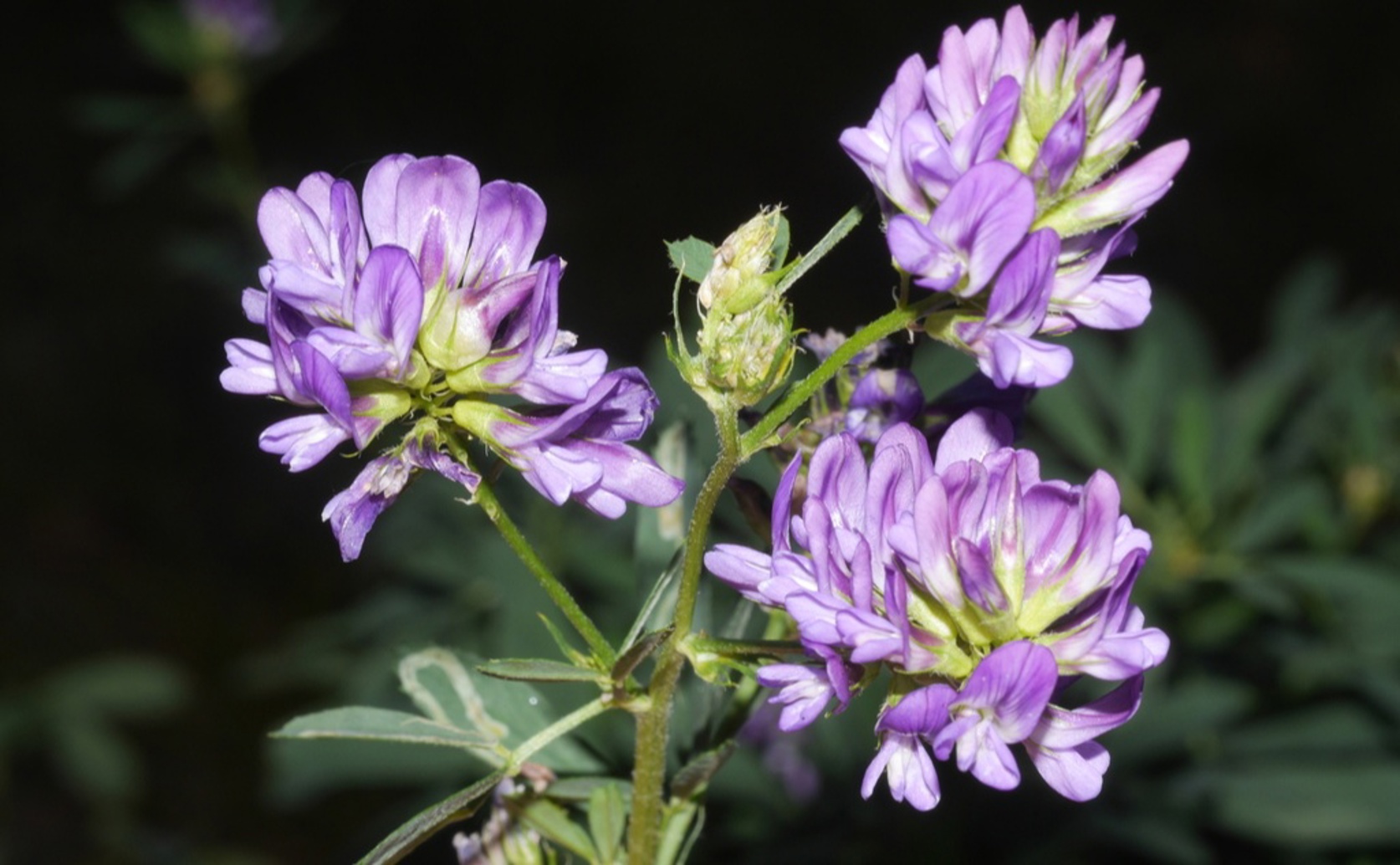
Unlocking Alfalfa's Genetic Resistance To Anthracnose

Jim Crocker
9th August, 2025

Unlocking Alfalfa's Genetic Resistance To Anthracnose
Alfalfa (Medicago sativa)

Key Findings

  • Researchers at INRAE identified six specific genetic regions, including two major ones on chromosome 8, that explain 58% of alfalfa's resistance to anthracnose disease
  • The study also showed that using genetic markers can predict alfalfa's anthracnose resistance with a high 85% accuracy, significantly speeding up breeding efforts
Alfalfa, a vital forage legume, plays a crucial role in sustainable agriculture, providing feed for livestock and contributing to soil health. However, its productivity and long-term viability can be severely impacted by diseases like anthracnose, caused by the fungus Colletotrichum trifolii. Developing alfalfa varieties resistant to such diseases is a key goal for breeders, as it reduces the need for chemical treatments and ensures stable yields. The challenge lies in efficiently identifying and incorporating the genetic traits responsible for this resistance into new varieties. Recent research conducted by INRAE[1] has made significant strides in addressing this challenge by pinpointing specific genetic regions associated with anthracnose resistance in alfalfa. The study aimed to precisely locate the genes responsible for resistance and to explore the potential of using genetic markers to predict resistance in breeding programs. While it was known that anthracnose resistance is an "oligogenic trait"—meaning it is controlled by a few major genes—their exact positions on the alfalfa genome remained largely unknown. To achieve this, the researchers first assessed the anthracnose resistance of a large collection of 417 alfalfa varieties and breeding lines, observing how many plants within each group showed resistance. They then utilized advanced genetic tools, specifically genotyping-by-sequencing (GBS), to obtain genetic profiles for 380 of these accessions. GBS involves sequencing a representative portion of an organism's DNA to identify single nucleotide polymorphisms (SNPs), which are variations at a single point in the DNA sequence that can serve as genetic markers. With this genetic data, the team performed a Genome-Wide Association Study (GWAS). GWAS is a powerful technique that scans the entire genome to find associations between specific genetic markers (like SNPs) and a particular trait, in this case, anthracnose resistance. This process helps identify "Quantitative Trait Loci" (QTLs), which are regions on chromosomes that contain genes influencing a specific trait. The study found a wide range of anthracnose resistance among the alfalfa accessions, with newer varieties and breeding materials generally showing higher resistance than older ones. American accessions exhibited the highest resistance, though some European ones also performed well. The GWAS analysis successfully identified six QTLs that collectively account for 58% of the variation in anthracnose resistance. Two of these were major QTLs located on chromosome 8. Interestingly, this region on chromosome 8 had been previously implicated in resistance in other alfalfa mapping populations. Four additional QTLs, each contributing less than 5% to the variation, were also found. One of these minor QTLs was located near a major resistance gene on chromosome 4 in Medicago truncatula, a closely related plant often used as a model species for alfalfa. This finding directly builds upon earlier research[2] which identified a major anthracnose resistance locus, Ct1, on chromosome 4 in Medicago truncatula. The presence of a similar resistance region in alfalfa suggests a conserved genetic mechanism for anthracnose resistance across these related species. Beyond identifying these specific genetic regions, the INRAE study also evaluated the effectiveness of "genomic prediction" for anthracnose resistance. Genomic prediction uses the genetic information from a large number of markers across the genome to predict the performance of individuals or their offspring, even before they are physically grown and evaluated. This can significantly accelerate breeding cycles. The predictive ability for anthracnose resistance in this study was remarkably high, reaching 85%. This high predictive ability is particularly noteworthy when compared to previous genomic selection efforts in alfalfa. Earlier studies, which also utilized genotyping-by-sequencing (GBS) and explored genomic prediction, often reported lower predictive accuracies for more complex traits like yield or stress tolerance. For instance, research on genomic selection for alfalfa yield[3] found predictive accuracies around 0.30 to 0.35, while a study focusing on drought and salinity tolerance[4] reported predictive abilities exceeding 0.20 for some environments, but also noted complications due to rapid "linkage disequilibrium decay" (the tendency for genetic markers close together on a chromosome to be inherited together, which can quickly diminish over generations in alfalfa due to its complex genetics). The significantly higher accuracy for anthracnose resistance in the current study suggests that for traits like disease resistance, which may be controlled by fewer major genes, genomic prediction can be exceptionally effective. The results from INRAE are highly promising. They not only provide precise locations for anthracnose resistance genes in alfalfa but also demonstrate the strong potential of using molecular markers and genomic prediction to efficiently improve disease resistance in future alfalfa breeding programs. This work, building on the growing body of knowledge from genomic studies in alfalfa[3][4], paves the way for developing more resilient and productive alfalfa varieties, contributing to more sustainable agricultural systems.

AgricultureGeneticsPlant Science

References

Main Study

1) QTL detection and genomic prediction for resistance to anthracnose in alfalfa (Medicago sativa)

Published 6th August, 2025

https://doi.org/10.1002/tpg2.70085


Related Studies

2) Genetic dissection of resistance to anthracnose and powdery mildew in Medicago truncatula.

Journal: Molecular plant-microbe interactions : MPMI, Issue: Vol 21, Issue 1, Jan 2008


3) Accuracy of genomic selection for alfalfa biomass yield in different reference populations.

https://doi.org/10.1186/s12864-015-2212-y


4) Alfalfa genomic selection for different stress-prone growing regions.

https://doi.org/10.1002/tpg2.20264


Related Articles

An unhandled error has occurred. Reload 🗙