Study Identifies Key Genes Influencing Growth and Quality in Mustard

Jenn Hoskins
26th April, 2025

Study Identifies Key Genes Influencing Growth and Quality in Mustard

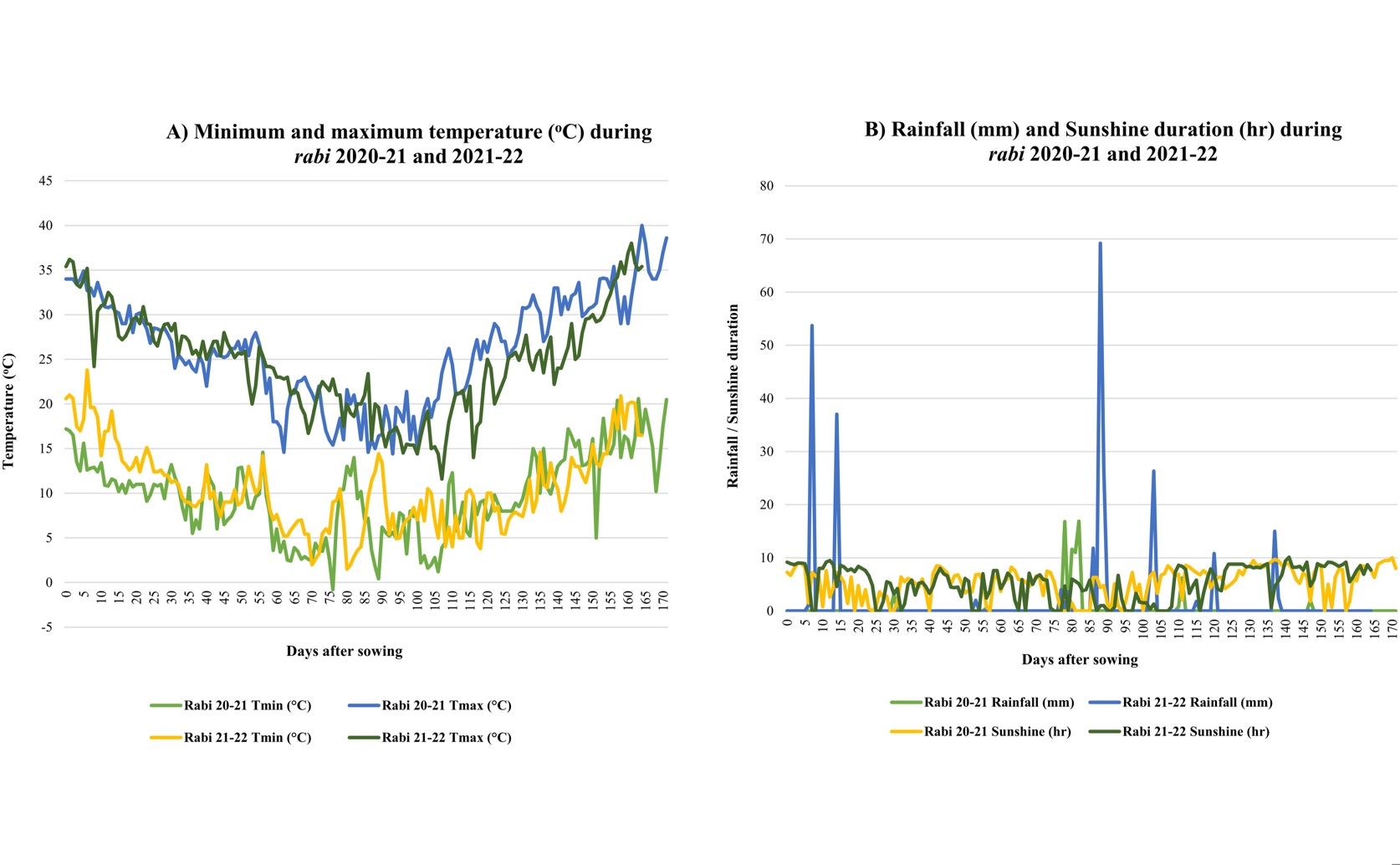
Contrasting meteorological conditions between the two study years, notably a wider temperature range (a) and higher rainfall with less sunshine (b) in the 2021-22 season, provided the environmental variation necessary for identifying stable genetic markers for key traits in Indian mustard (Brassica juncea).

Image adapted from: Patel et al. / CC BY (Source)

Key Findings

  • At India's ICAR-Indian Agricultural Research Institute, scientists identified specific genes in Indian mustard that control key traits like flowering time and oil quality
  • They discovered 12 reliable genetic markers that enable faster and more precise development of improved mustard varieties
  • This advancement allows breeders to select the best plants early, making mustard crop improvement more efficient and resource-effective
Improving Indian mustard, a vital oilseed crop, has traditionally relied on conventional breeding methods that are both time-consuming and resource-intensive. These methods often involve selecting plants with desirable traits over multiple generations, which can delay the development of improved varieties. To address these challenges, researchers at the ICAR-Indian Agricultural Research Institute[1] have turned to marker-assisted breeding, a modern approach that uses genetic information to accelerate the breeding process. In their recent study, the research team aimed to identify specific regions in the mustard genome that are responsible for important agricultural and quality traits. By doing so, they sought to make the breeding process more efficient and precise. The study involved a diverse group of 142 Indian mustard genotypes, which were evaluated for 20 different traits related to plant growth and oil quality. These traits included factors like the number of days to flowering, plant height, silique length (the seed pod), oil content, and glucosinolate content, which affects the flavor and nutritional quality of the oil. To uncover the genetic basis of these traits, the researchers employed a method called genome-wide association studies (GWAS). GWAS involves scanning the entire genome of different plants to find genetic markers associated with specific traits. In this case, the team used the Brassica 90K SNP array, a tool that identifies single nucleotide polymorphisms (SNPs) — variations at a single position in the DNA sequence — across the mustard genome. SNP markers are highly valuable in genetic studies due to their abundance and ease of detection[2]. The analysis revealed significant differences among the genotypes for the various traits studied, highlighting the genetic diversity within Indian mustard. The GWAS panel was grouped into three sub-populations based on their genetic structure and diversity, and the researchers confirmed a linkage disequilibrium (LD) decay of 1.05 megabases (Mb). LD decay refers to how quickly genetic markers become unlinked as the distance between them increases, which is crucial for accurately mapping traits to specific genomic regions. Using the BLINK model, a statistical method for GWAS, the researchers identified a total of 49 marker-trait associations (MTAs). These MTAs are specific genetic markers that are linked to the traits of interest. Of these, 28 and 21 MTAs were found during the two growing seasons (rabi 2020–21 and rabi 2021–22) for agro-morphological and quality traits, respectively. Importantly, twelve MTAs showed stable associations with traits such as days to 50% flowering, days to maturity, plant height, main shoot length, silique length, seeds per silique, oil content, and glucosinolate content across both years. These stable MTAs indicate consistent genetic regions that influence these important traits, making them reliable targets for marker-assisted selection. This approach allows breeders to select plants with desirable genetic profiles early in the breeding process, significantly speeding up the development of improved mustard varieties. The study also conducted an in silico analysis, which involves using computer simulations to examine the genetic data. This analysis identified 31 candidate genes near the stable SNPs that are likely involved in various biological processes related to the traits studied. Understanding these genes provides deeper insights into the molecular mechanisms that control plant growth and oil quality, offering potential targets for future genetic enhancements. This research builds on previous studies that have explored the genetic basis of yield-related traits in Brassica species. For instance, earlier work mapped quantitative trait loci (QTL) for similar traits in rapeseed, a close relative of Indian mustard, identifying regions of the genome that influence plant height, silique length, and other important characteristics[3]. The current study extends these findings by using advanced SNP markers and GWAS, providing a more detailed and comprehensive understanding of the genetic factors involved. Furthermore, the advancements in SNP marker technology discussed in prior research[2] have been instrumental in enabling this study. The use of high-throughput SNP arrays allows for the rapid and accurate identification of genetic variations, facilitating the discovery of MTAs that can be directly applied in breeding programs. This aligns with the trends in genomic selection (GS) highlighted in earlier studies[4], where the integration of molecular markers with high-throughput phenotyping is enhancing the efficiency and effectiveness of crop improvement efforts. By identifying specific genetic markers associated with key traits, the researchers have provided valuable tools for breeders. These markers can be used to screen large populations of mustard plants, selecting those with the best genetic potential for desirable traits. This not only speeds up the breeding process but also increases the precision of selecting plants that will perform well in different environmental conditions and meet quality standards. In conclusion, the study by the ICAR-Indian Agricultural Research Institute represents a significant advancement in the genetic improvement of Indian mustard. By leveraging GWAS and SNP marker technology, the researchers have identified key genetic regions that control important agricultural and quality traits. These findings pave the way for more efficient and targeted breeding strategies, ultimately leading to higher-yielding, higher-quality mustard varieties that can better meet the demands of farmers and consumers alike.

AgricultureGeneticsPlant Science

References

Main Study

1) Genome-wide association study uncovers key genomic regions governing agro-morphological and quality traits in Indian mustard [Brassica juncea (L.) Czern. and Coss.]

Published 24th April, 2025

https://doi.org/10.1371/journal.pone.0322120


Related Studies

2) SNP markers and their impact on plant breeding.

https://doi.org/10.1155/2012/728398


3) Detection of QTL for six yield-related traits in oilseed rape (Brassica napus) using DH and immortalized F(2) populations.

Journal: TAG. Theoretical and applied genetics. Theoretische und angewandte Genetik, Issue: Vol 115, Issue 6, Oct 2007


4) Genomic Selection in the Era of Next Generation Sequencing for Complex Traits in Plant Breeding.

https://doi.org/10.3389/fgene.2016.00221


Related Articles

An unhandled error has occurred. Reload 🗙