Yeast's Journey Through Organic Matter: Uncovering Indirect Nutritional Effects

Jenn Hoskins
4th July, 2025

Yeast's Journey Through Organic Matter: Uncovering Indirect Nutritional Effects

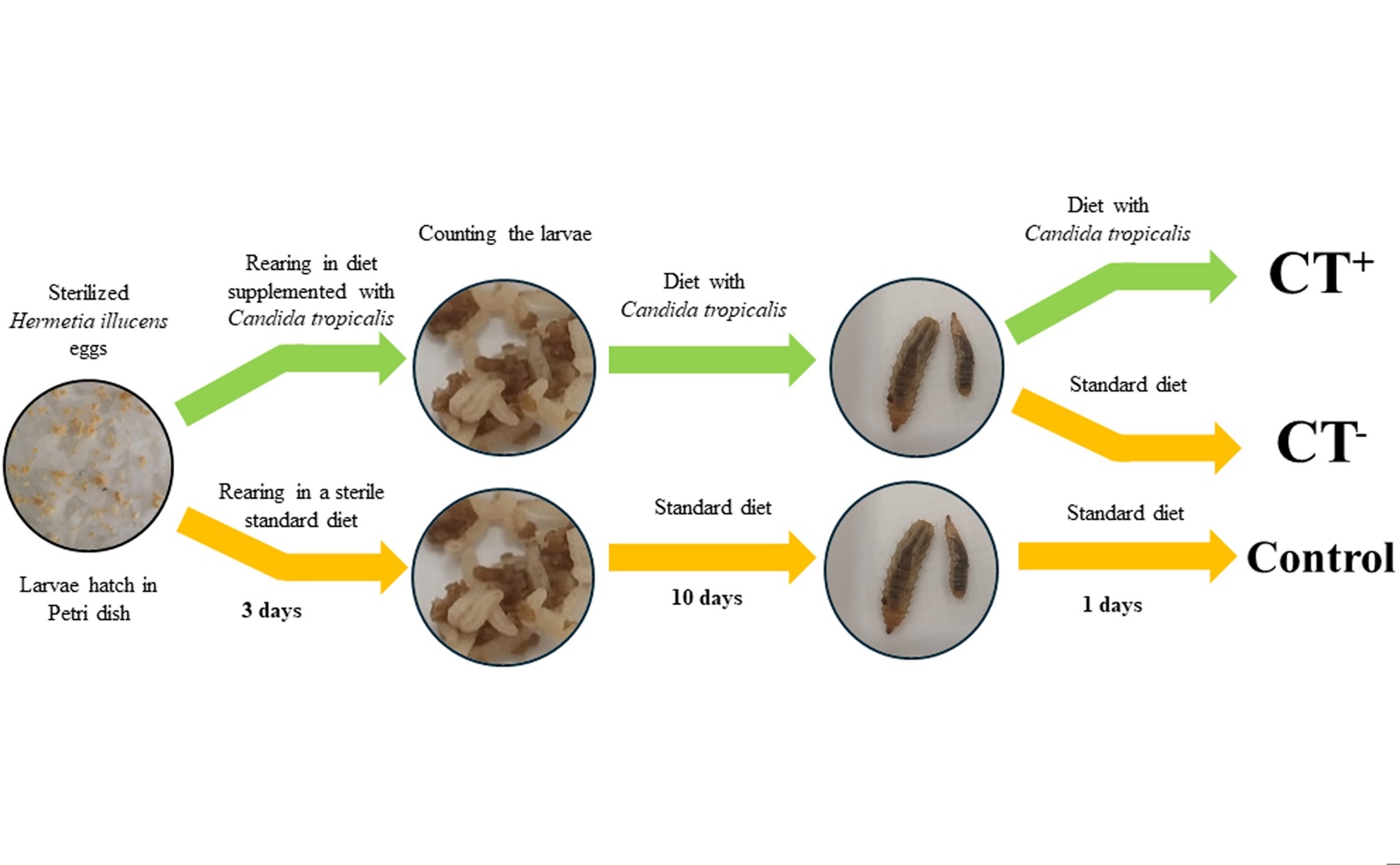
Experimental design and the different feeding conditions.

Image adapted from: Ben-Mordechai et al. / CC BY (Source)

Key Findings

  • A study by Various Universities found that Candida tropicalis fungus does not permanently live in black soldier fly larvae guts but passes through
  • Despite not colonizing, the fungus significantly boosts larvae's production of beneficial fatty acids and essential amino acids from their food
  • The fungus also reduces a key digestive enzyme in the larvae, suggesting it influences their gut environment for its own survival
Insects are known to host a diverse community of microorganisms, particularly bacteria, within their bodies, on their exoskeletons, and in their guts[2]. These microbial partners are crucial for insect survival and well-being, often providing essential nutrients like amino acids and vitamins, aiding in digestion, and even protecting against diseases[2][3]. For example, the gut microbiota of insects has been shown to contribute significantly to the host's digestion, detoxification, and overall physiology, with essential nutrient provisioning, such as amino acid biosynthesis, often being a dominant role[3]. This understanding has led to the exploration of using beneficial microorganisms, similar to probiotics, as dietary supplements to enhance insect growth and health, especially in insects mass-reared for food and feed[4]. However, while much is known about bacteria, the role of fungi in insect biology, especially their contribution to nutrition, has been less clear. A recent study conducted by Various Universities and Research Institutes[1] aimed to shed light on this gap by investigating the interaction between the black soldier fly (Hermetia illucens, BSF) larvae and a common fungus, Candida tropicalis. BSF larvae are increasingly important in bioconversion, turning organic waste into valuable biomass, and there's a growing interest in manipulating their diet to improve their nutritional profile, such as increasing omega-3 fatty acids[5]. The researchers in the new study focused on Candida tropicalis because it is frequently found in the gut and environment of BSF larvae. To understand its role, they first determined if the fungus actually colonizes, or permanently lives within, different regions of the BSF gut. They then analyzed the metabolic changes in larvae fed a diet supplemented with C. tropicalis, comparing these changes to the fungus's own metabolic composition and how the fungus altered the feeding substrate itself. Metabolomics, a technique that identifies and quantifies all the small molecules (metabolites) present in a biological sample, was used for this analysis. A key finding of the study was that C. tropicalis did not colonize the BSF gut. When the fungus was no longer provided in the diet, it quickly disappeared from the larvae's digestive system. This contrasts with the typical understanding of insect-microbe relationships where beneficial microorganisms often establish a resident population within the gut[2]. Despite this lack of direct colonization, the larvae still benefited significantly from the fungus's presence in their environment. Larvae raised on a diet supplemented with C. tropicalis showed an increase in the biosynthesis of fatty acids, specifically palmitic and myristic acids. These fatty acids are abundant in C. tropicalis itself, suggesting that the larvae were able to utilize these compounds, or their precursors, from the fungus present in their food. This aligns with previous research demonstrating that insects can enhance their nutritional intake through dietary microbial supplements[4], and specifically that BSF larvae can have their lipid profiles influenced by their diet[5]. Furthermore, the study found an increase in the biosynthesis pathways for certain essential amino acids – threonine, leucine, and isoleucine – in the larvae. Since these are not directly transferred but rather synthesized by the larvae, this suggests an indirect benefit. The researchers propose that the larvae are benefiting from metabolic excretions or breakdown products released by the fungus into the surrounding feeding substrate. This expands on the known role of microbes in providing essential nutrients like amino acids to their insect hosts[2][3], showing that this can occur even without direct gut colonization. Interestingly, the presence of C. tropicalis also led to a reduction in lysozyme activity in the larval gut. Lysozyme is an enzyme that breaks down the cell walls of bacteria and some fungi, acting as a part of the insect's immune system and also aiding in digestion. The reduction in its activity suggests that the fungus might be manipulating the BSF larvae's digestive processes to enhance its own survival in the external environment, perhaps by making the environment less hostile to itself. This highlights a complex, indirect symbiotic relationship where the fungus thrives in the BSF larvae's environment and influences the insect's physiology, while the larvae, in turn, gain metabolic advantages from the fungus's presence. This demonstrates a nuanced interaction, where microorganisms can modify insect immunity or digestive processes not just from within the gut, but also from the external feeding environment[2]. This research therefore expands our understanding of insect-microbe interactions beyond strict gut colonization. It shows that even environmental microorganisms, like Candida tropicalis, can have a profound impact on insect metabolism and growth, providing essential nutrients and influencing digestive processes. This has implications for optimizing the nutrition of mass-reared insects like BSF larvae, suggesting that the benefits of microbial supplements can extend beyond direct gut inhabitants, potentially leading to more efficient and nutritionally enhanced insect production for food and feed[4][5].

NutritionAnimal ScienceMycology

References

Main Study

1) The fate of Candida tropicalis in the black soldier fly larvae and its nutritional effect suggest indirect interactions

Published 3rd July, 2025

https://doi.org/10.1371/journal.pone.0325056


Related Studies

2) Multiorganismal insects: diversity and function of resident microorganisms.

https://doi.org/10.1146/annurev-ento-010814-020822


3) Most dominant roles of insect gut bacteria: digestion, detoxification, or essential nutrient provision?

https://doi.org/10.1186/s40168-020-00823-y


4) Bugs in Bugs: The Role of Probiotics and Prebiotics in Maintenance of Health in Mass-Reared Insects.

https://doi.org/10.3390/insects13040376


5) New value from food and industrial wastes - Bioaccumulation of omega-3 fatty acids from an oleaginous microbial biomass paired with a brewery by-product using black soldier fly (Hermetia illucens) larvae.

https://doi.org/10.1016/j.wasman.2022.02.029


Related Articles

An unhandled error has occurred. Reload 🗙