Mold's Protein: Where It Is Determines How It Grows

Jenn Hoskins
17th June, 2025

Mold's Protein: Where It Is Determines How It Grows

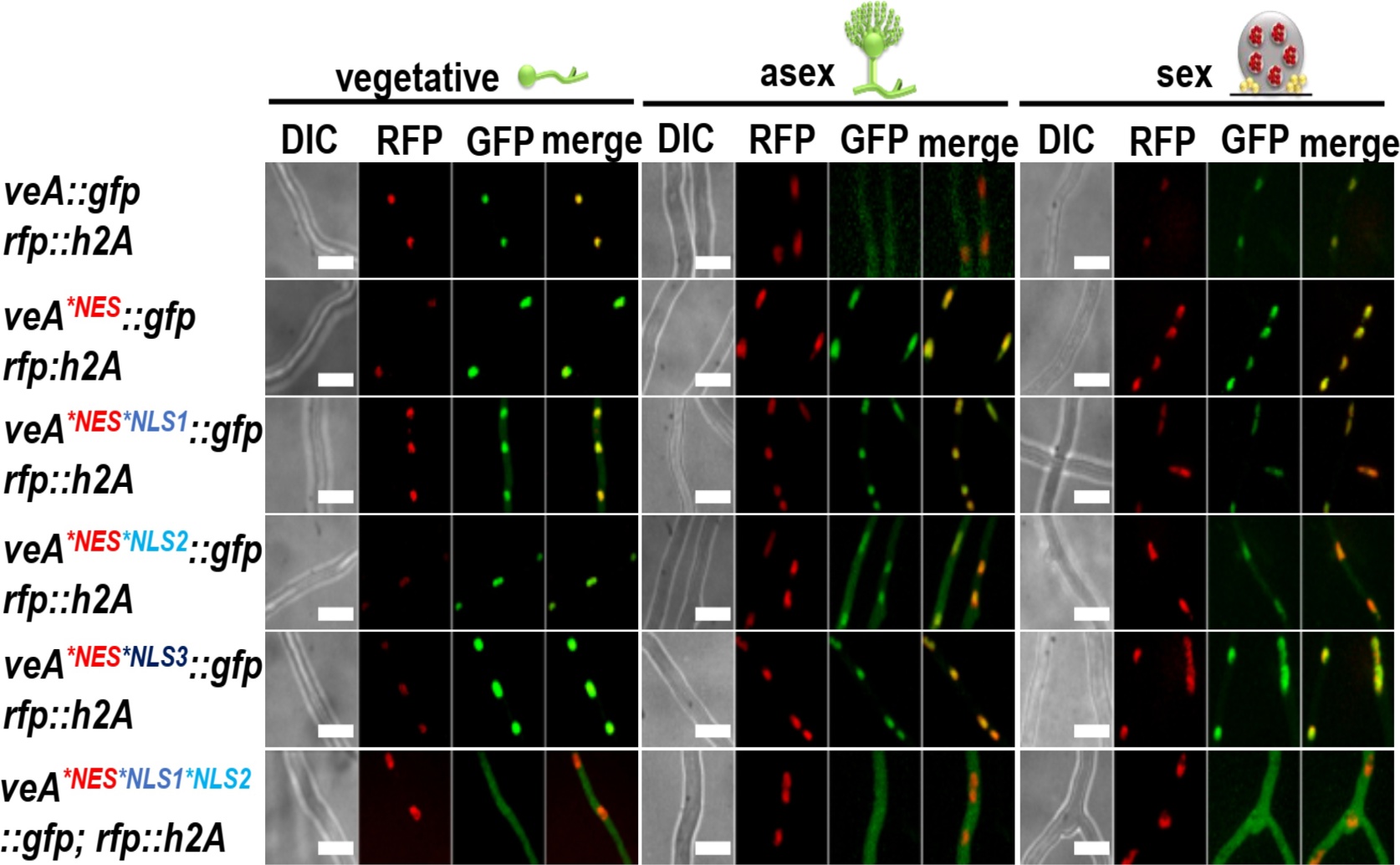
In Aspergillus nidulans, a defective Nuclear Export Signal (NES) traps the regulatory protein VeA in the nucleus, but this accumulation is counteracted when the NLS1 import signal is also mutated, revealing the dynamic interplay between nuclear shuttling signals that controls fungal development.

Image adapted from: Strohdiek et al. / CC BY (Source)

Key Findings

  • Researchers at the Universities of Göttingen and Maynooth found that a protein called VeA acts as a master switch, controlling how the fungus Aspergillus nidulans reproduces
  • VeA's location inside or outside the cell's control center determines its role: staying inside promotes sexual reproduction, while moving outside triggers asexual reproduction
  • This precise control of VeA's movement is crucial for the fungus to adapt its life cycle and produce vital chemical compounds in response to environmental signals like light
Fungi, like all living organisms, must make critical decisions about their development to survive and reproduce effectively. One of the most fundamental choices for many fungi is whether to reproduce asexually, creating identical copies quickly, or sexually, which involves genetic recombination and can lead to greater diversity and resilience in changing environments. This ability to differentiate in response to appropriate cues is known as developmental competence, a concept first described by Waddington, and it operates at various levels of biological organization, including an organism's reproductive strategy[2]. While this "reproductive competence"[2] is well-understood in mammals and plants, its underlying mechanisms in multicellular fungi have been less clear, often documented in scattered, older literature[2]. Recent research from the University of Göttingen and Maynooth University[1] has shed light on a crucial molecular switch governing this developmental decision in filamentous fungi, particularly in the model organism Aspergillus nidulans. Their study focuses on a group of proteins called Velvet domain proteins, which act as key regulators, essentially guiding the fungus towards either asexual or sexual differentiation. The core of their discovery revolves around a specific protein named VeA. VeA is not a lone actor; it's a central component of a larger complex known as VelB-VeA-LaeA. This complex plays a vital role in linking the control of gene expression (which genes are turned on or off) to epigenetic control (changes in gene activity that don't involve alterations to the underlying DNA sequence). Together, these controls coordinate the fungus's developmental programs, including its reproductive pathways and even the production of specialized chemical compounds known as secondary metabolites. The study revealed that the precise location of the VeA protein within the fungal cell is critical for determining its developmental fate. Cells are compartmentalized, with the nucleus housing the genetic material and the cytoplasm being the jelly-like substance surrounding it. For VeA to carry out its functions, it must be able to move between these compartments. The researchers found that VeA possesses three specific "nuclear localization signals" (NLS1, NLS2, NLS3), which are like molecular addresses that direct the protein into the nucleus. Crucially, they also identified an additional "nuclear export sequence" (NES), which acts as a signal for VeA to be moved out of the nucleus and into the cytoplasm. This dual system provides VeA with a "shuttle function," allowing the cell to precisely control its location. The key finding is that VeA's location directly dictates the fungus's reproductive path. During the fungus's normal growth phase (vegetative growth), VeA is primarily located inside the nucleus. However, for the fungus to embark on asexual development, VeA must be actively exported from the nucleus into the cytoplasm. Conversely, if the fungus is to proceed with sexual reproduction, VeA needs to remain continuously present within the nucleus. This precise control over VeA's movement and stability acts as a molecular switch, directly influencing the fungus's "reproductive competence"[2] by determining which developmental program is activated. This mechanism provides a clear example of an "elementary logic module"[2] that is necessary for the coordinated development of a multicellular organism like a fungus. This understanding of VeA's nuclear shuttling mechanism also helps connect to broader aspects of fungal biology and environmental responses. For instance, it's known that external cues, such as light, can significantly influence fungal development. Earlier research[3] demonstrated that in Aspergillus nidulans, red light stimulates asexual sporulation (spore formation) while repressing sexual development. This effect is mediated by a fungal phytochrome protein called FphA, which acts as a red-light sensor and is located in the cytoplasm[3]. While the direct link between FphA and VeA's nuclear shuttling isn't fully elucidated by the new study, it's plausible that environmental signals perceived by proteins like FphA could influence the activity or localization of VeA, thus integrating external cues with internal developmental decisions. This highlights how fungi coordinate their internal molecular machinery with their external environment. Furthermore, once the decision for asexual development is made, other intricate genetic networks come into play to shape the resulting structures. Previous studies[4] have detailed how a specific gene regulatory network, involving proteins like BrlA, AbaA, and WetA, controls the development of the asexual fruiting body, or conidiophore. A particular feature of these structures, the spore-producing phialides, is governed by AbaA[4]. The new findings regarding VeA's role provide the upstream control, dictating if asexual development occurs. Subsequently, the network involving AbaA[4] then dictates how that asexual development proceeds morphologically, with the loss of abaA in some fungal lineages leading to distinct changes in asexual fruiting body shape and spore viability[4]. This illustrates a hierarchical control system, where VeA makes the initial developmental fate decision, and then other gene regulatory networks refine the specific morphological outcomes. In summary, the research from the University of Göttingen and Maynooth University reveals that the precise movement of the VeA protein into and out of the nucleus is a fundamental regulatory mechanism controlling the choice between asexual and sexual development in fungi. This accurate nuclear import and export, coupled with stability control, are prerequisites for coordinated fungal development and the production of specialized compounds. These findings underscore the complex interdependencies of regulatory proteins in orchestrating the life cycle of fungi, providing a molecular basis for understanding their "reproductive competence"[2] and how it integrates with environmental signals[3] and subsequent morphological development[4].

GeneticsBiochemMycology

References

Main Study

1) The Aspergillus nidulans velvet domain containing transcription factor VeA is shuttled from cytoplasm into nucleus during vegetative growth and stays there for sexual development, but has to return into cytoplasm for asexual development

Published 16th June, 2025

https://doi.org/10.1371/journal.pgen.1011687


Related Studies

2) Reproductive competence: a recurrent logic module in eukaryotic development.

https://doi.org/10.1098/rspb.2013.0819


3) The Aspergillus nidulans phytochrome FphA represses sexual development in red light.

Journal: Current biology : CB, Issue: Vol 15, Issue 20, Oct 2005


4) Recurrent Loss of abaA, a Master Regulator of Asexual Development in Filamentous Fungi, Correlates with Changes in Genomic and Morphological Traits.

https://doi.org/10.1093/gbe/evaa107


Related Articles

An unhandled error has occurred. Reload 🗙