Gene Mapping Reveals Growth and Reproduction Tradeoff

Greg Howard
14th March, 2025

Gene Mapping Reveals Growth and Reproduction Tradeoff

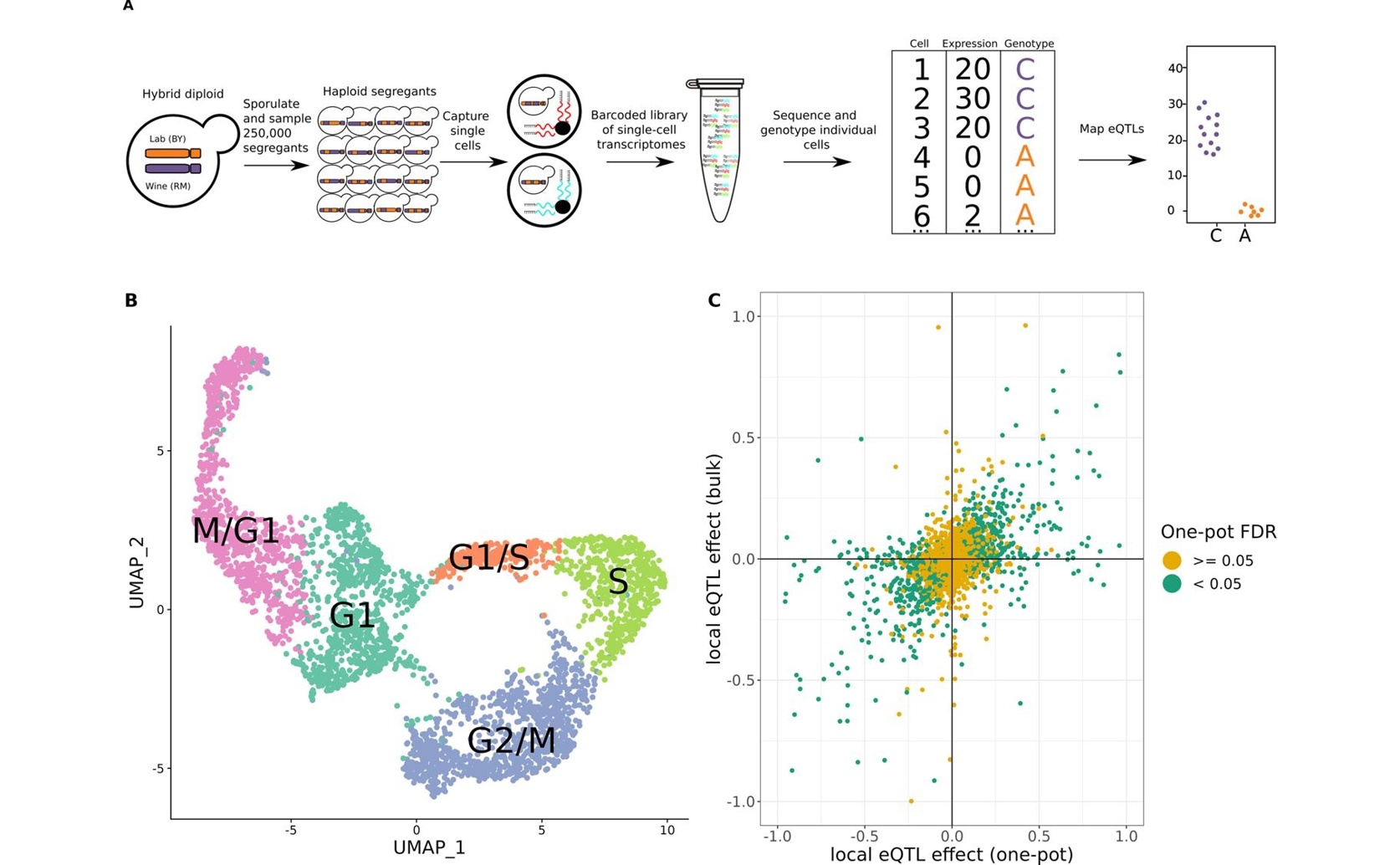
Single-cell RNA sequencing of over 100,000 yeast segregants from three crosses enabled simultaneous genotyping, gene expression profiling, and cell-cycle stage classification, revealing thousands of local and distant eQTLs, hundreds of genes with allele-specific effects on expression noise, and 20 cell-cycle occupancy loci, including a common GPA1 variant (W82R) that increases mating efficiency at the cost of slower growth and is associated with higher outcrossing rates in natural populations.

Image adapted from: Boocock et al. / CC BY (Source)

Key Findings

  • Researchers at UCLA used single-cell technology to study how genetics shape yeast cell functions
  • They identified thousands of genetic regions that influence gene activity and how these effects change during the cell cycle
  • A specific genetic variant in the GPA1 gene was found to boost yeast mating ability while slowing their growth
Understanding how our genetic code influences the traits we exhibit has been a significant focus of scientific research. One crucial aspect of this is identifying expression quantitative trait loci (eQTLs), which are regions of the genome that explain variations in gene expression levels. These variations can impact everything from cell growth to disease susceptibility. However, studying eQTLs has been challenging because their effects can vary across different tissues, cell types, and cellular states, making it difficult to capture the full picture using traditional bulk gene expression measurements. A recent study conducted by researchers at the University of California, Los Angeles[1], has advanced our understanding of eQTLs by employing a novel approach that utilizes single-cell RNA sequencing (scRNA-seq). This method allows scientists to examine gene expression at the resolution of individual cells, providing a much more detailed view of how genetic variants influence gene activity. In their study, the UCLA team analyzed over 100,000 single cells from three different yeast crosses. Yeast, a simple organism, serves as an excellent model for genetic studies due to its well-understood genetics and ease of manipulation. By using scRNA-seq, the researchers were able to genotype each cell, measure gene expression levels, and determine the cell's stage in the cell cycle—a series of phases that a cell goes through to divide and replicate. Through this comprehensive analysis, the team mapped thousands of local and distant eQTLs. Local eQTLs are located near the genes they regulate, while distant (or trans-) eQTLs can affect genes located on different chromosomes. Notably, they discovered interactions between eQTL effects and the cell-cycle stages, revealing how genetic variants can influence gene expression differently depending on the cell's state. One of the significant findings of this study was the identification of hundreds of genes with allele-specific effects on expression noise. Expression noise refers to the variability in gene expression levels among cells, even in a genetically identical population. Understanding how different alleles contribute to this noise can shed light on the mechanisms that maintain cellular diversity and stability. Moreover, the researchers mapped 20 loci that influence cell-cycle progression. One particularly interesting locus was found to affect the expression of genes involved in the mating response. They pinpointed a common variant, W82R, in the GPA1 gene, which encodes a signaling protein that regulates the mating pathway. This variant increases mating efficiency but slows down cell-cycle progression, suggesting a trade-off between reproductive success and growth speed. Such findings provide insights into how genetic variations can balance different biological processes to optimize an organism's fitness. This study builds on previous research that has highlighted the complexity of genetic influences on gene expression. For instance, earlier studies have shown that a significant portion of gene expression variation is due to trans-acting eQTLs that often cluster at specific hotspot locations[2]. These hotspots are enriched for transcription factor genes, which play a crucial role in regulating multiple target genes. Additionally, the Genotype-Tissue Expression (GTEx) project has demonstrated that local genetic variations affect gene expression levels across various human tissues, further emphasizing the intricate relationship between genetics and gene regulation[3]. By integrating single-cell data, the UCLA study provides a more granular understanding of how eQTLs operate within individual cells and across different cellular states. This level of detail allows for the identification of interactions and allele-specific effects that bulk measurements might miss. Furthermore, the ability to classify cells by their cycle stage and link genetic variants to specific biological processes, such as the mating response, offers a clearer picture of how genetics translates into observable traits and behaviors. The implications of this research are significant for understanding the genetic basis of complex traits and diseases. By mapping eQTLs with single-cell resolution, scientists can better identify the causal variants that contribute to disease risk and uncover the underlying molecular mechanisms. This approach also opens up possibilities for personalized medicine, where treatments can be tailored based on an individual's unique genetic and cellular profile. In summary, the UCLA study represents a substantial advancement in the field of genetics by leveraging single-cell technology to unravel the complex interactions between genetic variants and gene expression. By building on previous findings and introducing new methodologies, this research provides deeper insights into how our genetic makeup influences cellular functions and, ultimately, our health and traits.

GeneticsBiochemMycology

References

Main Study

1) Single-cell eQTL mapping in yeast reveals a tradeoff between growth and reproduction

Published 12th March, 2025

https://doi.org/10.7554/eLife.95566


Related Studies

2) Genetics of trans-regulatory variation in gene expression.

https://doi.org/10.7554/eLife.35471


3) Genetic effects on gene expression across human tissues.

https://doi.org/10.1038/nature24277


Related Articles

An unhandled error has occurred. Reload 🗙