High-Quality Genome Mapping and Analysis of a Harmful Plant Fungus

Jim Crocker
12th July, 2024

High-Quality Genome Mapping and Analysis of a Harmful Plant Fungus

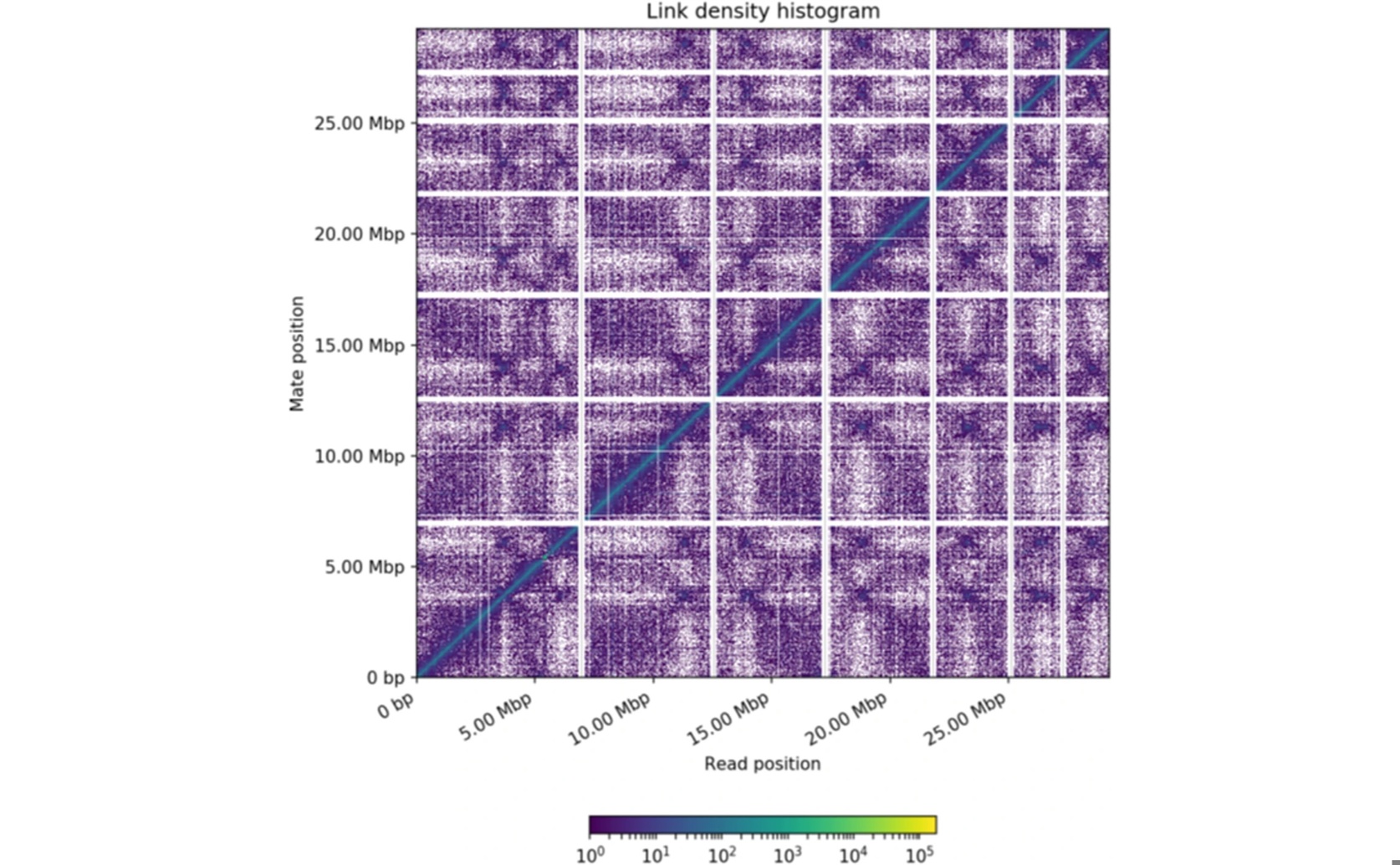
This heat map provides visual proof that the genetic material of the fungus Thielaviopsis punctulata has been correctly assembled into seven large, chromosome-like structures, confirming the high quality of the genome sequence.

Image adapted from: Purayil et al. / CC BY (Source)

Key Findings

  • Researchers at the United Arab Emirates University analyzed the genome of the fungus causing black scorch disease in date palms
  • They used advanced genomic techniques to create a detailed genome assembly of the pathogen
  • The study identified 7,169 genes and 3,501 Gene Ontology terms, providing insights for developing targeted disease resistance strategies
Black scorch disease (BSD) is a serious threat to date palm cultivation in the United Arab Emirates (UAE). The disease is caused by the fungal pathogen Thielaviopsis punctulata (Tp) DSM102798, which leads to severe symptoms including tissue necrosis, wilting, and eventual plant mortality[1]. This study, conducted by researchers at the United Arab Emirates University, aimed to better understand the genome of Tp DSM102798 to develop more effective strategies to combat BSD. In this study, the researchers used advanced genomic techniques to scaffold the genome of Tp DSM102798. They prepared Chicago and Hi-C libraries as input for the Dovetail HiRise pipeline, resulting in an assembly with a total length of 28.23 megabases (Mb) comprising 1,256 scaffolds. The assembly had a contig N50 of 18.56 kilobases (kb), L50 of three, and a BUSCO completeness score of 98.6% for 758 orthologous genes. Annotation of this assembly identified 7,169 genes and 3,501 Gene Ontology (GO) terms. Compared to five other Thielaviopsis genomes, Tp DSM102798 exhibited the highest continuity, with a cumulative size of 27.598 Mb for the first seven scaffolds, surpassing the assemblies of all examined strains. These findings provide a robust foundation for targeted strategies to enhance date palm resistance against BSD, promoting more sustainable and resilient agricultural systems. This study builds on previous research that identified Thielaviopsis punctulata as the causal agent of black scorch disease in the UAE. Earlier studies confirmed the pathogen's role in BSD by isolating it from all tissues of diseased trees and conducting pathogenicity tests[2]. The pathogen produces two types of conidia: thick-walled aleuroconidia (chlamydospores) and phialoconidia (endoconidia). The fungicide Score was found to inhibit the mycelial growth of T. punctulata both in vitro and in vivo[2]. Additionally, the study's findings align with research on other fungal pathogens affecting date palms in the region. For instance, sudden decline syndrome (SDS) in date palms is caused by Fusarium spp., including F. solani and F. proliferatum[3][4]. These studies highlighted the importance of understanding the genetic makeup of fungal pathogens to develop effective control measures. For example, the high-resolution genome assembly of F. proliferatum DSM106835 provided insights into the genes and metabolites associated with pathogenicity, contributing to the development of targeted interventions[4]. The current study's genomic analysis of Tp DSM102798 offers a similar foundation for understanding the pathogen's biology and evolutionary history. By identifying key genes and GO terms, researchers can develop targeted strategies to enhance date palm resistance against BSD. This approach is crucial for improving the sustainability and resilience of date palm cultivation in the UAE. Moreover, the study's findings could inform the development of biocontrol agents. Previous research identified beneficial fungi, such as Trichoderma harzianum and Trichoderma longibrachiatum, which exhibit antagonistic activity against various date palm pathogens, including T. punctulata[5]. These beneficial fungi could be integrated into management strategies to provide an environmentally friendly alternative to chemical fungicides. In conclusion, this study by the United Arab Emirates University provides a comprehensive genomic analysis of Thielaviopsis punctulata DSM102798, the causal agent of black scorch disease in date palms. By leveraging advanced genomic techniques, the researchers have laid the groundwork for developing targeted strategies to enhance date palm resistance against BSD. This research not only contributes to our understanding of fungal pathogens but also supports the development of sustainable and resilient agricultural systems in the UAE.

GeneticsBiochemMycology

References

Main Study

1) A high-quality genome assembly and annotation of Thielaviopsis punctulata DSM102798.

Published 9th July, 2024

https://doi.org/10.1038/s41597-024-03458-y


Related Studies

2) Chemical Control of Black Scorch Disease on Date Palm Caused by the Fungal Pathogen Thielaviopsis punctulata in United Arab Emirates.

https://doi.org/10.1094/PDIS-05-16-0645-RE


3) Molecular Identification and Disease Management of Date Palm Sudden Decline Syndrome in the United Arab Emirates.

https://doi.org/10.3390/ijms20040923


4) Fully resolved assembly of Fusarium proliferatum DSM106835 genome.

https://doi.org/10.1038/s41597-023-02610-4


5) Survey and Identification of Date Palm Pathogens and Indigenous Biocontrol Agents.

https://doi.org/10.1094/PDIS-12-19-2556-RE


Related Articles

An unhandled error has occurred. Reload 🗙