How Deleting a Specific Gene Affects Mushroom Growth on Plant-Based Materials

Greg Howard
13th November, 2024

How Deleting a Specific Gene Affects Mushroom Growth on Plant-Based Materials

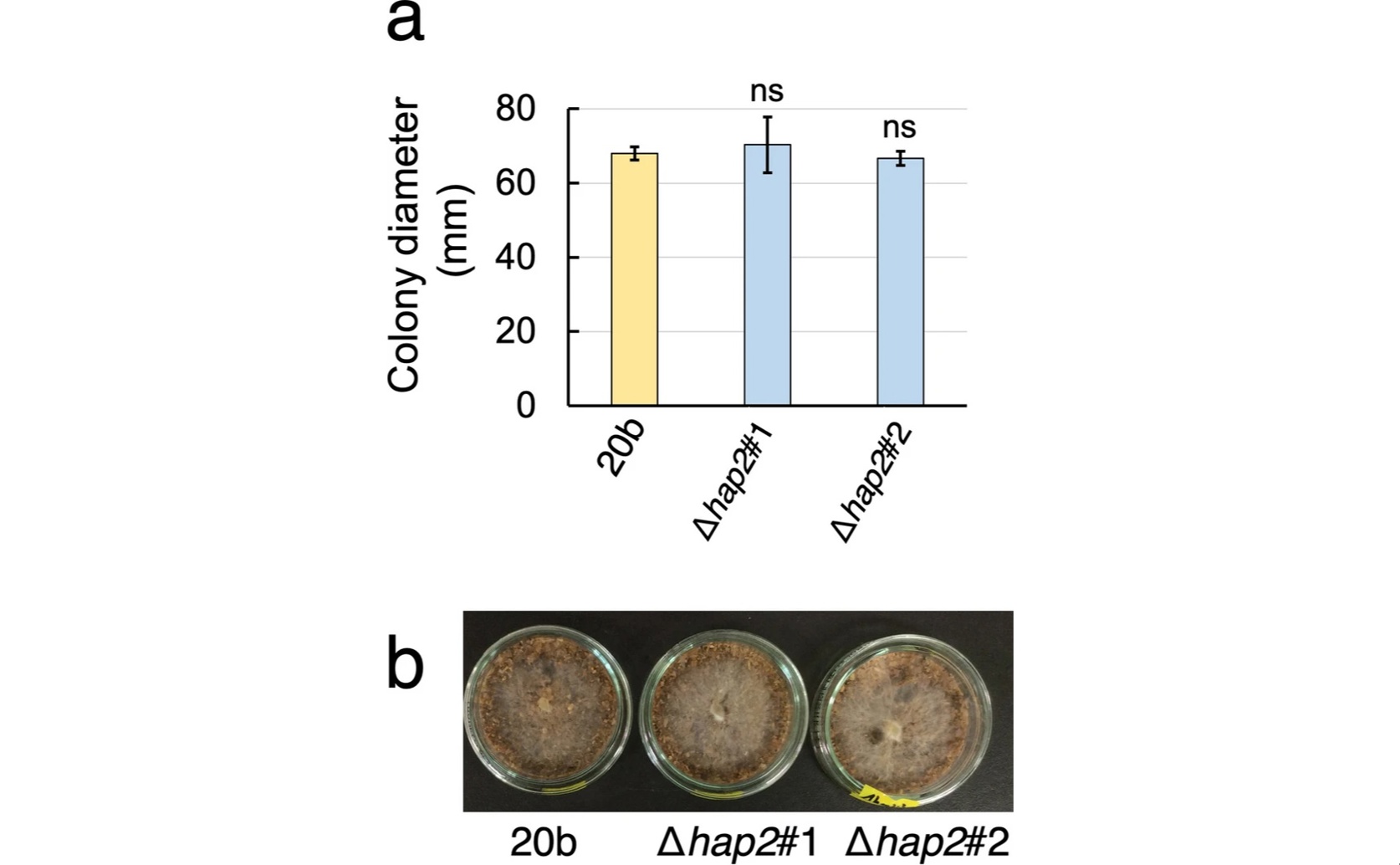
Deletion of the hap2 gene did not affect the growth rate of Pleurotus ostreatus on either a standard nutrient medium (a) or on beech wood sawdust (b), confirming that the gene's key role in lignin degradation is independent of the fungus's overall growth.

Image adapted from: Kayama et al. / CC BY (Source)

Key Findings

  • Researchers at Kyoto University studied the role of the hap2 gene in the white-rot fungus Pleurotus ostreatus
  • Deleting the hap2 gene reduced the fungus's ability to break down lignin and decreased Mn2+-dependent peroxidase activity
  • The hap2 gene is crucial for the expression of the vp2 gene, which is essential for lignin degradation, especially on lignocellulosic substrates
The study of gene regulation in white-rot fungi, particularly regarding lignin-modifying enzymes (LME), is crucial for understanding how these organisms break down lignin, a complex polymer found in plant cell walls. Lignin degradation is essential for carbon recycling in ecosystems and has significant industrial applications, such as in biofuel production. A recent study conducted by researchers at Kyoto University[1] has delved into the regulatory mechanisms of LME genes in the white-rot fungus Pleurotus ostreatus, focusing on the role of the hap2 gene. Pleurotus ostreatus is known for its ability to degrade lignin, a trait attributed to its ligninolytic peroxidases, including manganese peroxidases (MnPs) and versatile peroxidases (VPs)[2]. Previous research has shown that environmental factors like temperature and pH can influence the expression of these peroxidases, suggesting adaptive mechanisms[2]. However, the molecular underpinnings of these regulatory processes remained unclear. The Kyoto University study aimed to elucidate the role of the hap2 gene, which encodes a protein homologous to a component of the CCAAT-binding Hap complex. This complex is known to be involved in the transcriptional regulation of various genes, but its specific function in regulating LME genes in white-rot fungi was not well understood. To investigate this, the researchers generated hap2 deletants of P. ostreatus. They observed that these deletants exhibited significantly reduced Mn2+-dependent peroxidase activity and lignin-degrading capacity when grown on beech wood sawdust (BWS) medium compared to the parental strain. This finding highlights the importance of hap2 in the lignin degradation process. Real-time PCR analysis revealed that the transcript levels of the vp2 gene, which encodes one of the versatile peroxidases, were significantly lower in the hap2 deletants than in the parental strain when cultured on solid media consisting of BWS, holocellulose, or Avicel. Interestingly, this downregulation was not observed when the fungi were grown on yeast-malt-glucose (YMG) agar plates, indicating that the regulatory role of hap2 is substrate-dependent. Further experiments, including glutathione S-transferase (GST) pulldown and electrophoretic mobility shift assays, demonstrated that recombinant Hap2, along with Hap3 and Hap5, forms a complex capable of binding to the CCAAT sequence located upstream of the vp2 gene in vitro. This suggests that the Hap complex, with Hap2 as a critical component, is essential for the transcriptional upregulation of vp2 in P. ostreatus growing on lignocellulosic substrates. These findings build on earlier studies that identified the secretion of various ligninolytic peroxidases by P. ostreatus and the influence of environmental conditions on their expression[2]. The current study provides a deeper understanding of the genetic regulation behind these observations, specifically highlighting the role of the hap2 gene in modulating the expression of key enzymes involved in lignin degradation. Moreover, this research aligns with previous findings that the set of proteins secreted by a fungus is related to its lifestyle and can be used to predict fungal behavior under different conditions[3]. The identification of hap2 as a regulatory gene adds another layer to our understanding of how P. ostreatus adapts to its environment by modulating enzyme production. In summary, the Kyoto University study has made significant strides in uncovering the regulatory mechanisms of lignin-modifying enzyme genes in P. ostreatus. By demonstrating the essential role of the hap2 gene in the transcriptional regulation of the vp2 gene, the research provides valuable insights into the genetic control of lignin degradation. This knowledge not only enhances our understanding of fungal biology but also has potential applications in industries relying on lignin degradation processes.

GeneticsBiochemMycology

References

Main Study

1) Effects of hap2 deletion on mnp/vp transcription in Pleurotus ostreatus grown on lignocellulosic substrates.

Published 13th November, 2024

https://doi.org/10.1007/s00253-024-13352-7


Related Studies

2) Ligninolytic peroxidase gene expression by Pleurotus ostreatus: differential regulation in lignocellulose medium and effect of temperature and pH.

https://doi.org/10.1016/j.fgb.2014.02.003


3) Comparative and transcriptional analysis of the predicted secretome in the lignocellulose-degrading basidiomycete fungus Pleurotus ostreatus.

https://doi.org/10.1111/1462-2920.13360


Related Articles

An unhandled error has occurred. Reload 🗙