How Cell Machinery Helps Yeast Shape Change and Handle Stress

Jenn Hoskins
20th March, 2025

How Cell Machinery Helps Yeast Shape Change and Handle Stress

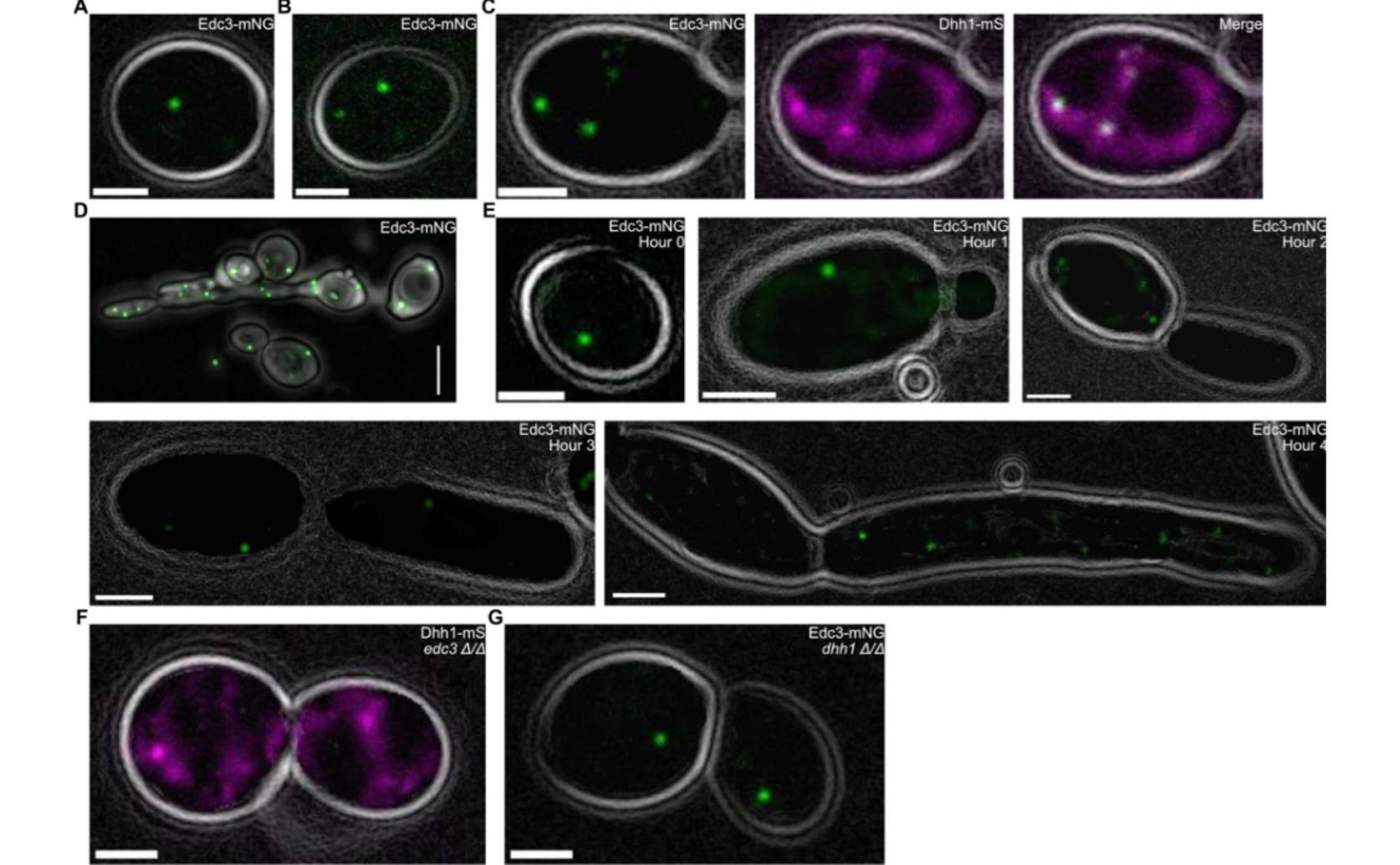
P-bodies containing Edc3 and Dhh1 form in Candida albicans under non-stress conditions, acute heat shock, starvation, and hyphal growth, and neither Edc3 nor Dhh1 is individually required for P-body condensation.

Image adapted from: Tosiano et al. / CC BY (Source)

Key Findings

  • Scientists from Carnegie Mellon, University of Georgia, and Institut Pasteur discovered that removing the DHH1 gene weakens Candida albicans' growth and infection capabilities
  • The DHH1 gene controls thousands of other genes, helping the fungus respond to stress and change shape to invade tissues effectively
  • Targeting the DHH1 gene could lead to new antifungal treatments, making infections caused by Candida albicans easier to treat
Candida albicans is a common fungus that lives harmlessly in many individuals but can cause severe infections, especially in immunocompromised people. These infections can be deadly, with mortality rates reaching up to 40% despite available treatments[2]. A key factor in the virulence of C. albicans is its ability to switch between different growth forms. Specifically, it can transform from a single-celled yeast to a filamentous hyphal form, which allows it to invade tissues and evade the immune system[2][3]. Recent research conducted by scientists at Carnegie Mellon University, the University of Georgia, and Institut Pasteur has shed light on the molecular mechanisms that regulate this morphological switch. The study focused on understanding how certain cellular factors, known as P-Body (PB) factors, influence the ability of C. albicans to form hyphae and cause infections[1]. PB factors are involved in the post-transcriptional regulation of gene expression, meaning they help control which proteins are made in the cell after the initial steps of gene expression have occurred. The researchers specifically investigated two PB factors: Dhh1 and Edc3. Previous studies had indicated that both of these factors are important for the virulence and filamentation of C. albicans[3]. However, the exact roles of Dhh1 and Edc3 were not well understood. To explore their functions, the team used a gene-editing technique called CRISPR-Cas9 to create strains of C. albicans that lacked either the DHH1 or EDC3 gene. By studying these modified strains, the researchers aimed to determine how the absence of these factors affects the fungus's growth and ability to form hyphae. The study found that deleting the DHH1 gene had a significant impact on C. albicans. Strains without DHH1 showed impaired growth, altered filamentation, and unusual colony shapes, especially under heat stress conditions. These changes were consistent across five different genetic backgrounds, indicating that DHH1 plays a crucial role in maintaining normal growth and morphology. In contrast, deleting the EDC3 gene did not have the same effect. Strains lacking EDC3 were still able to tolerate heat and form hyphae normally, suggesting that Edc3 is not as critical for these processes as Dhh1. To understand the broader impact of DHH1 deletion, the researchers performed RNA sequencing (RNA-seq) to analyze gene expression patterns. They discovered that removing DHH1 disrupted the regulation of thousands of genes under both yeast and hyphal growth conditions in two different strains, SC5314 and P57055. Notably, many stress response genes were upregulated even in the absence of external stress, mirroring findings from studies on the similar gene in another yeast species, S. cerevisiae. This suggests that DHH1 normally acts to repress these stress-related genes when they are not needed, helping the fungus maintain its typical growth state. These findings build on earlier research that identified various transcription factors and environmental signals involved in controlling hyphal morphogenesis in C. albicans[3][4]. For instance, previous studies have highlighted the importance of specific genes like ALS3, ECE1, and HWP1 in the formation of hyphae and their role in virulence[4]. By demonstrating that DHH1 regulates a wide array of genes involved in stress responses and filamentation, the current study adds a new layer of understanding to the complex regulatory networks that govern C. albicans biology. It highlights the importance of post-transcriptional regulation, a relatively less explored area compared to transcriptional control, in the pathogen’s ability to adapt and thrive in different environments. The implications of this research are significant for developing new treatments for candidiasis, the infection caused by C. albicans. By identifying DHH1 as a key regulator of hyphal growth and stress responses, the study provides a potential target for antifungal therapies. Inhibiting DHH1 function could disrupt the ability of C. albicans to form hyphae and respond to environmental stresses, thereby reducing its virulence and making it more susceptible to existing treatments[2]. Furthermore, the study underscores the importance of using advanced genetic tools like CRISPR-Cas9 to unravel the intricate mechanisms of fungal pathogenicity. By enabling precise manipulation of specific genes, researchers can more effectively dissect the roles of various factors in disease processes. This approach not only advances our basic understanding of fungal biology but also accelerates the discovery of novel therapeutic targets. In summary, the research from Carnegie Mellon University, the University of Georgia, and Institut Pasteur provides valuable insights into the role of post-transcriptional regulation in the virulence of Candida albicans. By demonstrating that DHH1 is essential for regulating gene expression related to stress responses and hyphal growth, the study expands our knowledge of the molecular underpinnings of this pathogen's adaptability and pathogenicity. These findings pave the way for new strategies to combat serious fungal infections, potentially improving outcomes for patients affected by candidiasis[2][3][4].

GeneticsBiochemMycology

References

Main Study

1) Roles of P-body factors in Candida albicans filamentation and stress response

Published 17th March, 2025

https://doi.org/10.1371/journal.pgen.1011632


Related Studies

2) The regulation of hyphae growth in Candida albicans.

https://doi.org/10.1080/21505594.2020.1748930


3) Transcriptional control of hyphal morphogenesis in Candida albicans.

https://doi.org/10.1093/femsyr/foaa005


4) A core filamentation response network in Candida albicans is restricted to eight genes.

https://doi.org/10.1371/journal.pone.0058613


Related Articles

An unhandled error has occurred. Reload đź—™