How A Protein Works With An Enzyme To Build Germs' Outer Layer

Greg Howard
17th June, 2025

How A Protein Works With An Enzyme To Build Germs' Outer Layer

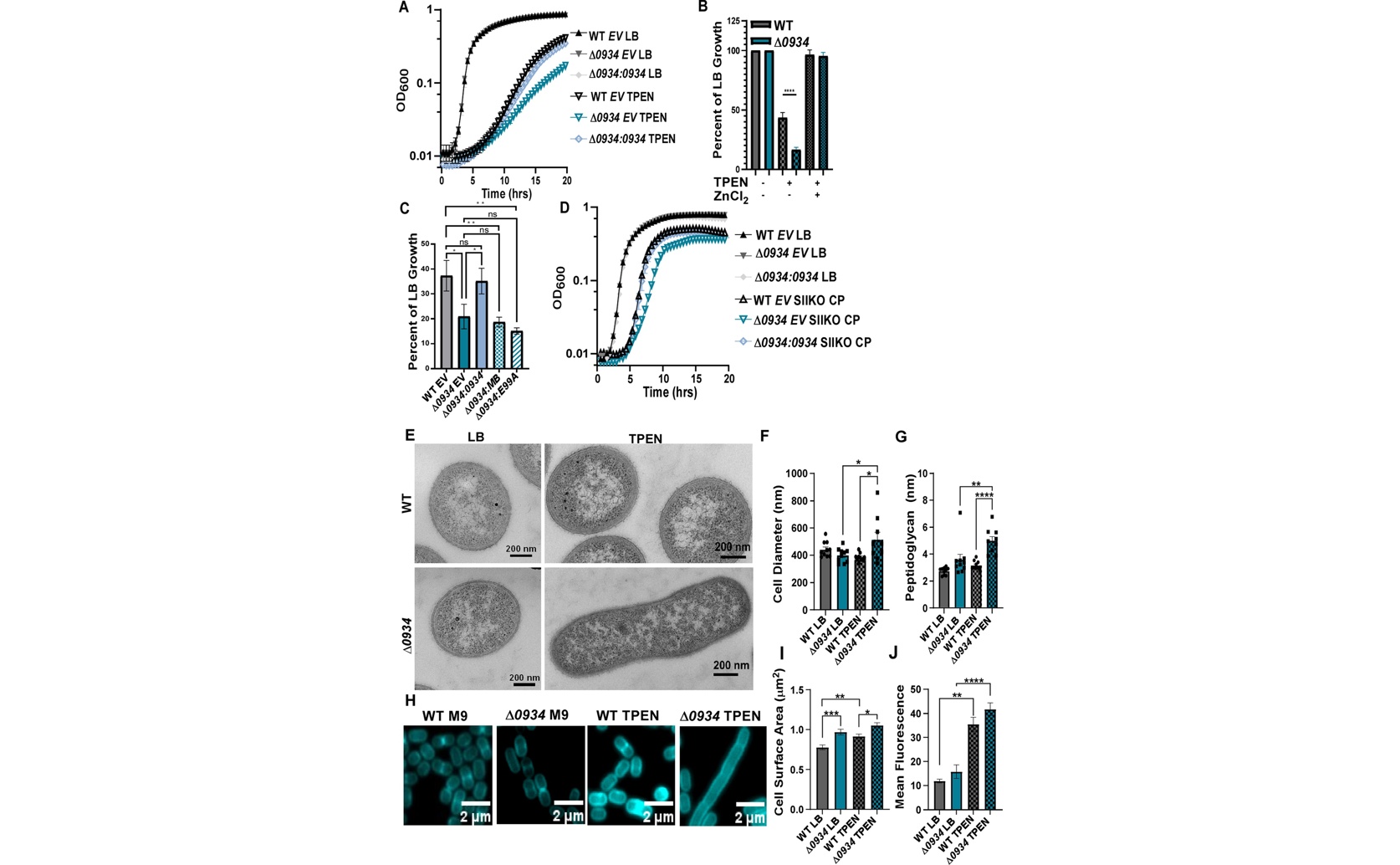
Lacking the protein A1S_0934 renders Acinetobacter baumannii highly sensitive to zinc limitation (a, b, d) and causes significant cell elongation with altered peptidoglycan structure (e-j), demonstrating that its metal-binding and GTPase activities (c) are essential for maintaining cell wall integrity under metal stress.

Image adapted from: Critchlow et al. / CC BY (Source)

Key Findings

  • US researchers discovered that a protein called MigC in the drug-resistant bacterium Acinetobacter baumannii links zinc levels to the strength of its protective cell wall
  • MigC, activated by zinc, directly inhibits MurD, a key enzyme that builds the bacterial cell wall, thus regulating the bacterium's defenses
  • Disrupting MigC weakens the bacteria's cell wall, making them more vulnerable to antibiotics and less able to cause infections, suggesting a new drug target
The global rise of antibiotic-resistant bacteria presents an urgent challenge to healthcare systems worldwide. Bacteria, particularly formidable pathogens like Acinetobacter baumannii, have evolved sophisticated mechanisms to survive and cause infections. A key to their survival is their ability to acquire essential nutrients from their host, such as zinc, and maintain a robust protective barrier around themselves. This barrier, known as the cell wall, is critical for bacterial survival and is a primary target for many existing antibiotics[2]. However, bacteria have developed resistance, necessitating the search for new vulnerabilities. Recent research conducted by US Universities and Medical Centers has uncovered a novel mechanism in A. baumannii that links zinc availability directly to the integrity of its cell wall[1]. This discovery sheds light on how this challenging bacterium maintains its defenses and offers potential new strategies for combating infections. Bacteria like A. baumannii must acquire zinc to thrive within a host, despite the host's efforts to sequester it, a process known as nutritional immunity[3]. To manage zinc levels, A. baumannii produces proteins that help transport zinc to other essential cellular components. One such protein, identified through advanced computational tools, is named MigC (MurD interacting GTPase COG0523). This study revealed that MigC directly interacts with MurD, an essential enzyme known as a muramyl ligase. MurD is crucial for building the peptidoglycan, the main structural component of the bacterial cell wall[2]. The researchers found that MigC is a GTPase, an enzyme that uses a molecule called GTP for energy, often playing a role in cellular signaling. Its activity is stimulated when zinc binds to a specific chemical structure within MigC. Crucially, the interaction between MigC and MurD was shown to inhibit MurD's activity. This means that MigC acts as a regulator, dampening the cell wall building process carried out by MurD. To understand the implications of this interaction, the scientists created A. baumannii strains lacking MigC. These MigC-deficient bacteria displayed several vulnerabilities. They were more sensitive to environments with low zinc, highlighting MigC's role in zinc homeostasis. Furthermore, their cell walls were structurally altered, indicating a defect in cell wall construction. These bacteria also showed increased cell elongation and became more susceptible to ceftriaxone, a type of antibiotic (a cephalosporin) that works by targeting bacterial cell wall synthesis. This sensitivity to antibiotics further confirms that the absence of MigC compromises the integrity of the bacterial cell wall. The importance of this MigC-MurD interaction was further demonstrated in animal models. A. baumannii strains lacking MigC had a significantly reduced ability to colonize mice in a pneumonia model, underscoring the critical role of this pathway in the bacterium's ability to cause infection. This research builds upon and expands our understanding of bacterial cell wall biogenesis and its coordination. Prior studies have established the bacterial cell wall as a prime target for antibiotics, with enzymes like MurD being extensively studied[2]. This new work reveals a layer of regulation for MurD itself, linking its activity to nutrient availability. While other research has shown how different components of the Gram-negative bacterial envelope, such as the peptidoglycan and outer membrane, are coordinated through enzymes like MurA and LpxC[4], this study introduces another crucial regulatory link involving MurD and zinc levels. It suggests that the bacterium's ability to sense and respond to its environment, specifically zinc availability, directly influences the strength and integrity of its protective cell wall. Previous findings also indicated that A. baumannii's ability to acquire zinc is vital for its survival and that zinc starvation can impact its cell envelope[3]. This study provides a specific molecular mechanism for how zinc influences the cell wall through the MigC-MurD pathway, complementing the understanding provided by earlier work on other zinc-related enzymes like ZrlA[3]. By identifying MigC as a key player in regulating cell wall biogenesis in response to zinc, this research opens new avenues for therapeutic development. Targeting MigC could potentially weaken A. baumannii's defenses, making it more vulnerable to existing antibiotics or paving the way for novel antimicrobial strategies against this drug-resistant pathogen.

MedicineHealthBiochem

References

Main Study

1) The zinc metalloprotein MigC impacts cell wall biogenesis through interactions with an essential Mur ligase in Acinetobacter baumannii

Published 16th June, 2025

https://doi.org/10.1371/journal.ppat.1013209


Related Studies

2) Breaking down the cell wall: Still an attractive antibacterial strategy.

https://doi.org/10.3389/fmicb.2022.952633


3) An Acinetobacter baumannii, Zinc-Regulated Peptidase Maintains Cell Wall Integrity during Immune-Mediated Nutrient Sequestration.

https://doi.org/10.1016/j.celrep.2019.01.089


4) Coordination of bacterial cell wall and outer membrane biosynthesis.

https://doi.org/10.1038/s41586-023-05750-0


Related Articles

An unhandled error has occurred. Reload 🗙