Gut Bacteria Changes During Elective Bone Surgery: A Preliminary Study

Jenn Hoskins
3rd June, 2025

Gut Bacteria Changes During Elective Bone Surgery: A Preliminary Study

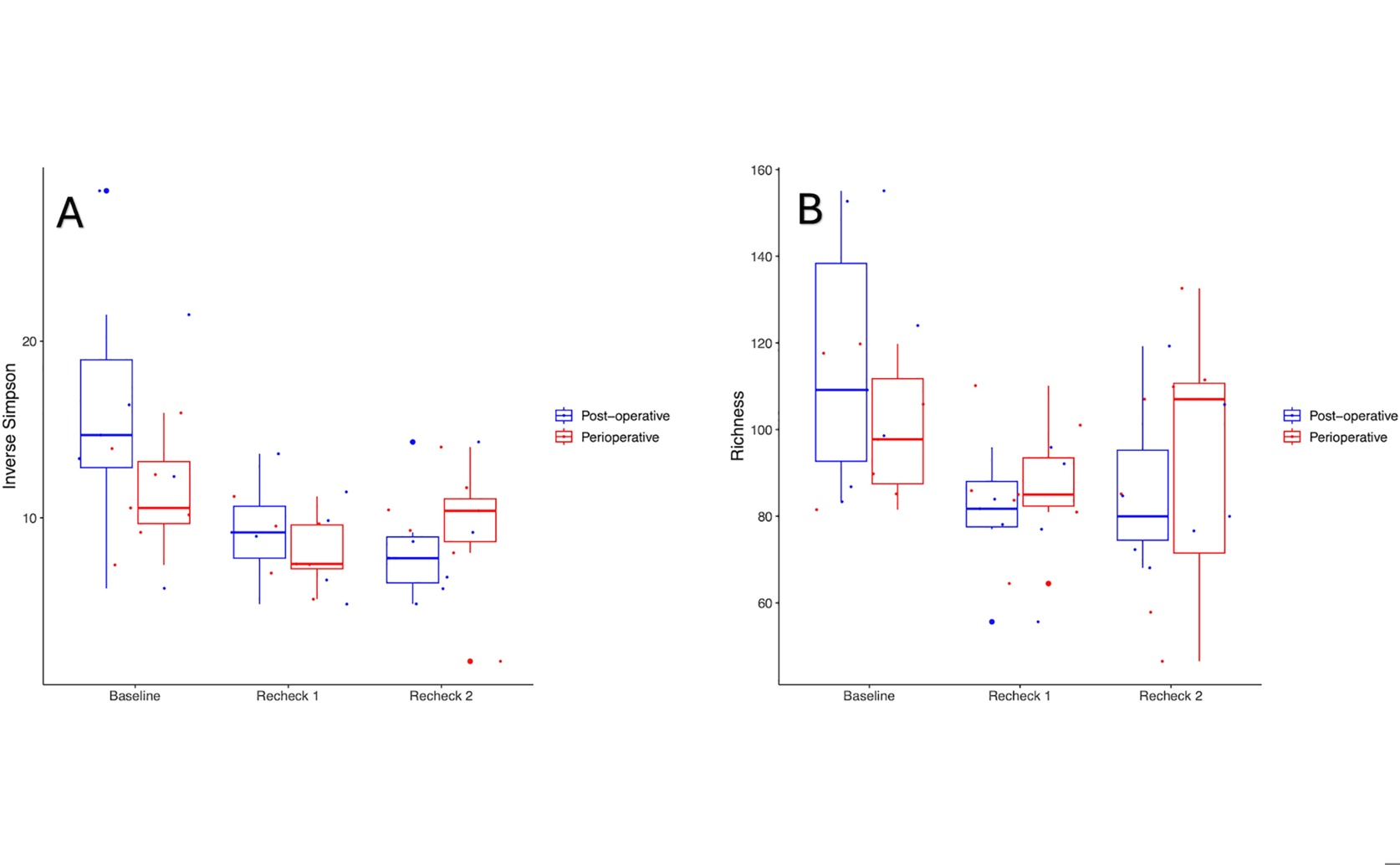
Reflecting the study's conclusion that elective orthopedic surgery induces sustained dysbiosis, both antibiotic groups displayed significant reductions in the Inverse Simpson diversity index (A) and species richness (B) compared to baseline, with diversity remaining significantly lower 2–3 months post-operatively.

Image adapted from: Collier et al. / CC BY (Source)

Key Findings

  • At Ontario Veterinary College in Canada, dogs having elective orthopedic surgery showed a lasting drop in gut bacteria diversity for up to 3 months after receiving antibiotics
  • Dogs given extra antibiotics post-surgery had more pronounced shifts in their gut bacteria balance compared to those getting only a single pre-surgery dose
This article explores recent research into how elective orthopedic surgery in dogs, combined with antibiotic use, affects their gut microbial community. The study, conducted by researchers at the University of Guelph, Abu Dhabi Equine and Camel Hospital, and the University of Illinois[1], provides insights into changes in the fecal microbiota before and after surgery, and how antibiotic treatment may have long-lasting effects on these microbial populations. The study focused on fourteen client-owned dogs older than one year undergoing elective orthopedic surgery. The purpose was to assess whether the antibiotics given around the time of surgery (known as perioperative antibiotics) or antibiotics prescribed for several days after surgery (post-operative antibiotics) would alter the composition of the bacteria in the dogs’ intestines. Fecal samples were taken before surgery (baseline) and then at two follow-up points: one between 13 and 50 days after surgery, and another between 55 and 90 days post-surgery. To understand the diversity of the gut microbiota, the researchers used a technique called 16S amplicon sequencing. This method sequences a specific region of bacterial DNA and helps identify and compare the community of bacteria present in the samples. They measured alpha diversity, which is a term used to describe the number and abundance of bacterial species within a single sample, using the Sobs Index, the Shannon Diversity Index, and the Inverse Simpson Index. These different indexes help provide a clear picture of how many types of bacteria are present and how evenly they are distributed. Meanwhile, beta diversity was assessed using the Bray-Curtis and Jaccard Indexes, which compare differences between the microbial communities in separate samples. The findings showed significant alterations in gut microbiota. Both the Inverse Simpson and the Shannon Diversity Index values were different when comparing the baseline with the first and second follow-up samples. This indicates that the composition of the bacteria changed after surgery and remained different for up to three months in both groups of dogs, regardless of whether they received only perioperative antibiotics or their treatment continued with an oral antibiotic after surgery. However, the Sobs Index, a metric that counts the number of bacterial species without taking into account their relative abundance, only showed significant differences between the baseline and the first follow-up. Furthermore, when comparing the two groups—dogs that received just the single, perioperative dose versus those treated with additional post-operative oral antibiotics—a clear difference in beta diversity was noted. The Bray-Curtis and Jaccard Indexes, which measure community structure differences between samples, highlighted that the dogs receiving post-operative antibiotics had a microbial community increasingly different from their pre-surgery status even at the later follow-up. This suggests that the extended antibiotic treatment had a more pronounced and lasting impact on altering the gut microbiota compared to a single, perioperative dose. The significance of these findings is underscored when considered alongside previous research. Earlier studies[2] have shown that the use of antibiotics in dogs with uncomplicated conditions such as acute diarrhea does not improve clinical outcomes but instead may lead to an increase in antibiotic-resistant bacteria. Although that study focused on acute diarrhea and used amoxicillin-clavulanic acid, the underlying concern is similar: antibiotics, while sometimes necessary, can disrupt the natural balance of gut bacteria. The current study extends this understanding to the context of elective surgery, showing that antibiotics contribute not only to potential resistance issues but also to long-term changes in microbial diversity and community structure. In simple terms, the research highlights that while antibiotics are a standard part of surgical procedures to prevent infections, they also have the unintended consequence of altering the gut’s ecosystem. These changes are not short-lived; they can persist for a few months after surgery. The alteration in microbial diversity could have implications for the animal’s overall health, immunity, and future resistance to infections, although more studies are needed to fully understand these connections. The study is significant because it ties together observations about antibiotic use in other contexts[2] with changes noted after surgical procedures, emphasizing caution in the use of antibiotics. It suggests that every decision to use antibiotics needs to be balanced with the potential for long-term disruption in the normal bacterial community. As the role of the microbiome in health becomes increasingly clear, studies like this provide valuable data to help veterinarians make more informed decisions regarding antibiotic stewardship in dogs undergoing surgery.

MedicineAnimal Science

References

Main Study

1) Assessing changes to the fecal microbiota in dogs undergoing elective orthopedic surgery: A preliminary investigation

Published 2nd June, 2025

https://doi.org/10.1371/journal.pone.0325163


Related Studies

2) Effect of amoxicillin-clavulanic acid on clinical scores, intestinal microbiome, and amoxicillin-resistant Escherichia coli in dogs with uncomplicated acute diarrhea.

https://doi.org/10.1111/jvim.15775


Related Articles

An unhandled error has occurred. Reload 🗙