Environment and History Shape Local Genetics on Three Islands

Jenn Hoskins
12th May, 2025

Environment and History Shape Local Genetics on Three Islands

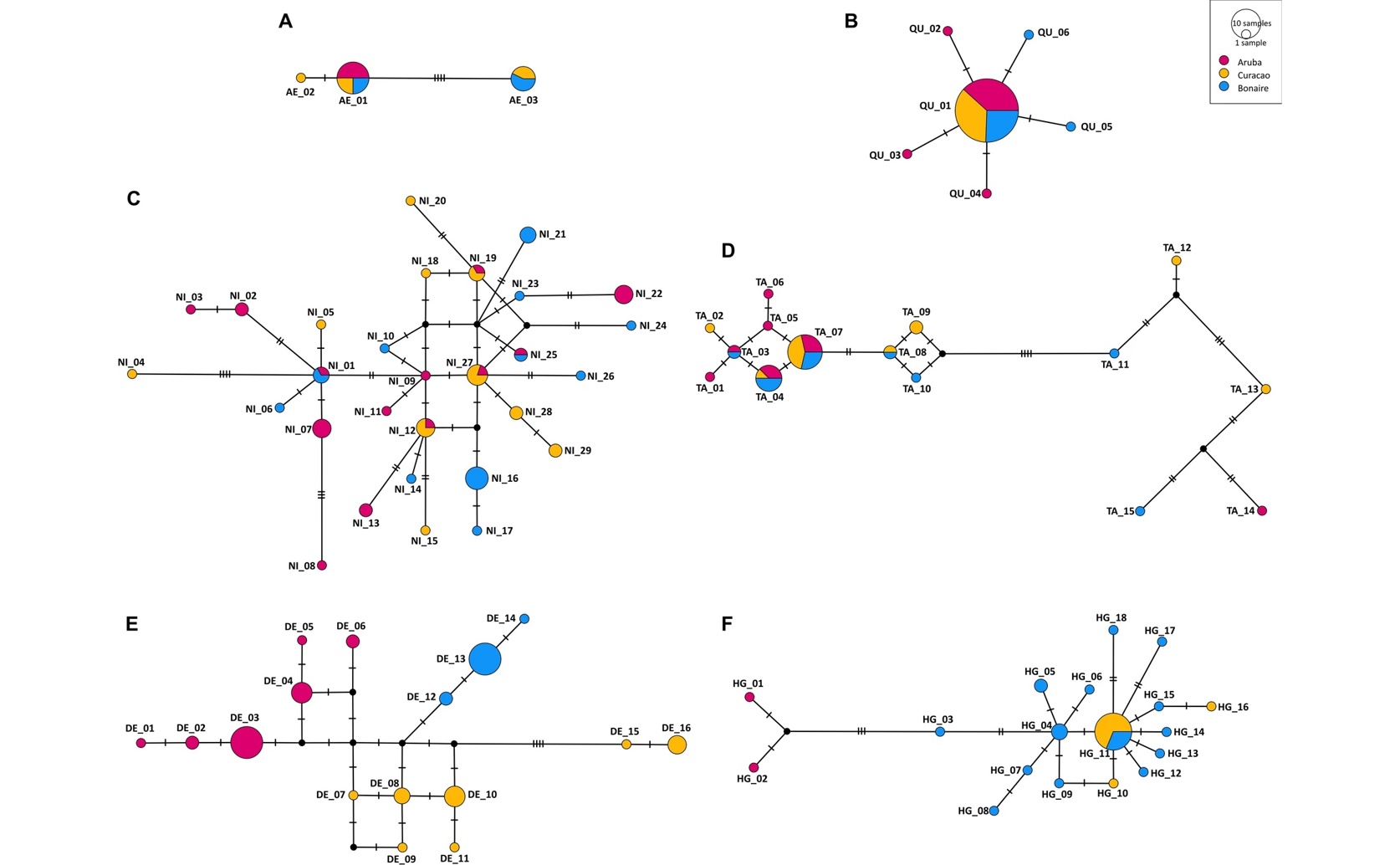
Haplotype analysis reveals that the non-native Aedes aegypti (A) and Culex quinquefasciatus (B) possess low genetic diversity due to population history, whereas native species display high diversity that is either shared across islands in the dispersive Culex nigripalpus (C) and Aedes taeniorhynchus (D) or restricted to specific islands in the habitat specialists Deinocerites sp. (E) and Haemagogus chrysochlorus (F).

Image adapted from: Helleman et al. / CC BY (Source)

Key Findings

  • Researchers in Aruba, Curaçao, and Bonaire found that non-native mosquitoes have low genetic diversity, suggesting they arrived in small numbers
  • Native mosquito species showed high genetic variety, with some spreading across islands and others remaining unique to each location
  • These findings highlight the need for customized strategies to control different mosquito species and reduce disease risks
Mosquito-borne diseases pose significant health risks worldwide, and understanding the population dynamics of different mosquito species is crucial for effective disease management. A recent study by researchers at Leiden University[1] investigates the genetic diversity of both native and non-native mosquito species on the Caribbean islands of Aruba, Curaçao, and Bonaire. By analyzing the genetic makeup of these mosquitoes, the study aims to uncover patterns that could inform strategies to control mosquito populations and mitigate disease transmission. The study collected 258 mosquito specimens from six different species across all three islands. These species include both native mosquitoes and non-native invasive species. To assess genetic variation, the researchers sequenced the mitochondrial COII gene, a common marker used in population genetics, and performed haplotype network analysis. This method helps visualize the relationships between different genetic variants within and between populations. The findings revealed distinct genetic patterns among the mosquito species. The non-native species exhibited low genetic diversity across all three islands, suggesting a limited number of introductions and a possible genetic bottleneck during their spread[2]. In contrast, locally native species showed high genetic diversity. Among the native species, some had closely related haplotypes shared across different islands, indicating gene flow and movement between populations. Other native species had high genetic diversity with haplotypes restricted to specific islands, reflecting limited dispersal and localized population structures. These results highlight the significant differences in population genetics between non-native and native mosquito species. Non-native species often show reduced genetic variation due to their recent introduction and limited initial population sizes[2][3][4]. This low diversity can affect their adaptability and vector competence—the ability to transmit pathogens. Understanding these genetic differences is essential for assessing the risk of mosquito-borne diseases and developing targeted control measures. The study also underscores the importance of ecological factors in shaping genetic structures. Mosquito species that share the same environment may still exhibit distinct genetic patterns due to differences in their ecology and dispersal abilities. For instance, species with greater dispersal capacity can spread more easily between islands, leading to more homogeneous genetic structures across regions[2]. Conversely, species with limited dispersal may develop unique genetic profiles on each island, enhancing their adaptability to specific local conditions. By comparing native and non-native species within the same geographical area, the study provides a comprehensive view of mosquito population genetics. This approach allows for a better understanding of how different factors, such as introduction history and ecological niches, influence genetic diversity and population structure. Previous research on invasive mosquitoes, like the studies on Aedes japonicus in the United States and Germany[3][4], supports the finding that multiple introductions and subsequent admixture can increase genetic diversity in invasive populations over time. However, the Caribbean study shows that this pattern is not universal and depends on the specific history and ecology of each species. The research at Leiden University suggests that a broad-based approach to studying mosquito genetics, encompassing multiple species and ecological contexts, is beneficial for grasping the complex dynamics of mosquito populations. This comprehensive perspective can help predict how mosquitoes might respond to environmental changes, such as climate change or urbanization, and how these responses could impact disease transmission[2]. In conclusion, the genetic analysis of mosquito populations in the Caribbean provides valuable insights into the differences between native and non-native species. The study demonstrates that non-native mosquitoes generally have lower genetic diversity, while native species display higher and more varied genetic structures. These findings emphasize the need for tailored mosquito control strategies that consider the unique genetic and ecological characteristics of each species. By integrating these genetic insights with environmental and population data, public health officials can better manage mosquito populations and reduce the incidence of mosquito-borne diseases.

EnvironmentGeneticsEcology

References

Main Study

1) The ecological niche and population history shape mosquito population genetics on a group of three Caribbean islands

Published 9th May, 2025

https://doi.org/10.1186/s13071-025-06801-3


Related Studies

2) Monitoring population and environmental parameters of invasive mosquito species in Europe.

https://doi.org/10.1186/1756-3305-7-187


3) Fine-scale spatial and temporal population genetics of Aedes japonicus, a new US mosquito, reveal multiple introductions.

https://doi.org/10.1111/j.1365-294X.2010.04576.x


4) Population genetics of the invasive Asian bush mosquito Aedes japonicus (Diptera, Culicidae) in Germany-a re-evaluation in a time period of separate populations merging.

https://doi.org/10.1007/s00436-019-06376-w


Related Articles

An unhandled error has occurred. Reload 🗙