Creating a Detailed DNA Map of a Freshwater Mussel

Jim Crocker
5th May, 2025

Creating a Detailed DNA Map of a Freshwater Mussel

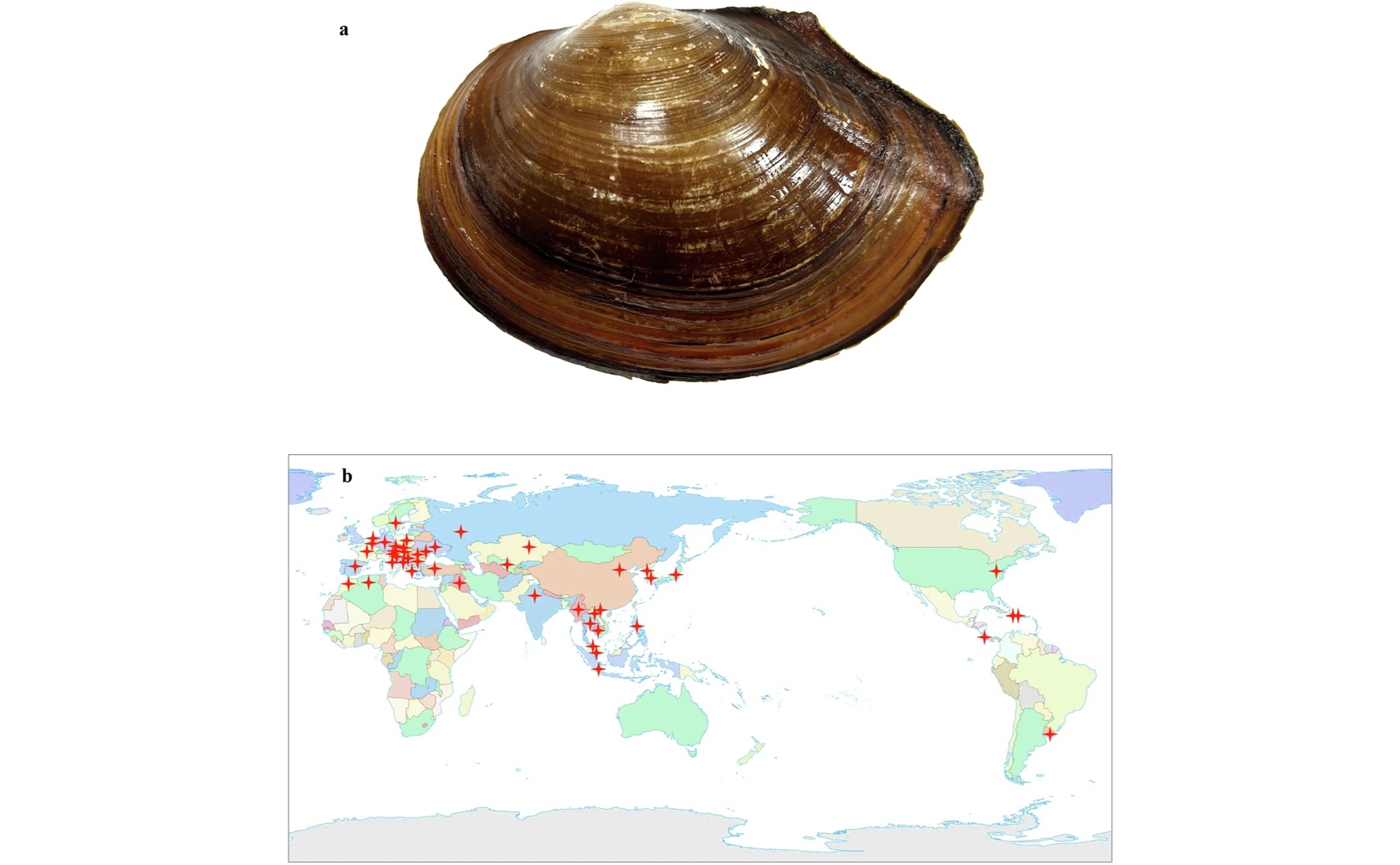
The Chinese pond mussel (Anodonta woodiana) (a) is an ecologically and economically important species that has achieved a widespread global distribution (b), underscoring the significance of this first genome assembly for its future study and management.

Image adapted from: Chen et al. / CC BY (Source)

Key Findings

  • Researchers in China decoded the genome of Anodonta woodiana, an invasive freshwater mussel from the Yangtze River
  • They identified nearly 45,000 genes, revealing how the mussel adapts and thrives in diverse environments
  • This genetic information helps manage the mussel's spread and use it to monitor water pollution effectively
Understanding the genetic makeup of invasive species is crucial for managing their spread and mitigating their impact on native ecosystems. Anodonta (Sinanodonta) woodiana, a freshwater mussel native to the Yangtze River basin in China, has become a successful invader in various regions across Asia, Europe, North America, and Africa. The Chinese Academy of Fishery Sciences has recently made significant progress in this area by assembling a high-quality chromosome-level genome of A. woodiana using advanced sequencing technologies such as Illumina, PacBio, and Hi-C[1]. The genome assembly revealed a size of 2.80 gigabases (Gb), with high continuity indicated by a contig N50 of 4.01 megabases (Mb) and a scaffold N50 of 143.34 Mb. A total of 1,609 contigs, representing 99.57% of the assembled genome, were organized into 19 chromosomes. This comprehensive genomic resource identified 1.51 Gb of repeat sequences and predicted 44,785 protein-coding genes. This is the first genome to be published for A. woodiana and the Anodonta genus, marking a significant milestone for researchers studying this species. The availability of the A. woodiana genome provides a valuable tool for investigating the species' biology and understanding the molecular mechanisms that enable it to adapt to diverse and challenging environments. Previous research has highlighted the invasive success of S. woodiana, particularly in Europe, where all populations are traced back to the Yangtze basin in China[2]. The genomic data from can enhance these findings by offering deeper insights into the genetic variations and adaptations that have facilitated the species' rapid expansion. In addition to its invasive characteristics, A. woodiana has been studied for its role as a bioindicator of environmental pollution. Studies conducted around Taihu Lake in China analyzed the accumulation of various pollutants in the mussels’ tissues[3][4]. These studies found significant levels of butyltins and phenyltins, as well as organochlorines like hexachlorocyclohexane isomers and dichlorodiphenyltrichloroethanes, in mussels from different sites. The high-quality genome assembly from can support ongoing and future pollution monitoring efforts by providing a genetic basis for understanding how these mussels metabolize and respond to contaminants. This genetic information could lead to the identification of specific genes involved in detoxification processes, enhancing the use of A. woodiana as a bioindicator. Moreover, the genomic data can aid in studying the population structure and gene flow of invasive populations. Previous research indicated that European populations of S. woodiana originated from a single colonization event and that their spread was driven by in situ adaptation through repeated admixture[2]. With the complete genome, researchers can perform more detailed analyses of genetic diversity and identify specific genetic markers associated with adaptability and resilience. This can inform management strategies aimed at controlling the spread of invasive populations by targeting genetic vulnerabilities. The assembly of the A. woodiana genome also opens up opportunities for comparative genomic studies within the Anodonta genus and other freshwater mussels. By comparing the genomes of different species, scientists can identify evolutionary differences and similarities that contribute to varying levels of invasiveness and environmental tolerance. Such comparisons can reveal the genetic basis of traits that make certain mussel species more successful invaders, providing insights that could be applied to other invasive species management efforts. Furthermore, the genome data can support research into the reproductive biology and lifecycle of A. woodiana. Understanding the genetic factors that influence reproduction and dispersal can help explain how the species maintains and expands its populations in non-native environments. This knowledge is particularly relevant in light of findings from[2], which suggest that genetic admixture plays a key role in the species' ability to adapt and thrive in new regions. In summary, the high-quality genome assembly of Anodonta (Sinanodonta) woodiana by the Chinese Academy of Fishery Sciences represents a significant advancement in the study of this invasive species. It provides a foundational resource for exploring the genetic mechanisms underlying its invasiveness, adaptability, and role as a bioindicator of environmental pollution. By integrating these genomic insights with previous research, scientists can develop more effective strategies for managing the spread of A. woodiana and mitigating its impact on native ecosystems[2][3][4].

GeneticsAnimal Science

References

Main Study

1) Chromosome-level genome assembly of the freshwater bivalve Anodonta woodiana

Published 2nd May, 2025

https://doi.org/10.1038/s41597-025-05078-6


Related Studies

2) Modelling the invasion history of Sinanodonta woodiana in Europe: Tracking the routes of a sedentary aquatic invader with mobile parasitic larvae.

https://doi.org/10.1111/eva.12700


3) Monitoring the organotin contamination in the Taihu Lake of China by bivalve mussel Anodonta woodiana.

https://doi.org/10.1007/s00128-008-9464-z


4) HCH and DDT Residues in Bivalves Anodonta woodiana from the Taihu Lake, China.

https://doi.org/10.1007/s00244-008-9173-y


Related Articles

An unhandled error has occurred. Reload đź—™