Glucose Transporter 2: A Key Player in Liver Cell and Liver Cancer Development

Jenn Hoskins
28th April, 2025

Glucose Transporter 2: A Key Player in Liver Cell and Liver Cancer Development

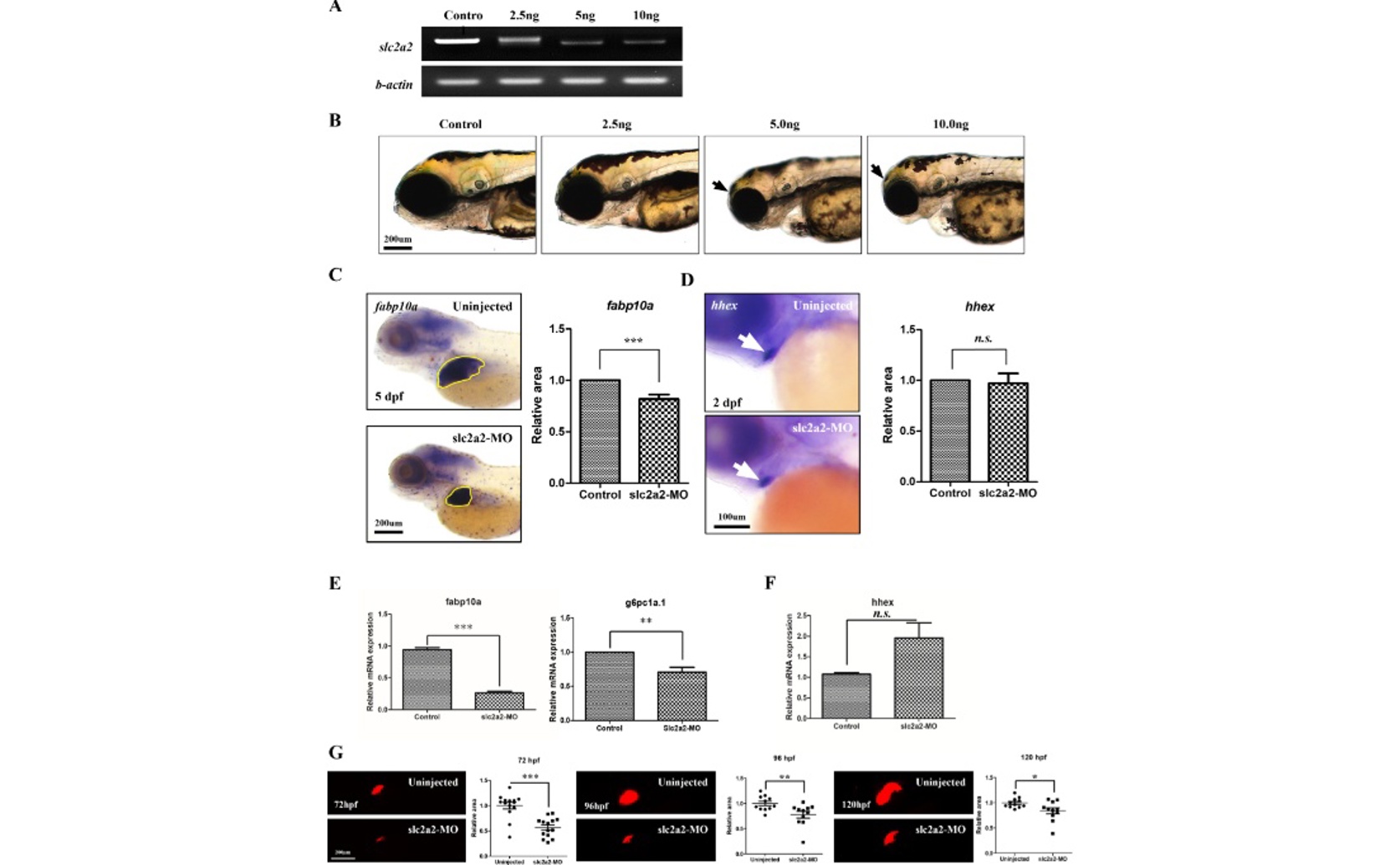
Knockdown of slc2a2 in developing zebrafish (Danio rerio) embryos (a, b) demonstrates its essential role in later-stage liver differentiation by reducing mature hepatocyte markers and liver size (c, e, g) while leaving the early hepatoblast marker hhex unaffected (d, f).

Image adapted from: Kim et al. / CC BY (Source)

Key Findings

  • Researchers at Pusan National University discovered that lower levels of the glucose transporter SLC2A2 are associated with more advanced liver cancer
  • Reduced SLC2A2 makes liver cancer cells more stem-like, increasing their ability to grow and resist treatments
  • Targeting SLC2A2 could lead to new, personalized therapies that improve outcomes for liver cancer patients
Hepatocellular carcinoma (HCC) is the most common type of primary liver cancer and poses significant treatment challenges. Over the past decade, advancements in systemic treatments have improved patient outcomes, but many patients still develop resistance to therapies, limiting their effectiveness[2]. Understanding the underlying molecular mechanisms of HCC is crucial for developing more effective, personalized treatments. A recent study conducted by researchers at Pusan National University explored the role of GLUT2 (SLC2A2), a vital glucose transporter, in liver differentiation and the progression of HCC[1]. GLUT2 is essential for regulating blood glucose levels and energy metabolism in liver, pancreas, and kidney tissues. Beyond its metabolic functions, SLC2A2 plays a role in cell differentiation and the metabolic adaptation necessary during embryonic development and tissue regeneration. However, its specific role in liver differentiation and HCC had not been thoroughly investigated until now. The study utilized a combination of computational analyses, laboratory experiments, and animal models to investigate how SLC2A2 affects liver cells and cancer progression. By analyzing gene expression data from various databases, including GEO datasets (GSE132606, GSE25417, GSE67848) and The Cancer Genome Atlas (TCGA) for HCC, the researchers found that the expression of SLC2A2 decreases as HCC progresses. Concurrently, genes associated with "stemness," such as SOX2 and POU5F1, were upregulated. Stemness refers to the qualities that make cancer cells more like stem cells, allowing them to grow and spread more easily[3]. To further understand the role of SLC2A2, the researchers conducted experiments using zebrafish embryos. By targeting SLC2A2 with morpholino, a molecule used to modify gene expression, they observed a reduction in the expression of fabp10a, a marker of liver differentiation. However, the expression of hhex, a hepatoblast marker, remained largely unchanged. This suggests that SLC2A2 is specifically important for the differentiation of liver cells rather than the initial formation of liver progenitor cells. In addition, experiments with HepG2 cells, a type of liver cancer cell line, revealed that knocking down SLC2A2 led to an increase in stemness and activation of the IGF1R pathway. The IGF1R pathway is involved in cell growth and survival, and its activation is often linked to cancer progression and resistance to treatment[2][3]. This shift towards a less differentiated state indicates that lower levels of SLC2A2 may contribute to the aggressiveness and treatment resistance observed in advanced HCC cases. These findings build upon previous research that has highlighted the complexity of HCC at the molecular level. For instance, earlier studies have identified various genetic and epigenetic alterations in HCC, including mutations in pathways like Wnt/β-catenin and P53, which are crucial for cell cycle regulation and tumor suppression[3]. Additionally, epigenetic dysregulation, such as changes in enhancer regions that control gene expression, has been shown to play a significant role in HCC prognosis and progression[4]. The current study adds to this body of knowledge by identifying SLC2A2 as a key player in maintaining liver cell differentiation and suppressing pathways that lead to malignancy. Moreover, the study's insights into how SLC2A2 interacts with metabolic processes and stemness pathways align with the broader push towards precision medicine in cancer treatment. Precision treatment aims to tailor therapies based on the unique molecular characteristics of each patient's tumor, potentially improving efficacy and reducing side effects[2]. By identifying SLC2A2 as a potential biomarker and therapeutic target, this research opens new avenues for personalized treatment strategies in HCC. The implications of these findings are significant. Targeting SLC2A2 could offer a dual approach in treating HCC: enhancing liver cell differentiation to restore normal function and inhibiting pathways that contribute to tumor growth and resistance. This approach complements existing strategies that focus on specific genetic mutations and epigenetic modifications within HCC tumors[3][4]. Furthermore, understanding the role of glucose metabolism in liver differentiation provides additional targets for intervention, given the central role of metabolism in cancer cell survival and proliferation. In conclusion, the study from Pusan National University sheds light on the critical role of SLC2A2 in liver differentiation and HCC progression. By demonstrating that SLC2A2 supports liver cell differentiation and suppresses stemness-associated pathways, the research provides a promising target for future therapeutic interventions. These findings not only enhance our understanding of HCC biology but also contribute to the development of more effective, personalized treatment approaches for patients battling this challenging cancer[2][3][4].

MedicineGeneticsBiochem

References

Main Study

1) Solute carrier family 2 member 2 (glucose transporter 2): a common factor of hepatocyte and hepatocellular carcinoma differentiation

Published 25th April, 2025

https://doi.org/10.1371/journal.pone.0321020


Related Studies

2) Precision treatment in advanced hepatocellular carcinoma.

https://doi.org/10.1016/j.ccell.2024.01.007


3) Advances in molecular classification and precision oncology in hepatocellular carcinoma.

https://doi.org/10.1016/j.jhep.2019.08.017


4) A genomic enhancer signature associates with hepatocellular carcinoma prognosis.

https://doi.org/10.1016/j.jhepr.2023.100715


Related Articles

An unhandled error has occurred. Reload 🗙