Salt and Acidity Influence Microorganism Changes and Mineral Growth

Jim Crocker
25th April, 2025

Salt and Acidity Influence Microorganism Changes and Mineral Growth

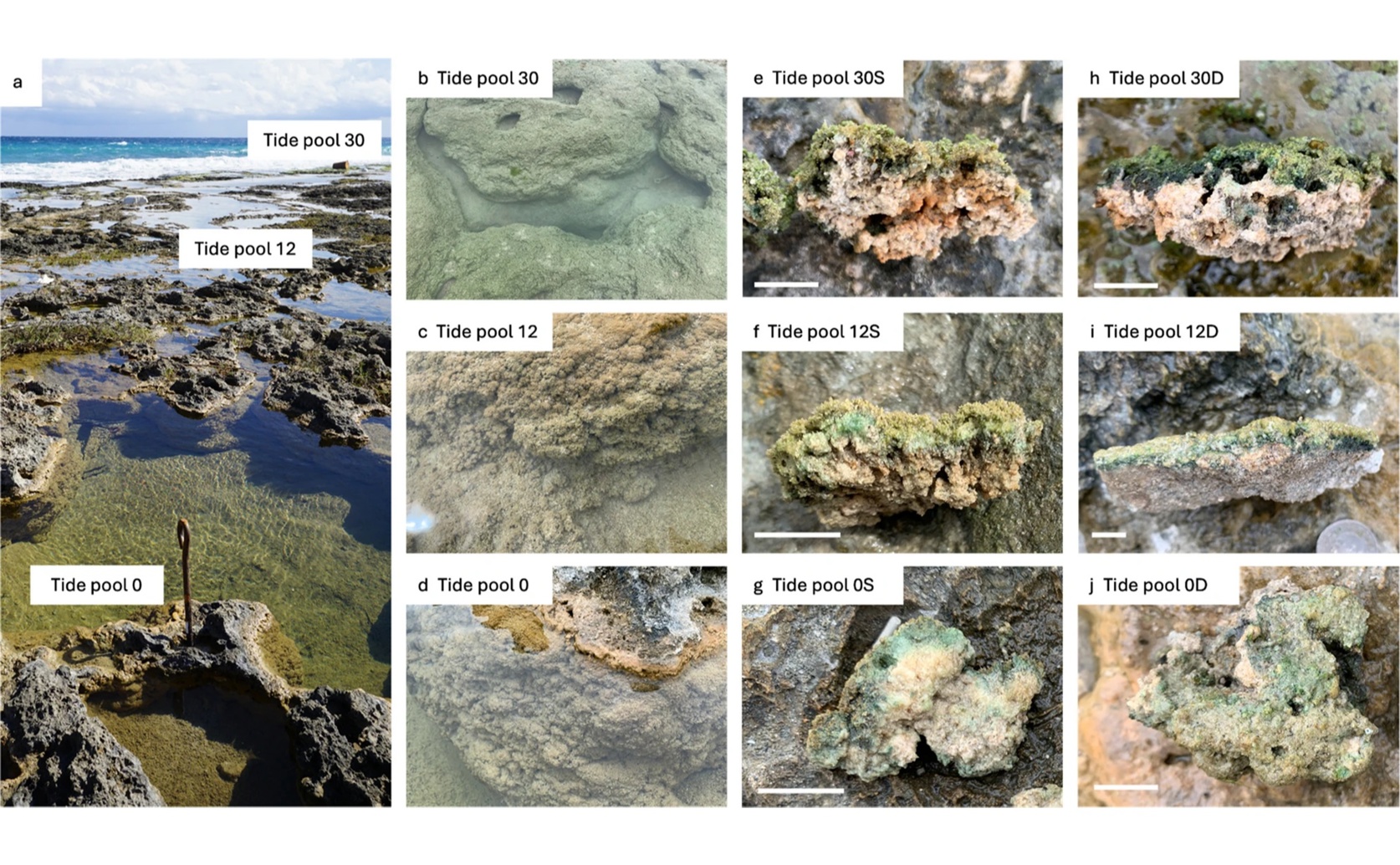
Modern microbialites sampled along a peritidal gradient (a) exhibit a visible decrease in mat thickness and pigmentation, reflecting reduced development from the upper freshwater-influenced tide pool (b, e, h) to the lower seawater-influenced pool (d, g, j).

Image adapted from: Hsieh et al. / CC BY (Source)

Key Findings

  • In Taiwanese tide pools, water acidity (pH) has a greater impact on which microbes thrive than salt levels
  • High salinity causes microbes to use different nitrogen sources, enhancing mineral (carbonate) formation
  • Both photosynthetic and non-photosynthetic microbes work together to build carbonate structures in these environments
Microbialites, ancient rock formations created by microorganisms, hold valuable clues about Earth's past environments. These structures can act as natural records, preserving information about past geochemical conditions and helping scientists understand how ecosystems have changed over billions of years. However, interpreting these records is complex, as microbial activity can involve various processes that influence mineral formation. A recent study conducted by researchers at the Max Planck Institute of Molecular Plant Physiology in Potsdam, Germany[1] delves into the relationship between microbial communities and carbonate precipitation in modern microbialites. By investigating microbialites in three tide pools from the peritidal zone of Fongchueisha, Hengchun, Taiwan, the study aims to uncover how salinity affects the composition of microbial communities and the mechanisms behind carbonate formation. Previous research has highlighted the significance of microbialites in recording environmental changes. For instance, the 3.43-billion-year-old Strelley Pool Chert in Australia[2] contains well-preserved stromatolites, which are layered structures formed by microbial communities. This study identified seven distinct stromatolite types, supporting the idea that these formations are biologically driven rather than abiogenic. Such findings provide a foundational understanding of how microbialites can serve as biosignatures of ancient life and environmental conditions. Further studies in South Australia[3] and Western Australia[4] have explored the microbial diversity within modern microbialites. These studies revealed that bacterial communities, particularly Cyanobacteria, play crucial roles in sediment stabilization and carbonate precipitation. In South Australian saline lakes, Cyanobacteria were found to be more abundant in mat samples compared to surrounding sediments, indicating their importance in maintaining stable ecosystem functions. Similarly, research in Shark Bay showed a high diversity of heterocytous Cyanobacteria, which are vital for nitrogen fixation and biofilm formation, even under varying salinity conditions[4]. Building on this foundation, the study from the Max Planck Institute used next-generation sequencing (NGS) to analyze the bacterial and eukaryotic communities present in the Taiwanese tide pools. By collecting samples across different salinity gradients and multiple time points, the researchers were able to assess how changes in salinity and pH influence microbial community composition and carbonate precipitation processes. The findings revealed that dominant bacterial groups, including Cyanobacteria and Alphaproteobacteria, were significantly affected by salinity variations. However, pH levels showed an even stronger correlation with community composition. This suggests that while salinity is an important factor, the acidity or alkalinity of the environment plays a more critical role in determining which microbial groups thrive. Additionally, the study identified a shift in the microbial community's trophic mode under high salinity conditions. In these environments, the utilization of urea and amino acids as nitrogen sources became more prominent, overshadowing traditional nitrogen fixation processes like diazotrophy and ureolysis. This shift contributed to increased carbonate precipitation by elevating both pH and dissolved inorganic carbon levels. These results expand our understanding of microbialite formation by highlighting the complexity of microbial interactions and their response to environmental changes. Unlike earlier studies that primarily focused on photosynthetic pathways, this research underscores the importance of non-photosynthetic processes in carbonate precipitation. The ability of different microbial communities to maintain stable carbonate formation despite varying environmental conditions suggests a resilient and adaptable system. Moreover, the study integrates insights from previous research by demonstrating how modern microbialites continue to reflect ancient patterns observed in formations like the Strelley Pool Chert[2]. The consistency in metabolic pathways across different environments, as seen in South Australian lakes[3], is mirrored in the Taiwanese tide pools, where distinct microbial communities perform similar functions to sustain carbonate precipitation. This reinforces the idea that the specific identities of microbial taxa might be less critical than their overall metabolic capabilities in driving ecosystem functions. In conclusion, the research from the Max Planck Institute provides valuable insights into the mechanisms behind microbialite formation and their potential to record environmental changes. By elucidating the roles of various microbial communities and their responses to salinity and pH, this study advances our ability to interpret microbialite records and better understand the history of Earth's ecosystems. The integration of findings from earlier studies[2][3][4] further solidifies the importance of microbialites as reliable indicators of past environmental conditions, paving the way for future research in this intriguing field.

BiochemEcologyMarine Biology

References

Main Study

1) Microbial Community Shifts and Nitrogen Utilization in Peritidal Microbialites: The Role of Salinity and pH in Microbially Induced Carbonate Precipitation

Published 22nd April, 2025

https://doi.org/10.1007/s00248-025-02532-1


Related Studies

2) Stromatolite reef from the Early Archaean era of Australia.

Journal: Nature, Issue: Vol 441, Issue 7094, Jun 2006


3) Bacterial community structure and metabolic potential in microbialite-forming mats from South Australian saline lakes.

https://doi.org/10.1111/gbi.12489


4) Salinity-driven ecology and diversity changes of heterocytous cyanobacteria in Australian freshwater and coastal-marine microbial mats.

https://doi.org/10.1111/1462-2920.16225


Related Articles

An unhandled error has occurred. Reload 🗙