Pomegranate Peel Compounds Fight Mold on Stored Fruits

Greg Howard
18th April, 2025

Pomegranate Peel Compounds Fight Mold on Stored Fruits

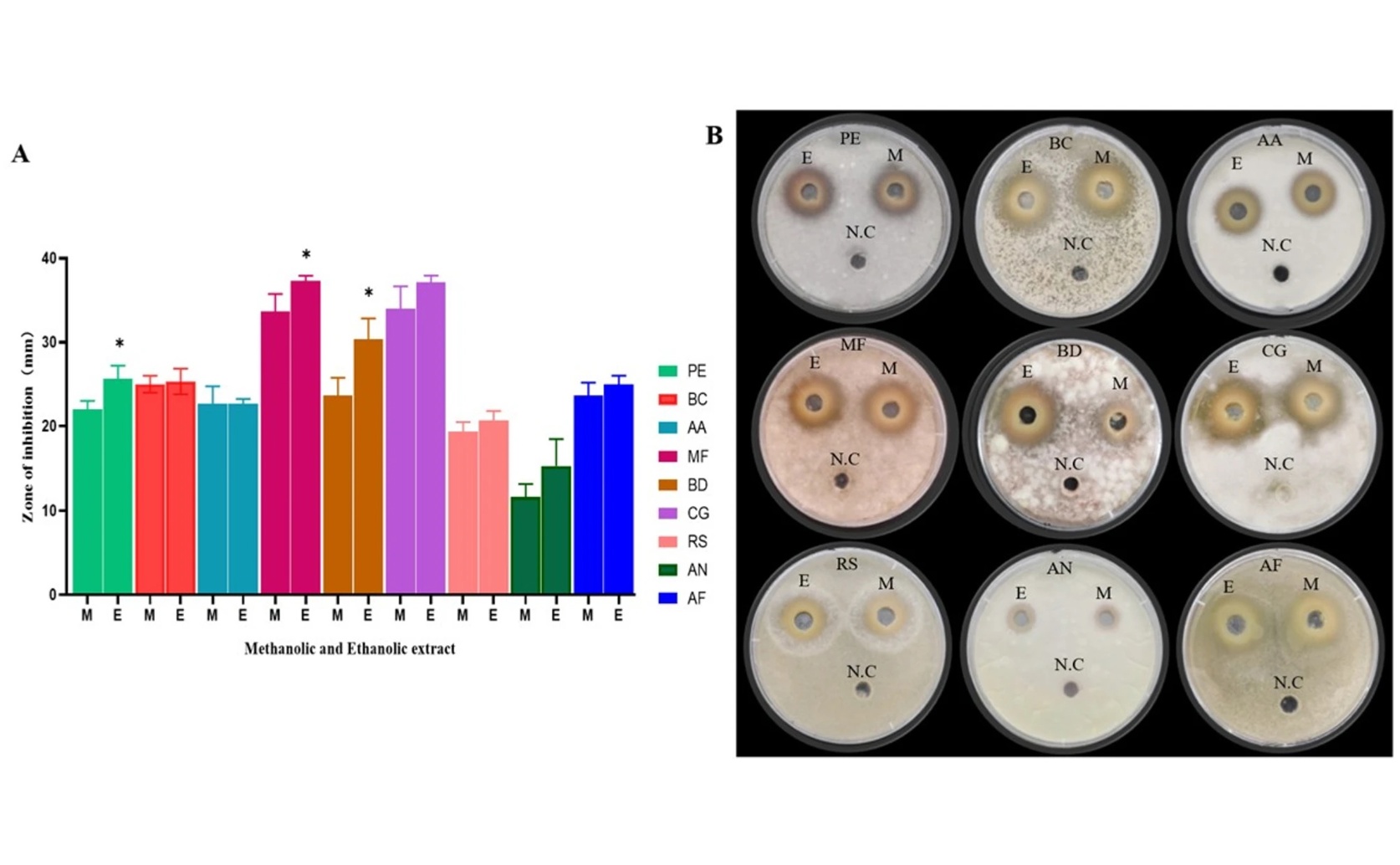
Ethanolic extracts from pomegranate peel were more effective at inhibiting the growth of nine postharvest fungal pathogens than methanolic extracts, showing significantly greater activity against Penicillium expansum, Monilinia fructicola, and Botryosphaeria dothidea.

Image adapted from: Nawaz et al. / CC BY (Source)

Key Findings

  • Researchers in China discovered that extracts from pomegranate peels can naturally prevent common fruit spoilage fungi
  • The most effective extract was the n-hexane fraction, which inhibited a wide range of fungal growth
  • They identified 36 natural compounds in the extract, including new ones like nobiletin, which showed strong antifungal effects
Postharvest diseases in fruits lead to significant economic losses and reduce the quality of produce available to consumers. Traditional chemical fungicides, while effective, raise concerns about environmental impact and human health. This has driven research into safe, natural alternatives to control these diseases. A recent study by the Chinese Academy of Agricultural Sciences[1] explores the potential of pomegranate peel extracts (PPE) as a natural antifungal agent to address this issue. The study focused on evaluating the antifungal properties of PPE against nine pathogenic fungi that commonly affect fruits after harvest. Researchers employed various extraction methods to obtain different fractions of pomegranate peel, ultimately identifying the n-hexane partitioned fraction of the ethanolic extract as the most effective in inhibiting fungal growth. This fraction demonstrated broad-spectrum antifungal activity, making it a promising candidate for postharvest disease management. To understand the active components responsible for this antifungal effect, the study utilized advanced analytical techniques. High-performance liquid chromatography coupled with quadrupole time-of-flight tandem mass spectrometry (HPLC-QTOF-MS) was employed to identify and quantify the polyphenolic compounds within the extracts. A total of 36 polyphenols were detected, including ten newly discovered compounds specific to pomegranate peel. Notably, nine of these polyphenols were found in relatively high concentrations in the n-hexane fraction, highlighting their significant role in the observed antifungal activity. Among the identified compounds, nobiletin stood out for its strong inhibitory effects against several fungi, including Colletotrichum gloeosporioides, Rhizopus stolonifer, and Aspergillus niger. These fungi are notorious for causing diseases such as anthracnose, which affects a wide range of fruits, leading to decay and spoilage. Salidroside and cinnamic acid also showed considerable antifungal activity, targeting specific pathogens like Monilinia fructicola and Alternaria alternata, respectively. Additionally, caffeic acid and protocatechuic acid were effective at lower concentrations against Penicillium expansum, another significant postharvest pathogen. This research builds on previous studies that have highlighted the rich polyphenolic profile of pomegranate byproducts. For instance, a study identified 50 polyphenols in pomegranate husk, including nine newly discovered compounds, emphasizing the plant's potential in developing novel drugs and quality control methods[2]. Another review detailed the nutritional and functional properties of pomegranate peel, noting its applications as food additives and nutraceuticals, while also pointing out challenges related to its astringency and anti-nutritional properties[3]. Additionally, earlier research demonstrated the antifungal activity of specific pomegranate phenolics like punicalagin, which showed effectiveness against both plant and human fungal pathogens by targeting essential enzymes[4]. The current study advances this body of knowledge by not only confirming the antifungal potential of pomegranate peel but also by identifying new compounds that enhance its efficacy. The use of the n-hexane fraction proved particularly beneficial, as it concentrated the most active polyphenols, thereby increasing the extract's overall antifungal strength. This approach aligns with previous findings but extends them by providing a more detailed understanding of the specific compounds involved and their mechanisms of action. To achieve these results, the researchers conducted antifungal assays using methods such as the Agar Disk Diffusion Assay and minimum inhibitory concentration (MIC) evaluations. These methods allowed them to measure the extent of fungal growth inhibition and determine the effectiveness of each polyphenol. The identification of the compounds was meticulously carried out using HPLC-QTOF-MS in negative electrospray ionization mode, ensuring accurate detection and characterization of the polyphenols. The implications of this study are significant for the agricultural and food industries. By utilizing PPE, especially the n-hexane fraction, it is possible to develop natural and effective treatments for postharvest diseases, reducing reliance on synthetic fungicides. This not only promotes safer agricultural practices but also adds value to pomegranate byproducts, which are often considered waste. Furthermore, the identification of specific polyphenols opens avenues for the development of targeted antifungal agents that can be tailored to combat specific pathogens. In conclusion, the research conducted by the Chinese Academy of Agricultural Sciences provides compelling evidence for the use of pomegranate peel extracts as a natural antifungal agent. By leveraging the rich polyphenolic content of pomegranate peels and identifying key active compounds, this study offers a sustainable and effective solution to managing postharvest diseases in fruits. Future studies may focus on optimizing extraction methods, enhancing the stability and efficacy of these natural extracts, and exploring their applications in different agricultural settings to fully harness their potential.

MedicineAgricultureBiochem

References

Main Study

1) Integrated evaluation of antifungal activity of pomegranate peel polyphenols against a diverse range of postharvest fruit pathogens

Published 15th April, 2025

https://doi.org/10.1186/s40643-025-00874-9


Related Studies

2) Qualitative Analysis of Polyphenols in Macroporous Resin Pretreated Pomegranate Husk Extract by HPLC-QTOF-MS.

https://doi.org/10.1002/pca.2695


3) Pomegranate peel and peel extracts: chemistry and food features.

https://doi.org/10.1016/j.foodchem.2014.11.035


4) Antifungal Activity and DNA Topoisomerase Inhibition of Hydrolysable Tannins from Punica granatum L.

https://doi.org/10.3390/ijms22084175


Related Articles

An unhandled error has occurred. Reload 🗙