
How Environment Helps Populations Survive Through Drug Resistance
Jim Crocker
6th April, 2025


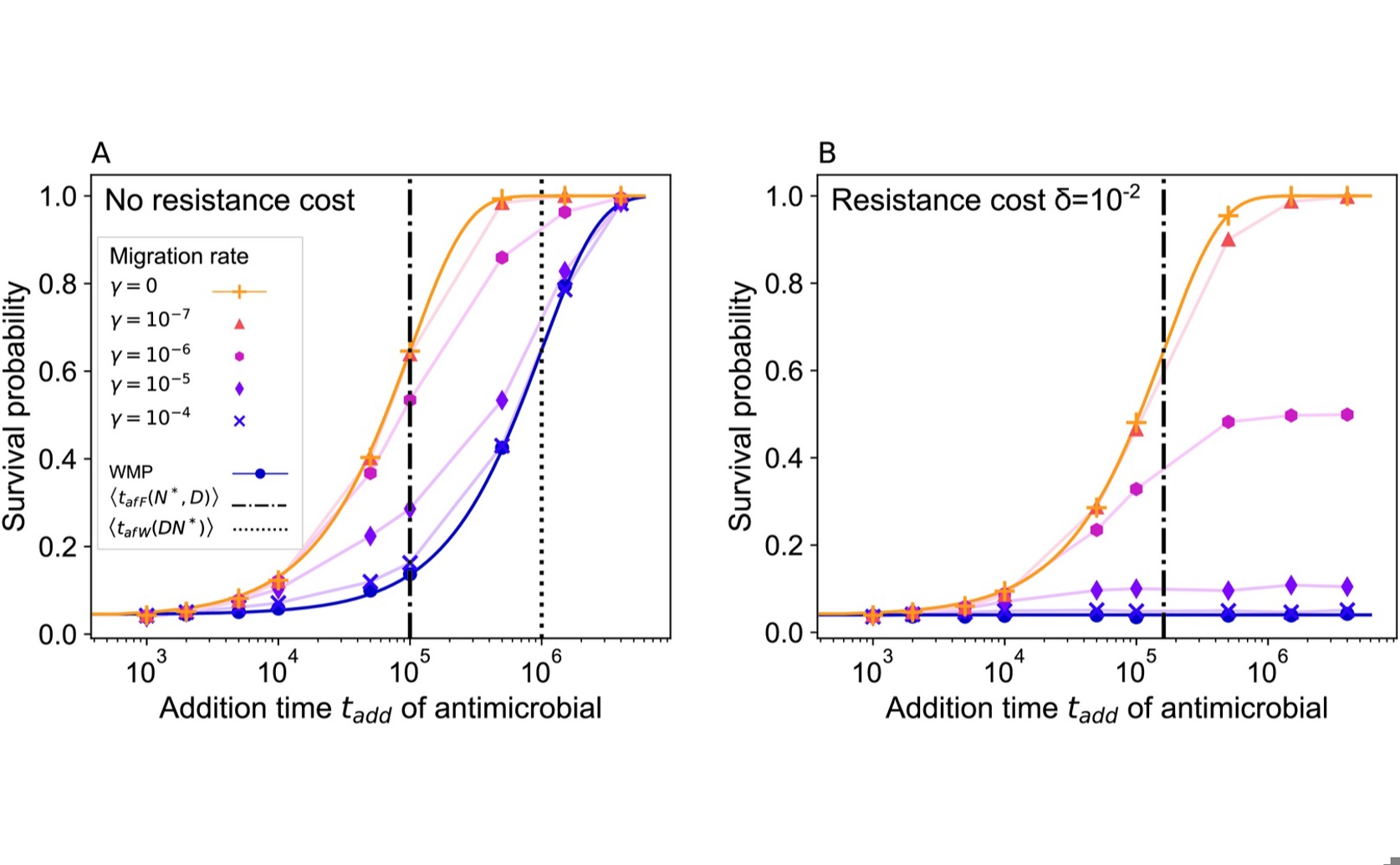
Spatially structured bacterial populations show a significantly higher probability of surviving antibiotic treatment compared to well-mixed populations, an effect that is evident for neutral resistance mutations (a) and becomes even more pronounced when resistance carries a fitness cost (b).
Key Findings
- Researchers at EPFL discovered that bacteria living in separate groups are more likely to survive antibiotic treatments
- Smaller, isolated bacterial communities increase the chances that resistant strains develop and persist before antibiotics are introduced
- Controlling how bacteria move between these groups could be crucial in preventing the spread of antibiotic resistance
References
Main Study
1) Spatial structure facilitates evolutionary rescue by drug resistance
Published 3rd April, 2025
https://doi.org/10.1371/journal.pcbi.1012861
Related Studies
2) Spatiotemporal microbial evolution on antibiotic landscapes.
3) The effect of population structure on the emergence of drug resistance during influenza pandemics.
Journal: Journal of the Royal Society, Interface, Issue: Vol 4, Issue 16, Oct 2007
4) Population structure across scales facilitates coexistence and spatial heterogeneity of antibiotic-resistant infections.
Related Articles
 2nd April, 2025 | Jim Crocker