Improved Memory Despite Severe Sleep Loss in Sleepless Models

Jenn Hoskins
21st March, 2025

Improved Memory Despite Severe Sleep Loss in Sleepless Models

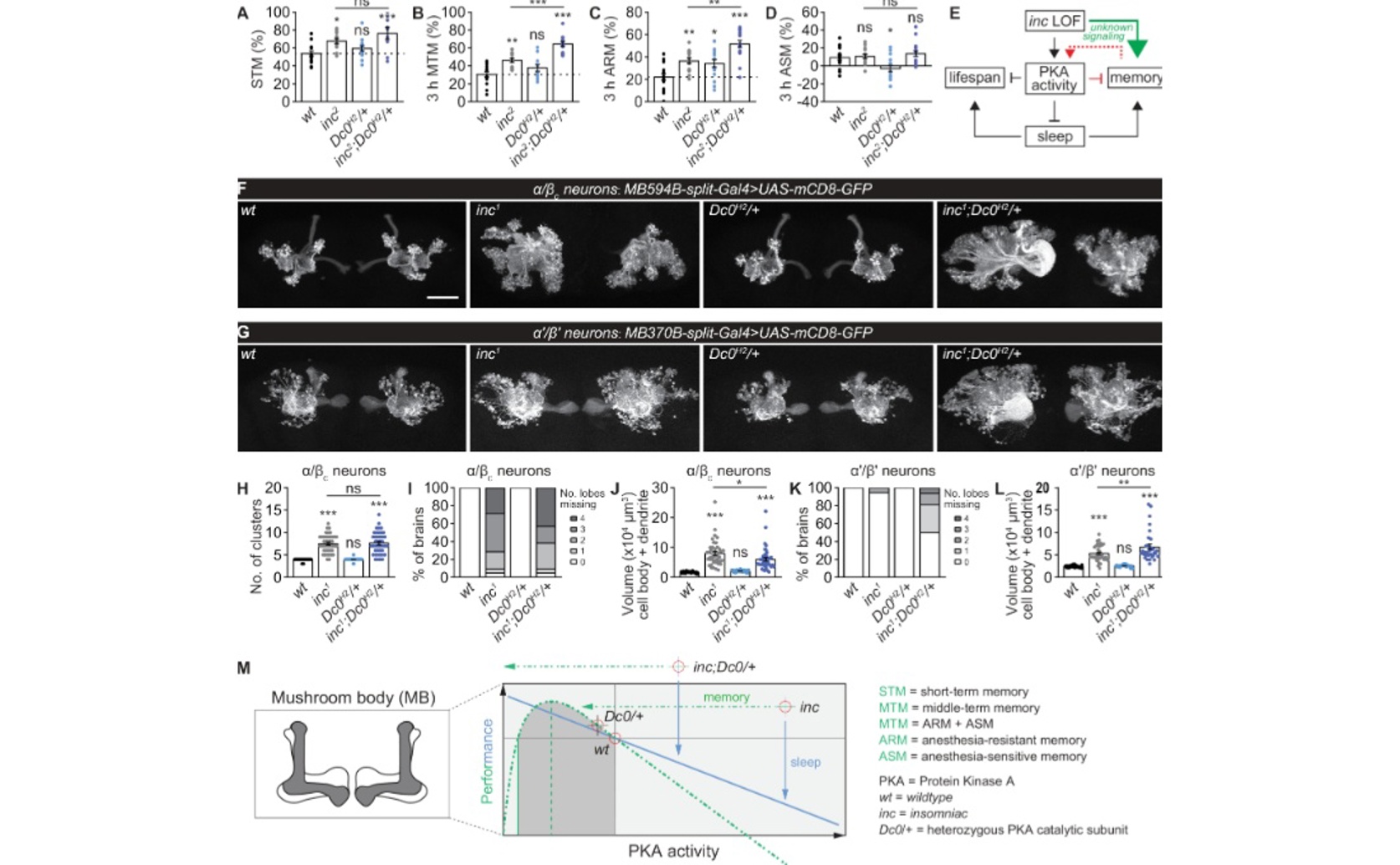
Image Source: © Natural Science News. This image is an artistic rendition.Reducing PKA signaling in Drosophila insomniac mutants rescues sleep and longevity deficits but further enhances their already elevated olfactory memory and mushroom body overgrowth (a–d, f–l), supporting a model (e, m) in which elevated PKA activity constrains memory hyperfunction while driving the sleep loss characteristic of these mutants.

Image adapted from: Huang et al. / CC BY (Source)

Key Findings

  • *Study in Berlin found that fruit flies genetically modified to sleep less actually have better memory.*
  • *Researchers discovered that adjusting a specific protein pathway can restore normal sleep and further enhance memory.*
  • *These insights could lead to new treatments for sleep disorders and memory-related issues in humans.*
Sleep plays a vital role in maintaining cognitive functions and overall health across various species. Understanding the intricate relationship between sleep and memory has been a subject of extensive research. Traditional methods of studying sleep often involve sleep deprivation through sensory stimulation, which can introduce stress and unrelated side effects[2]. Recent advances have shifted towards genetic approaches, allowing for more precise manipulation of sleep circuits without the confounding factors associated with sensory-induced methods. A recent study conducted by researchers at Freie Universität Berlin, Charité Universitätsmedizin, and Washington University[1] delves into the genetic underpinnings of sleep and its impact on memory. The research focuses on the Drosophila insomniac (inc) mutant, a variant of the common fruit fly that exhibits significantly reduced sleep. The inc mutant lacks an adaptor protein essential for the function of the Cullin-3 ubiquitin ligase, a protein complex associated with autism. Unlike other sleep mutants that typically show normal or diminished memory capabilities, the inc mutants demonstrate enhanced Pavlovian aversive olfactory learning and memory. This unexpected improvement in memory despite reduced sleep challenges existing notions about the direct relationship between sleep deprivation and cognitive decline. To explore the mechanisms behind this phenomenon, the researchers employed a genetic modifier screen. This approach involves systematically altering specific genes to observe the resulting changes in phenotype. The screen revealed that a slight reduction in Protein Kinase A (PKA) signaling could rescue the sleep deficits and extend the lifespan of the inc mutants. However, this intervention had the unintended consequence of further enhancing memory performance and causing overgrowth in the mushroom bodies, brain regions in fruit flies responsible for learning and memory[3][4]. The study suggests that the loss of the inc gene leads to increased PKA activity, which in turn suppresses sleep. This heightened PKA signaling not only reduces sleep but also limits the excessive memory enhancements seen in the inc mutants. By modulating PKA activity, the researchers were able to balance sleep and memory functions, highlighting a crucial signaling cascade that governs these processes. This finding provides a plausible explanation for the sleep deficits observed in inc mutants, proposing that excessive memory formation can be a driving factor behind reduced sleep. This research builds upon earlier studies that utilized genetic tools in Drosophila to uncover the complexities of sleep regulation[3][4]. The fruit fly has proven to be an invaluable model organism due to its well-mapped genetics and the conservation of sleep mechanisms across species. The ability to manipulate specific genes and observe the resulting phenotypic changes offers deep insights into the fundamental functions of sleep and its integration with other biological processes such as circadian rhythms, metabolism, and aging[3]. Moreover, the study aligns with the broader understanding that sleep is not a monolithic state but consists of multiple physiological and behavioral phases that adapt to environmental demands and life history[3]. By using genetic sleep deprivation, the researchers avoided the non-specific stressors associated with traditional sleep deprivation methods[2], thereby providing clearer insights into the direct effects of sleep loss on cognitive functions. The implications of this study extend beyond basic neuroscience. Understanding the genetic and molecular pathways that balance sleep and memory could inform therapeutic strategies for sleep disorders and cognitive impairments. For instance, targeting the PKA signaling pathway might offer avenues to mitigate the negative effects of sleep deprivation on memory or to enhance cognitive functions in populations with sleep-related challenges. Furthermore, the findings challenge previous assumptions about the relationship between sleep and memory. While it has long been believed that sleep deprivation universally impairs cognitive performance, the enhanced memory observed in the inc mutants suggests that the relationship is more nuanced. This complexity underscores the importance of exploring the underlying genetic and molecular mechanisms to fully comprehend how sleep influences brain function. In summary, the study from Freie Universität Berlin and its collaborators provides significant insights into the genetic regulation of sleep and its impact on memory. By identifying the role of PKA signaling in balancing these functions, the research opens new avenues for understanding the biological basis of sleep and its critical role in cognitive health. This work not only advances our knowledge of sleep biology but also highlights the power of genetic approaches in unraveling the complexities of brain function.

HealthGeneticsAnimal Science

References

Main Study

1) Enhanced memory despite severe sleep loss in Drosophila insomniac mutants

Published 20th March, 2025

https://doi.org/10.1371/journal.pbio.3003076


Related Studies

2) Genetic sleep deprivation: using sleep mutants to study sleep functions.

https://doi.org/10.15252/embr.201846807


3) The Regulation of Drosophila Sleep.

https://doi.org/10.1016/j.cub.2020.10.082


4) The neurobiological basis of sleep: Insights from Drosophila.

https://doi.org/10.1016/j.neubiorev.2018.01.015


Related Articles

An unhandled error has occurred. Reload 🗙