Competition and Cooperation Between Algae and Bacteria When Carbon is Low

Greg Howard
11th March, 2025

Competition and Cooperation Between Algae and Bacteria When Carbon is Low

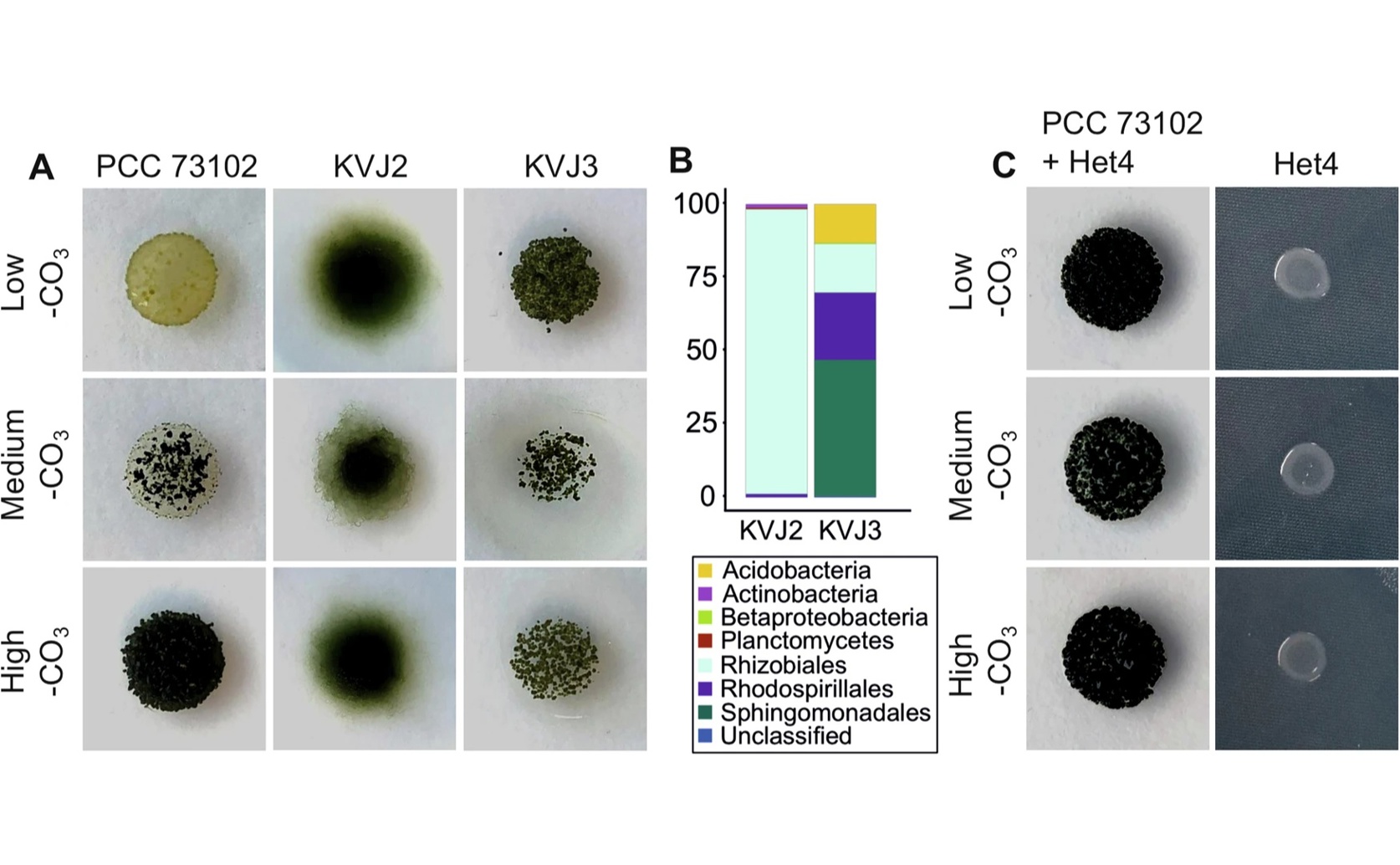
Co-culture with Agrobacterium tumefaciens Het4 rescues growth of axenic Nostoc punctiforme PCC 73102 under inorganic carbon limitation, demonstrating that heterotrophic bacteria associated with non-axenic Nostoc strains KVJ2 and KVJ3 compensate for a weak carbon-concentrating mechanism in these symbiotic cyanobacteria.

Image adapted from: Teikari et al. / CC BY (Source)

Key Findings

  • A University of Helsinki study found that Nostoc punctiforme, a vital cyanobacterium, relies on nearby bacteria when carbon is scarce
  • Under low carbon conditions, Nostoc punctiforme cannot grow alone but thrives with bacterial partners that help manage carbon and nutrients
  • The cyanobacterium’s weak carbon-fixing ability makes it dependent on these bacteria for effective carbon acquisition and survival
Cyanobacteria play a crucial role in ecosystems by fixing atmospheric nitrogen, a process essential for plant growth and ecosystem productivity[2]. Among these, Nostoc punctiforme stands out for its ability to engage in symbiotic relationships with various plants and serve as a hub for heterotrophic bacteria. A recent study conducted by researchers at the University of Helsinki[1] has shed light on the intricate dependencies within these symbiotic systems, revealing that Nostoc punctiforme relies heavily on associated heterotrophic bacteria, especially under conditions where carbon is scarce. The study compared an axenic strain of Nostoc punctiforme, which exists without any other microbial partners, with xenic strains that coexist with heterotrophic bacteria. The findings demonstrated that when carbon availability is limited, the cyanobacteria exhibit an almost obligatory dependence on these bacterial partners. This dependence is rooted in the complex interactions between Nostoc punctiforme and bacteria such as Agrobacterium tumefaciens Het4. Through techniques like shotgun proteomics and microscopy, the researchers uncovered a dynamic partnership characterized by both competition and cooperation. Specifically, while the cyanobacteria and bacteria compete for essential iron resources, they also collaborate in carbon management. One of the key discoveries of the study was the localization of the carbon-fixing enzyme RubisCO outside the main cellular compartments of Nostoc punctiforme. This suggests that the cyanobacteria possess a weak carbon-concentrating mechanism, making them less efficient at fixing carbon on their own. As a result, they become dependent on heterotrophic bacteria to facilitate carbon acquisition, highlighting a limited autonomy in their symbiotic lifestyle. This finding aligns with earlier research on symbiotic relationships, such as the association between Gunnera plants and Nostoc cyanobacteria. In Gunnera, plants secrete specific sugars to attract and maintain Nostoc colonies, ensuring a stable supply of fixed nitrogen[3]. The current study builds on this understanding by illustrating how carbon facilitation by bacteria is equally vital for the survival of Nostoc in carbon-limited environments. Furthermore, the study's insights resonate with previous research on nitrogen fixation in moss-cyanobacteria associations. While earlier studies emphasized the environmental drivers of nitrogen fixation, such as nitrogen inputs and moisture levels[2], the University of Helsinki’s research delves deeper into the metabolic dependencies that underpin these symbiotic relationships. This comprehensive approach enhances our understanding of ecosystem nitrogen cycling by revealing the nuanced roles that different microbial partners play in supporting each other's metabolic needs. The research also touches upon the competitive dynamics within these microbial communities. Similar to how moss-associated cyanobacteria compete for resources under varying environmental conditions[2], Nostoc punctiforme faces competition for iron, an essential nutrient, from its bacterial partners. However, this competition is balanced by mutual benefits, such as enhanced carbon fixation, which underscores the delicate equilibrium maintained within these symbiotic systems. This balance is crucial for the stability and functionality of ecosystems where these interactions occur. In addition to competition and cooperation for nutrients, the study highlights the spatial organization of metabolic processes within Nostoc punctiforme. The extracarboxysomal placement of RubisCO implies that carbon fixation occurs outside specialized compartments, possibly making the process more vulnerable to environmental fluctuations. This vulnerability necessitates the presence of heterotrophic bacteria that can assist in carbon acquisition, thereby reinforcing the dependence of Nostoc on its microbial partners. Such spatial arrangements are reminiscent of how other symbiotic systems, like those involving liverworts and hornworts, rely on specialized structures and interactions to facilitate nutrient exchange[4]. The findings from the University of Helsinki also offer potential explanations for the preference of certain Nostoc strains for symbiotic interactions over free-living states. By demonstrating that symbiotic Nostoc strains have limited autonomy due to their reliance on heterotrophic bacteria for carbon, the study provides a mechanistic basis for their tendency to form and maintain symbiotic relationships. This preference ensures that the cyanobacteria can thrive in environments where nutrients are limited, thereby contributing to the resilience and productivity of the ecosystems they inhabit. In summary, the University of Helsinki's research significantly advances our understanding of the symbiotic dependencies of Nostoc punctiforme. By elucidating the balance between competition and cooperation for essential nutrients and highlighting the metabolic interdependencies with heterotrophic bacteria, the study offers valuable insights into the complexity of microbial symbioses. This work not only builds upon previous studies on nitrogen fixation and symbiotic interactions[2][3][4] but also opens new avenues for exploring how microbial communities adapt to and thrive in varying environmental conditions.

EnvironmentEcology

References

Main Study

1) Competition and interdependence define interactions of Nostoc sp. and Agrobacterium sp. under inorganic carbon limitation

Published 8th March, 2025

https://doi.org/10.1038/s41522-025-00675-0


Related Studies

2) Moss-cyanobacteria associations as biogenic sources of nitrogen in boreal forest ecosystems.

https://doi.org/10.3389/fmicb.2013.00150


3) Multiple roles of soluble sugars in the establishment of Gunnera-Nostoc endosymbiosis.

https://doi.org/10.1104/pp.110.162529


4) Cyanobacteria-bryophyte symbioses.

https://doi.org/10.1093/jxb/ern005


Related Articles

An unhandled error has occurred. Reload 🗙