Genes Help Bacteria Break Down Chitin to Thrive

Greg Howard
3rd March, 2025

Genes Help Bacteria Break Down Chitin to Thrive

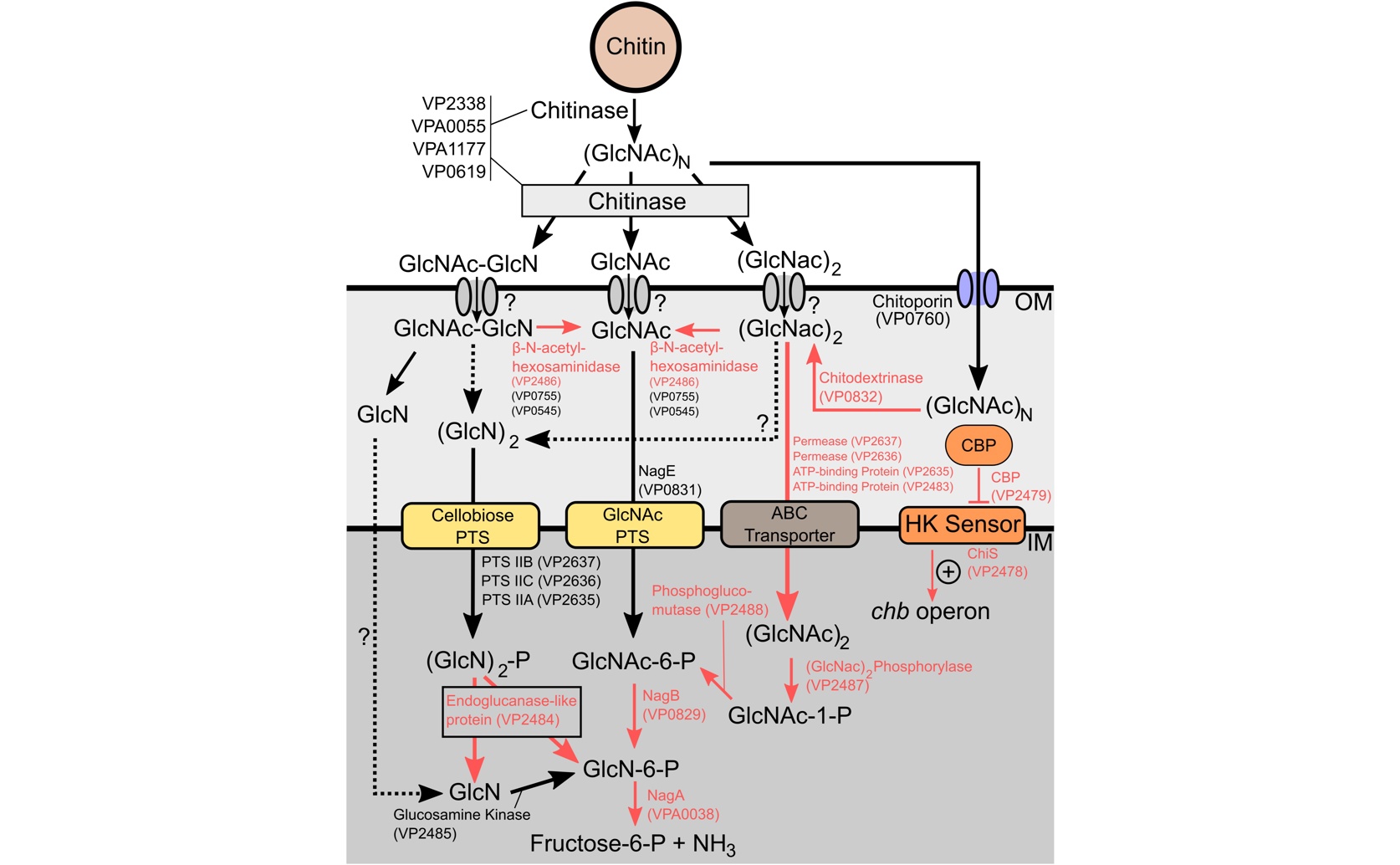
Tn-seq mapping demonstrates that a defined subset of enzymes linking chitin degradation to fructose-6-phosphate production are conditionally essential for growth on chitin in Vibrio parahaemolyticus, supporting the study’s conclusion that environmental fitness relies on a tightly integrated chitin catabolic and central carbon metabolism network.

Image adapted from: Getz et al. / CC BY (Source)

Key Findings

  • Scientists from Dalhousie University and Friedrich-Schiller-Universitat Jena identified key genes that allow Vibrio parahaemolyticus to break down chitin, crucial for recycling ocean carbon
  • They discovered a new protein that helps the bacteria absorb chitin fragments and found HexR, a regulator that controls growth, biofilm formation, and movement
  • HexR is vital for creating protective biofilms and adapting to low-nutrient environments, enhancing the bacterium's survival and competitiveness in marine ecosystems
Vibrio parahaemolyticus, a marine bacterium, plays a crucial role in the global carbon cycle by breaking down chitin, one of the most abundant natural polymers. Chitin is found in the exoskeletons of marine organisms like shrimp and crabs, and its degradation is essential for recycling carbon and nitrogen in aquatic environments[2]. Understanding how V. parahaemolyticus efficiently utilizes chitin can provide insights into its survival and competitiveness in marine ecosystems. Researchers at Dalhousie University and Friedrich-Schiller-Universitat Jena in Germany conducted a study to uncover the genetic factors that enable V. parahaemolyticus to thrive on chitin as its primary carbon source[1]. Using a technique called transposon sequencing (Tn-seq), they systematically disrupted genes in the bacterium to determine which ones are essential for growth on chitin. This approach allowed them to identify both known and previously unrecognized genes involved in chitin metabolism. The study confirmed the importance of several genes already associated with chitin degradation in Vibrio species. However, it also discovered two new critical components: an unclassified OprD-like import chitoporin and a HexR family transcriptional regulator. The OprD-like chitoporin functions as a channel in the bacterial cell membrane, facilitating the uptake of chitin breakdown products into the cell. This discovery highlights a vital import mechanism that ensures the bacterium can access the necessary nutrients from chitin. The HexR transcriptional regulator plays a multifaceted role in the bacterium's physiology. It controls various processes essential for environmental survival, including carbon assimilation, which is the conversion of carbon sources into usable forms for growth. Additionally, HexR influences biofilm formation and cell motility. Biofilms are structured communities of bacteria that adhere to surfaces, providing protection and enhancing survival in harsh conditions[3]. The ability to form biofilms on chitinous surfaces is particularly important for Vibrio species, as it allows them to colonize and compete effectively in their natural habitats. Under nutrient-limited conditions, HexR was found to be necessary for the development of filamentous cell morphology. Filamentous cells are elongated forms that can enhance the bacterium's ability to colonize surfaces and form robust biofilms[3]. This morphological adaptation provides a competitive advantage in environments where chitin particles are rapidly available and need to be efficiently exploited. The integration of these findings with previous research underscores the complexity of Vibrio's adaptation to chitin-rich environments. For instance, earlier studies have shown that Vibrio species, including V. cholerae, initiate genetic transformations when associated with chitin surfaces, enhancing their genetic diversity and adaptability[4]. The newly identified HexR regulator adds another layer to this adaptive mechanism by coordinating multiple physiological responses necessary for optimal growth and survival on chitin. Moreover, the study's identification of the OprD-like chitoporin aligns with the understanding of how bacteria manage nutrient uptake from complex polymers like chitin[2]. By facilitating the import of chitin degradation products, this protein ensures that V. parahaemolyticus can efficiently utilize available resources, reinforcing its role in the marine carbon cycle. The research also ties back to the mechanisms of pathogenicity in Vibrio species. Previous studies have highlighted the role of plasmids in disease-causing strains of V. parahaemolyticus, which carry toxins essential for infecting shrimp[5]. Although the current study focuses on environmental survival, the genetic tools and regulatory systems uncovered may also influence the bacterium's pathogenic potential, offering potential targets for mitigating disease outbreaks in aquaculture. In summary, the study from Dalhousie University and Friedrich-Schiller-Universitat Jena provides significant insights into the genetic basis of chitin utilization in V. parahaemolyticus. By identifying key genes involved in nutrient uptake and regulatory processes, the research enhances our understanding of how this bacterium competes and thrives in marine environments. These findings not only contribute to the broader knowledge of microbial ecology and carbon cycling but also open avenues for addressing challenges in shrimp farming and managing Vibrio-related diseases.

GeneticsBiochemMarine Biology

References

Main Study

1) Functional genomics of chitin degradation by Vibrio parahaemolyticus reveals finely integrated metabolic contributions to support environmental fitness

Published 3rd March, 2025

https://doi.org/10.1371/journal.pgen.1011370


Related Studies

2) Bacterial chitin degradation-mechanisms and ecophysiological strategies.

https://doi.org/10.3389/fmicb.2013.00149


3) Vibrio cholerae filamentation promotes chitin surface attachment at the expense of competition in biofilms.

https://doi.org/10.1073/pnas.1819016116


4) The regulatory network of natural competence and transformation of Vibrio cholerae.

https://doi.org/10.1371/journal.pgen.1002778


5) The opportunistic marine pathogen Vibrio parahaemolyticus becomes virulent by acquiring a plasmid that expresses a deadly toxin.

https://doi.org/10.1073/pnas.1503129112


Related Articles

An unhandled error has occurred. Reload 🗙