How Changes Over Time in Sorting and Evolution Affect Community Dynamics

Greg Howard
1st January, 2025

How Changes Over Time in Sorting and Evolution Affect Community Dynamics

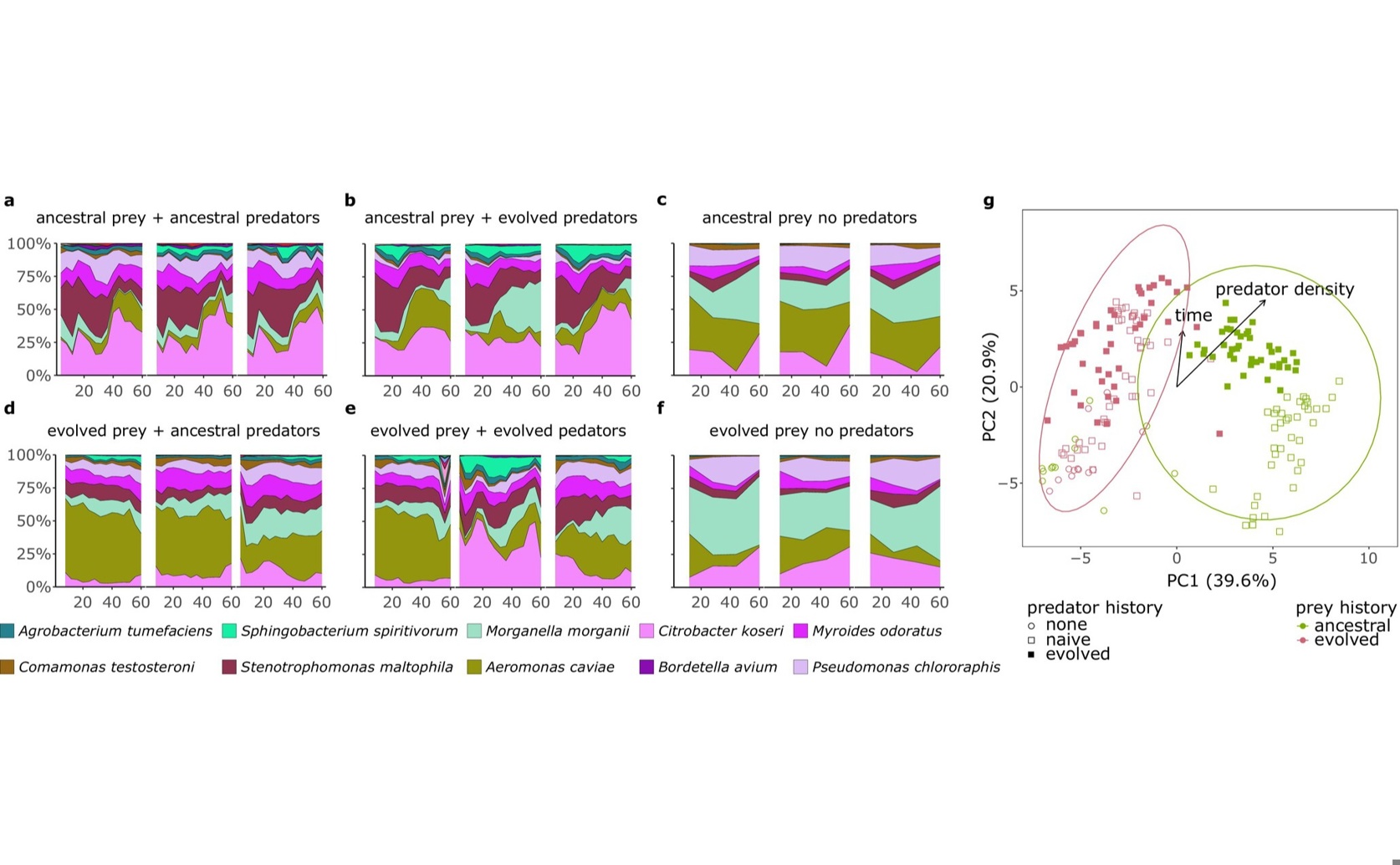
The bacterial community's composition was primarily determined by the prey's evolutionary history, with ancestral and evolved communities forming distinct groups (g) and following different compositional trajectories over time (a–f), demonstrating how past evolution shapes current ecological dynamics.

Image adapted from: Hoffmann et al. / CC BY (Source)

Key Findings

  • The study by the University of Konstanz, Germany, examined bacterial communities under predation pressure over 60 days
  • Species sorting increased the community's carrying capacity by favoring bacteria better adapted to predators
  • Evolutionary changes within species led to decreased anti-predator defenses, showing adaptation without heightened defenses
Understanding how ecological and evolutionary processes shape communities is critical for predicting how ecosystems respond to environmental changes. A recent study by researchers at the University of Konstanz, Germany, has shed light on the interplay between species sorting and evolutionary changes in bacterial communities under predation pressure[1]. This study explores how these processes contribute to community dynamics over time, providing insights into the mechanisms that structure ecosystems. The study observed bacterial communities consisting of 24 species over a 60-day period, with a focus on the effects of a ciliate predator. The researchers aimed to disentangle the contributions of species sorting (the process where certain species thrive while others decline based on environmental conditions) and evolutionary changes (genetic adaptations within species) to the overall community dynamics. One of the key findings was that species sorting played a significant role in increasing the community's carrying capacity—the maximum population size that the environment can sustain. This was evident as certain bacterial species that were better adapted to the presence of the predator became more dominant over time. On the other hand, evolutionary changes within species led to decreased anti-predator defenses, suggesting that these bacteria were adapting to the predator in ways that did not necessarily involve heightened defense mechanisms. Interestingly, the relative importance of species sorting and evolutionary changes shifted throughout the study period. If the initial trait variation within the bacterial community aligned with the direction of selection imposed by the predator, species sorting was the dominant process. However, when the initial traits were not well-matched to the selective pressures, evolutionary changes within species took precedence in driving phenotypic changes. This study also highlighted the influence of phenotypic match-mismatch combinations between predator and prey evolutionary histories on community composition, population densities, and genomic evolution. This means that the evolutionary background of both the predator and prey significantly affects how the community evolves and adapts over time. These findings integrate and expand upon previous research in several ways. For example, earlier studies have demonstrated how predator-mediated interactions can shape bacterial communities and influence ecosystem functions[2][3]. The current study builds on this by showing how both species sorting and evolutionary changes contribute to these dynamics, providing a more comprehensive understanding of the processes at play. Additionally, the study's insights into the role of evolutionary changes complement previous work on eco-evolutionary feedbacks, where evolutionary changes in organisms can influence ecological processes and vice versa[4]. By detailing the conditions under which species sorting or evolutionary changes dominate, the study enhances our understanding of these feedback mechanisms. The use of phylogenetically-conserved candidate genes (PCCGs) as a measure of biodiversity has been proposed as a way to link intra- and interspecific biodiversity to ecosystem functions[5]. The current study's findings on genomic evolution under predation pressure can be seen as a practical example of how genetic diversity within species contributes to community dynamics and ecosystem functioning. In conclusion, the study by the University of Konstanz provides valuable insights into the relative contributions of species sorting and evolutionary changes in shaping bacterial communities under predation pressure. By elucidating the conditions under which each process prevails, the research offers a deeper understanding of the complex interactions that structure ecosystems and drive their evolution.

GeneticsEcologyEvolution

References

Main Study

1) Temporal Changes in the Role of Species Sorting and Evolution Determine Community Dynamics.

Published 31st December, 2024

https://doi.org/10.1111/ele.70033


Related Studies

2) Cheating, facilitation and cooperation regulate the effectiveness of phage-encoded exotoxins as antipredator molecules.

https://doi.org/10.1002/mbo3.636


3) Predation increases multiple components of microbial diversity in activated sludge communities.

https://doi.org/10.1038/s41396-021-01145-z


4) Local adaptation in Trinidadian guppies alters ecosystem processes.

https://doi.org/10.1073/pnas.0908023107


5) Phylogenetically-conserved candidate genes unify biodiversity-ecosystem function relationships and eco-evolutionary dynamics across biological scales.

https://doi.org/10.1111/mec.17043


Related Articles

An unhandled error has occurred. Reload 🗙