
How Changes in a Protein Help Early Cell Development in Sea Urchin Embryos
Greg Howard
24th December, 2024


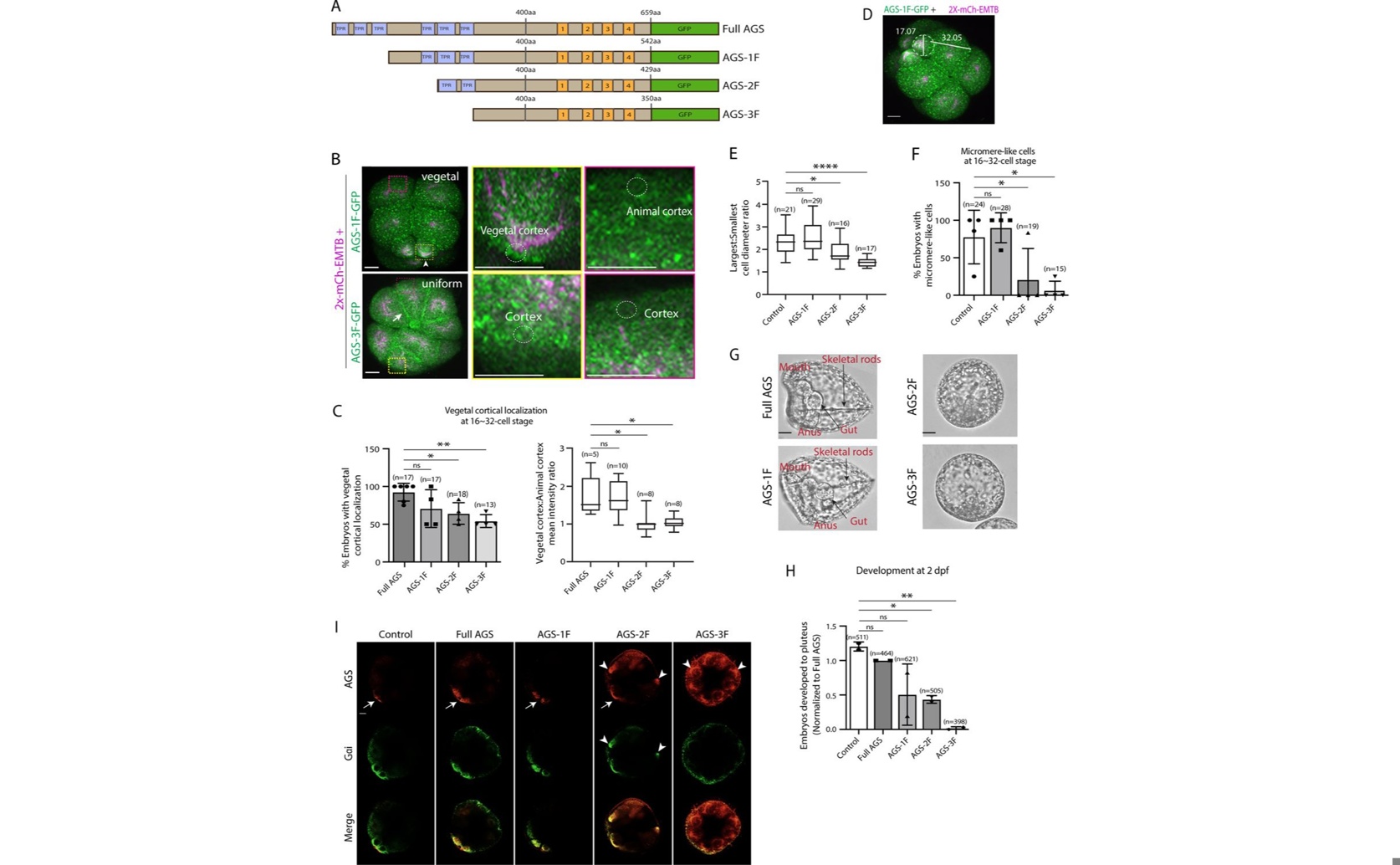
Deletion of the N-terminal TPR domain of the SpAGS protein in the sea urchin (Strongylocentrotus purpuratus) disrupts its crucial restriction to the vegetal cortex, causing uniform mislocalization (b, c, i) that prevents proper micromere formation (e, f) and subsequent embryonic development (h).
Key Findings
- Researchers at Brown University studied how sea urchin embryos develop unique cells called micromeres
- They found that a protein called AGS is crucial for forming these micromeres during the 16-cell stage
- The study showed that AGS has evolved uniquely in sea urchins, helping to create developmental diversity among echinoderms
GeneticsMarine BiologyEvolution
References
Main Study
1) The evolutionary modifications of a GoLoco motif in the AGS protein facilitate micromere formation in the sea urchin embryo.
Published 23rd December, 2024
https://doi.org/10.7554/eLife.100086
Related Studies
2) Lineage tracing shows that cell size asymmetries predict the dorsoventral axis in the sea star embryo.
3) Genome-wide use of high- and low-affinity Tbrain transcription factor binding sites during echinoderm development.
Related Articles
 23rd March, 2024 | Jim Crocker