How Genomes Change When Bacteria Adapt to Living in Nectar

Jenn Hoskins
27th December, 2024

How Genomes Change When Bacteria Adapt to Living in Nectar

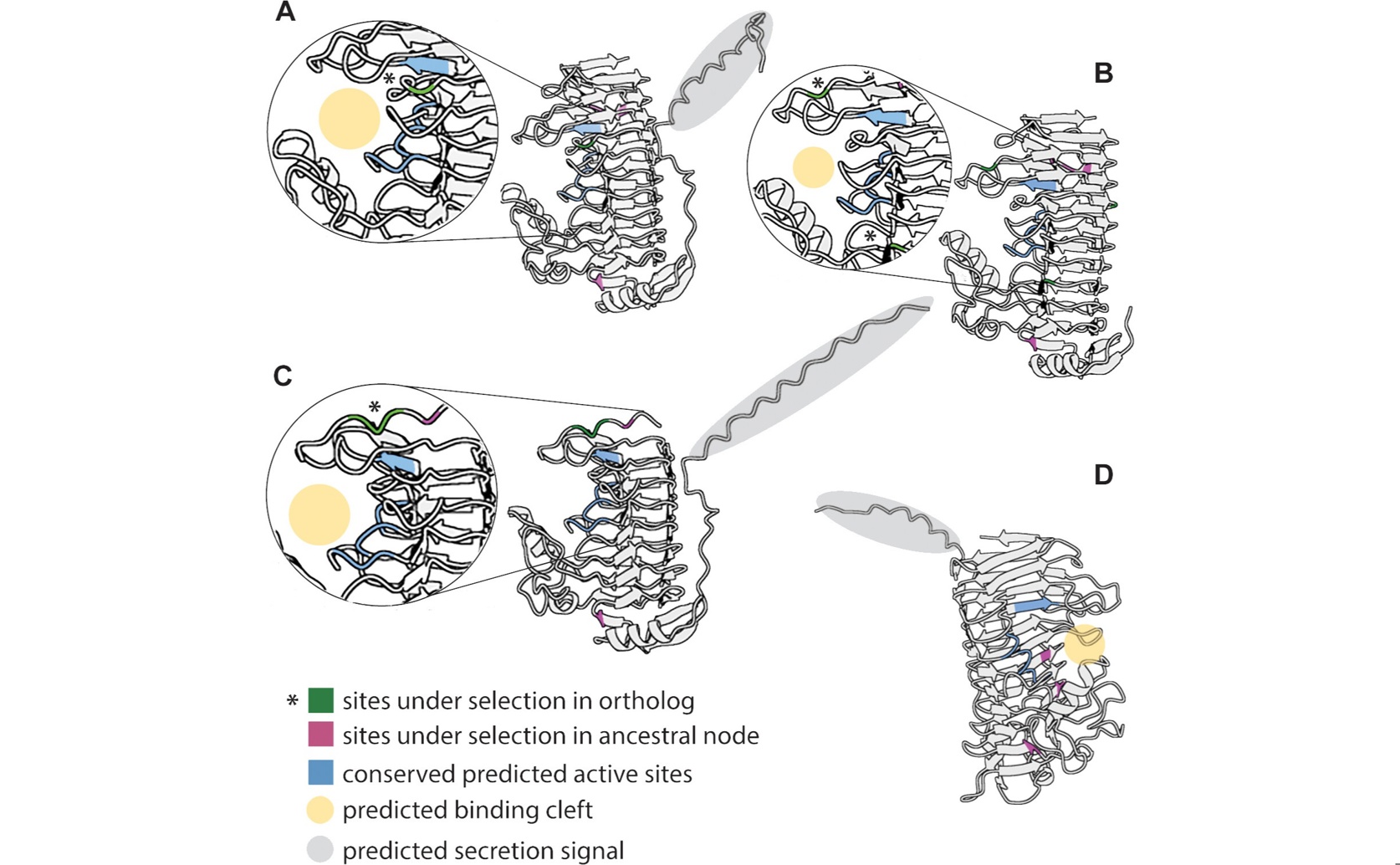
Structural models of the polygalacturonase enzyme from nectar-dwelling bacteria, including Acinetobacter pollinis (a, c, d) and Acinetobacter apis (b), reveal that sites under positive evolutionary selection are concentrated near the enzyme's active binding cleft, indicating a key adaptation for accessing nutrients in floral nectar.

Image adapted from: Sanchez et al. / CC BY (Source)

Key Findings

  • The study from Cornell University examined how Acinetobacter bacteria adapt from soil to floral nectar environments
  • Nectar-dwelling Acinetobacter species have smaller genomes and show dynamic gene gains and losses
  • These bacteria prefer simple sugars found in nectar and have adapted to scavenge nitrogen, crucial for survival in nutrient-limited nectar
  • Gene gains, including those for pectin degradation, result from duplication, evolutionary divergence, and horizontal gene transfer, aiding in nutrient access and adaptation
The genus Acinetobacter encompasses a diverse range of bacterial species found in various habitats, including soil, water, and host organisms. This diversity is underpinned by significant genetic variability, which allows these bacteria to adapt to different environments. However, the specific genetic changes that facilitate these habitat switches are not well understood. A recent study from Cornell University[1] sheds light on the genomic adaptations that enable Acinetobacter species to transition from soil-dwelling to thriving in floral nectar. The research team conducted a comparative genomic analysis of Acinetobacter species found in floral nectar and pollinators with those from other environments like soil and water. This comparison aimed to identify the genomic changes associated with this ecological shift. The study discovered that the nectar-dwelling Acinetobacter species underwent a reduction in genome size and experienced dynamic gene gains and losses as they adapted to their new environment. One significant finding was the shift in metabolism. Nectar-dwelling Acinetobacter species showed a preference for metabolizing monosaccharides, simple sugars commonly found in nectar, over a diverse range of carbohydrates. Additionally, these bacteria adapted to scavenge nitrogen sources, which is advantageous in the nutritionally limited environment of nectar. These metabolic shifts are indicative of the specialized adaptations required to thrive in floral nectar. Gene gains in nectar-dwelling Acinetobacter were found to result from duplication events, evolutionary divergence, and horizontal gene transfer (HGT). HGT refers to the transfer of genetic material between different organisms, which can introduce new functions and traits. This process is crucial for bacterial adaptation and evolution. The study highlights the acquisition of genes for pectin degradation from plant pathogens as a key adaptation. Pectin is a complex polysaccharide found in plant cell walls, and the ability to degrade it likely provides nectar-dwelling Acinetobacter with improved access to nutrients. These pectin-degrading genes underwent duplication and are under selective pressure, suggesting their importance in the new habitat. The findings of this study align with earlier research on the genetic diversity and environmental adaptability of Acinetobacter. For instance, a previous study[2] highlighted the role of environmental perturbations in shaping the distribution of Acinetobacter species. It was observed that bovines treated with antibiotics had uniform Acinetobacter communities similar to those in humans, indicating that environmental factors significantly influence bacterial evolution and adaptation. Another study[3] identified new Acinetobacter species in floral nectar, underscoring the ecological diversity within this genus. Moreover, the role of plasmids in bacterial evolution, as discussed in another study[4], is relevant here. Plasmids are genetic elements that can carry additional traits and facilitate gene transfer between bacteria. The dynamic gene gains observed in nectar-dwelling Acinetobacter could be partly attributed to plasmid-mediated HGT, which introduces new genes and functions that aid in adaptation. In conclusion, the study from Cornell University provides valuable insights into the genetic changes that enable Acinetobacter species to transition from soil to floral nectar environments. By identifying key adaptations such as the ability to degrade pectin and shifts in metabolic pathways, the research enhances our understanding of bacterial evolution and ecological diversity. This knowledge not only contributes to the broader field of microbial ecology but also has potential implications for understanding how bacteria adapt to new and challenging environments.

GeneticsEcologyEvolution

References

Main Study

1) Genome evolution following an ecological shift in nectar-dwelling Acinetobacter.

Published 26th December, 2024

https://doi.org/10.1128/msphere.01010-24


Related Studies

2) Metagenomic assessment of the interplay between the environment and the genetic diversification of Acinetobacter.

https://doi.org/10.1111/1462-2920.13949


3) Acinetobacter nectaris sp. nov. and Acinetobacter boissieri sp. nov., isolated from floral nectar of wild Mediterranean insect-pollinated plants.

https://doi.org/10.1099/ijs.0.043489-0


4) Exploring the evolutionary dynamics of plasmids: the Acinetobacter pan-plasmidome.

https://doi.org/10.1186/1471-2148-10-59


Related Articles

An unhandled error has occurred. Reload 🗙