Social Interactions Don't Influence Mycoplasma Infections in Large Birds

Greg Howard
13th December, 2024

Social Interactions Don't Influence Mycoplasma Infections in Large Birds

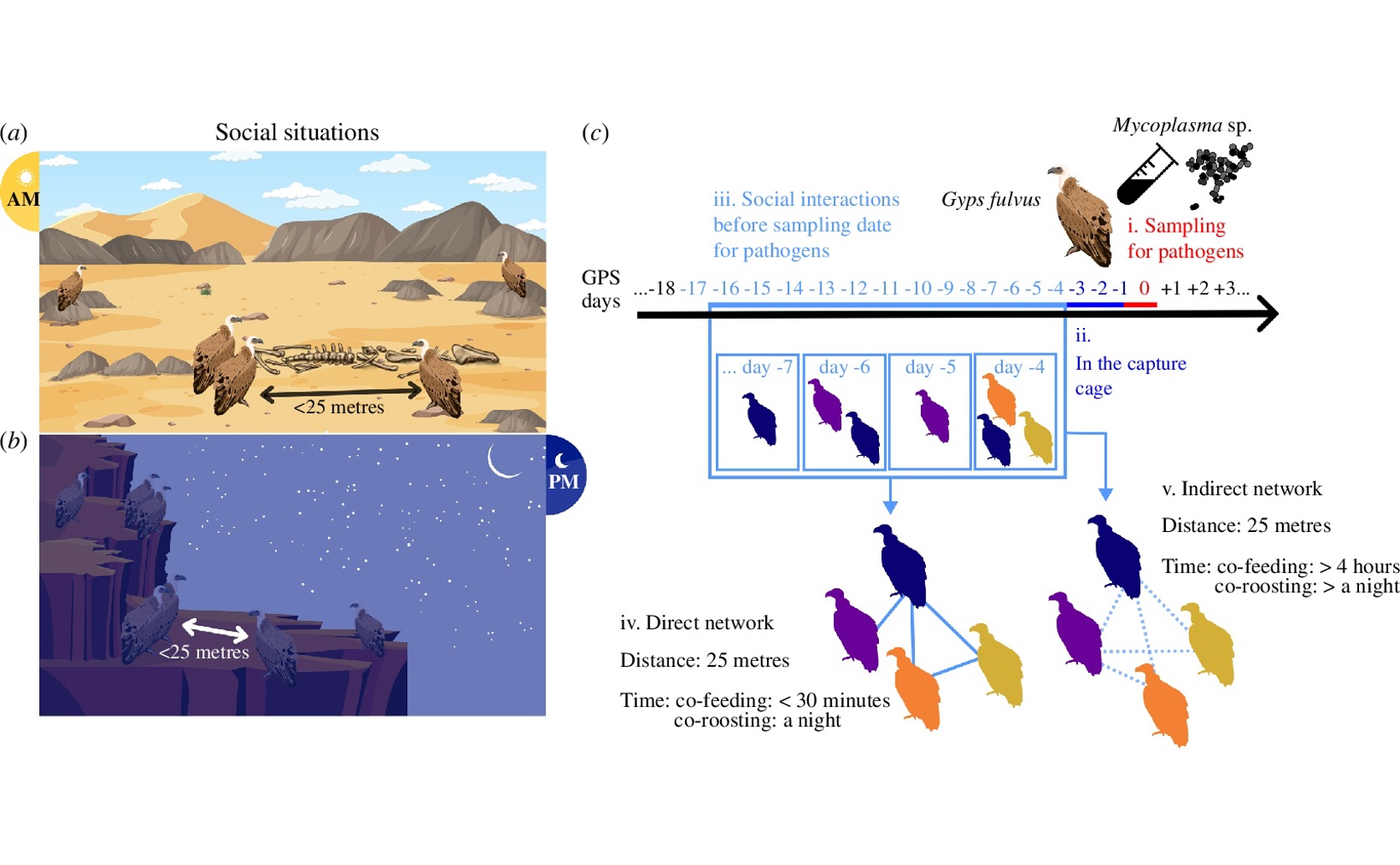
Social networks were constructed to define direct and indirect interactions of Griffon vultures (Gyps fulvus) during feeding (a) and roosting (b) over a specific time period (c) to investigate their impact on mycoplasma infection, which the study ultimately found to be non-significant.

Image adapted from: D'Bastiani et al. / CC BY (Source)

Key Findings

  • The study focused on griffon vultures in California and how their social behavior affects the spread of mycoplasma, a respiratory disease
  • Researchers used GPS tracking to observe both direct and indirect social interactions among the vultures
  • They found no significant effect of social interactions on the infection status of the vultures, suggesting other factors might influence the spread of the bacteria
Understanding how diseases spread within animal populations can help us manage and protect these populations. A recent study from the University of California Los Angeles (UCLA)[1] focused on griffon vultures (Gyps fulvus) and how their social behavior affects the spread of mycoplasma, a type of bacteria that causes respiratory diseases in birds. The researchers used high-resolution GPS tracking data to observe the social interactions of griffon vultures in different situations. They looked at direct interactions, where vultures are in the same place at the same time, and indirect interactions, where vultures use the same space at different times. Surprisingly, they found no significant effect of social interactions on the infection status of the vultures. Despite this, there was a high prevalence of mycoplasma in the population, indicating that other factors might influence the spread of the bacteria. This study ties into earlier research on disease transmission and social behavior in animals. For instance, previous studies have shown that diseases in animal populations can be influenced by complex patterns of interactions within social networks[2]. Network analysis can help quantify these interactions and their impact on disease spread, providing valuable insights for disease management. The UCLA study used similar principles but did not find a direct link between social interactions and mycoplasma infection in vultures. Another relevant aspect is the role of individual variation in disease transmission. Research has shown that individual differences in infectiousness can significantly impact outbreak dynamics[3]. Some individuals, known as superspreaders, can infect many others, leading to explosive outbreaks. The lack of a significant effect of social interactions in the vulture study suggests that individual variation or other factors might be more critical in this case. Furthermore, the study highlights the importance of considering movement ecology in disease research. Movement patterns can influence how animals interact and spread pathogens[4]. By using GPS tracking data, the researchers could accurately model the vultures' interactions and movements, providing a detailed picture of their social behavior and its potential role in disease transmission. In conclusion, the UCLA study provides valuable insights into the complex dynamics of disease transmission in wildlife. While social interactions did not significantly impact mycoplasma infection in griffon vultures, the high prevalence of the bacteria suggests that other factors are at play. This research underscores the need for a multifaceted approach to understanding and managing infectious diseases in animal populations, incorporating social network analysis, individual variation, and movement ecology.

HealthAnimal Science

References

Main Study

1) Social interactions do not affect mycoplasma infection in griffon vultures.

Published 12th December, 2024

https://doi.org/10.1098/rsos.240500


Related Studies

2) Using Social Network Measures in Wildlife Disease Ecology, Epidemiology, and Management.

https://doi.org/10.1093/biosci/biw175


3) Superspreading and the effect of individual variation on disease emergence.

Journal: Nature, Issue: Vol 438, Issue 7066, Nov 2005


4) Going through the motions: incorporating movement analyses into disease research.

https://doi.org/10.1111/ele.12917


Related Articles

An unhandled error has occurred. Reload 🗙