Blueberry Extract in Rice Milk Gel to Monitor Freshness of Chicken

Jenn Hoskins
5th November, 2024

Blueberry Extract in Rice Milk Gel to Monitor Freshness of Chicken

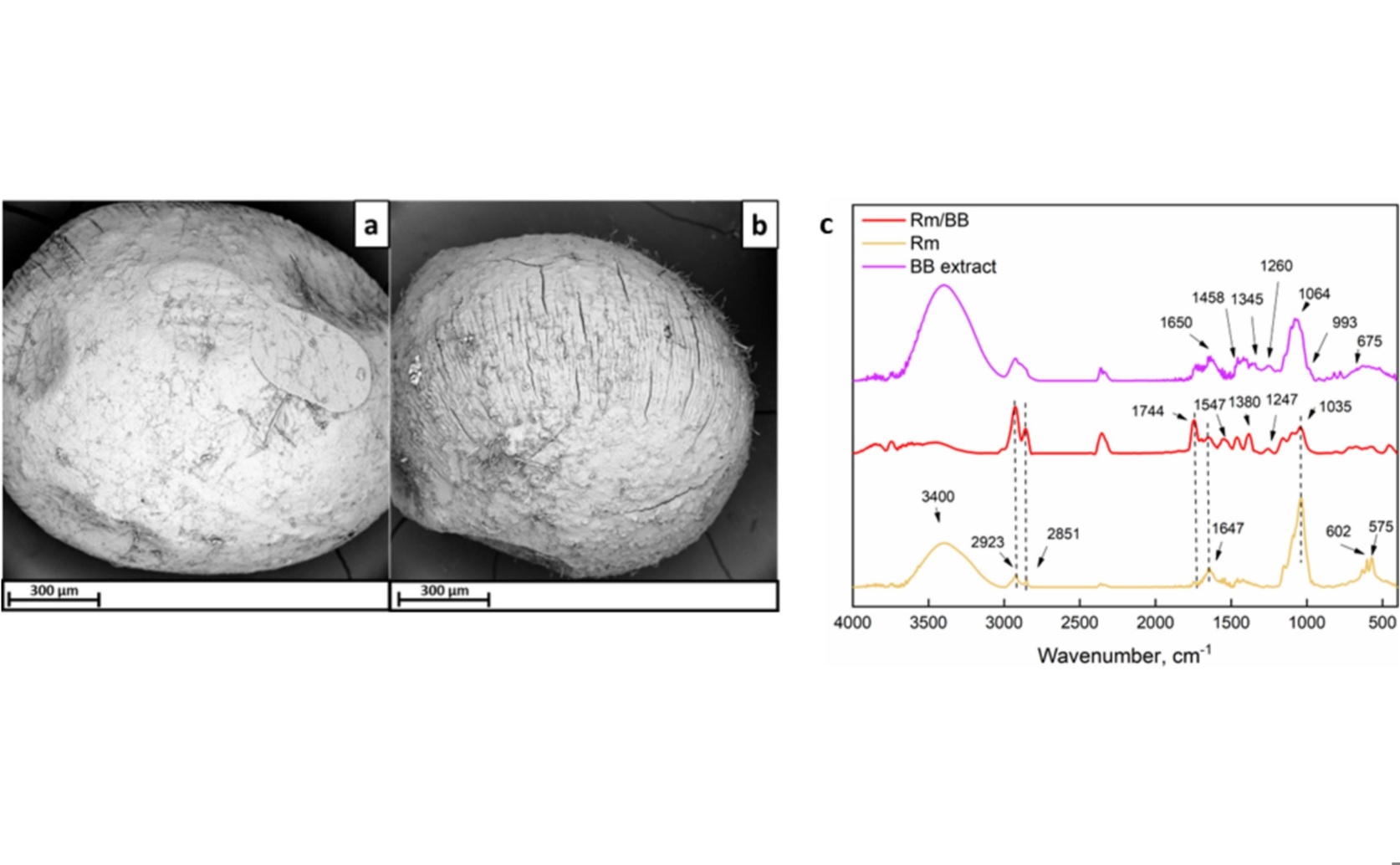
Microscopic imaging reveals that adding blueberry extract creates a rougher, more wrinkled surface on the rice milk beads (a, b), while chemical analysis confirms the extract was successfully encapsulated by showing the characteristic molecular signatures of both components in the final product (c).

Image adapted from: Viscusi et al. / CC BY (Source)

Key Findings

  • Researchers at the University of Salerno developed hydrogel beads from rice milk and blueberry skins to monitor food spoilage
  • The beads change color visibly in response to pH changes, indicating spoilage in protein-rich foods like minced chicken breast
  • The beads remained stable and functional for up to 28 days under various conditions, making them a sustainable and reusable packaging solution
The University of Salerno has recently conducted a study that explores the development of innovative hydrogel beads from rice milk and blueberry (BB) skins for use as pH-sensitive devices[1]. This study focuses on creating a sustainable and cost-effective solution for intelligent packaging applications, particularly in monitoring the spoilage of protein-rich food products. The encapsulation process of blueberry extract into rice milk and alginate beads was straightforward, resulting in beads that could indicate pH changes through visible color shifts. This colorimetric response was tested across various pH levels, demonstrating the beads' ability to revert to their original color, thus proving their reusability. Stability tests under accelerated aging conditions (temperatures of 4, 25, and 40 °C, and exposure to visible/UV light) showed that the beads maintained their integrity and functionality for up to 28 days, even under harsh conditions. However, it was noted that the half-life of cyanidin-3-glucoside, a key anthocyanin in blueberries, decreased at higher temperatures and under UV light. The sensitivity of the beads to ammonia (NH3) and trimethylamine (TMA), which are primary spoilage volatiles of protein food products, was also assessed. The detection limits for NH3 and TMA were found to be 22.4 ppm and 72.1 ppm, respectively. These findings are significant as they indicate that the beads can effectively detect spoilage in protein-rich foods such as minced chicken breast. The beads exhibited a visible color change from dark reddish to green/yellowish after 3-5 days, which correlates with the increased levels of amines due to food spoilage. This study builds on previous research that has explored the use of anthocyanins and biodegradable polymers for intelligent packaging. For instance, a study involving the use of soybean extract-based hydrogel beads loaded with Lambrusco grape extract demonstrated the potential of using food industry by-products to create pH-indicator devices[2]. Similarly, another study developed an intelligent indicating film using biodegradable polymers and roselle anthocyanins to monitor pork freshness, highlighting the versatility of anthocyanins in different food monitoring applications[3]. Additionally, the stability and sensitivity of anthocyanins-loaded alginate hydrogel beads were previously examined, showing that smaller beads had a longer half-life and were less prone to color changes under accelerated light exposure[4]. The current study from the University of Salerno expands on these findings by introducing a novel material combination of rice milk and blueberry skins, which are both sustainable and cost-effective. The use of rice milk and blueberry skins not only provides a biodegradable matrix but also leverages the natural pH-sensitive properties of anthocyanins found in blueberries. This approach aligns with the principles of circular economy and sustainability, as it utilizes food by-products that would otherwise go to waste. In conclusion, the research conducted by the University of Salerno presents a promising method for developing intelligent packaging solutions using bio-based hydrogel beads. These beads are capable of monitoring food spoilage through visible color changes, offering a practical and environmentally friendly alternative to traditional packaging methods. The study also underscores the potential for further innovation in this field, building on the foundational work of previous studies[2][3][4].

FruitsBiochem

References

Main Study

1) Blueberry extract loaded into rice milk/alginate-based hydrogel as pH-sensitive systems to monitor the freshness of minced chicken.

Published 2nd November, 2024

https://doi.org/10.1016/j.ijbiomac.2024.137210


Related Studies

2) Encapsulation of Grape (Vitis vinifera L.) Pomace Polyphenols in Soybean Extract-Based Hydrogel Beads as Carriers of Polyphenols and pH-Monitoring Devices.

https://doi.org/10.3390/gels8110734


3) Preparation of an intelligent pH film based on biodegradable polymers and roselle anthocyanins for monitoring pork freshness.

https://doi.org/10.1016/j.foodchem.2018.08.041


4) The potential of anthocyanin-loaded alginate hydrogel beads for intelligent packaging applications: Stability and sensitivity to volatile amines.

https://doi.org/10.1016/j.crfs.2023.100560


Related Articles

An unhandled error has occurred. Reload 🗙