Boosting Garden Cress Growth with Humic Acids Controlled by Phenolic Radicals

Jenn Hoskins
26th July, 2024

Boosting Garden Cress Growth with Humic Acids Controlled by Phenolic Radicals

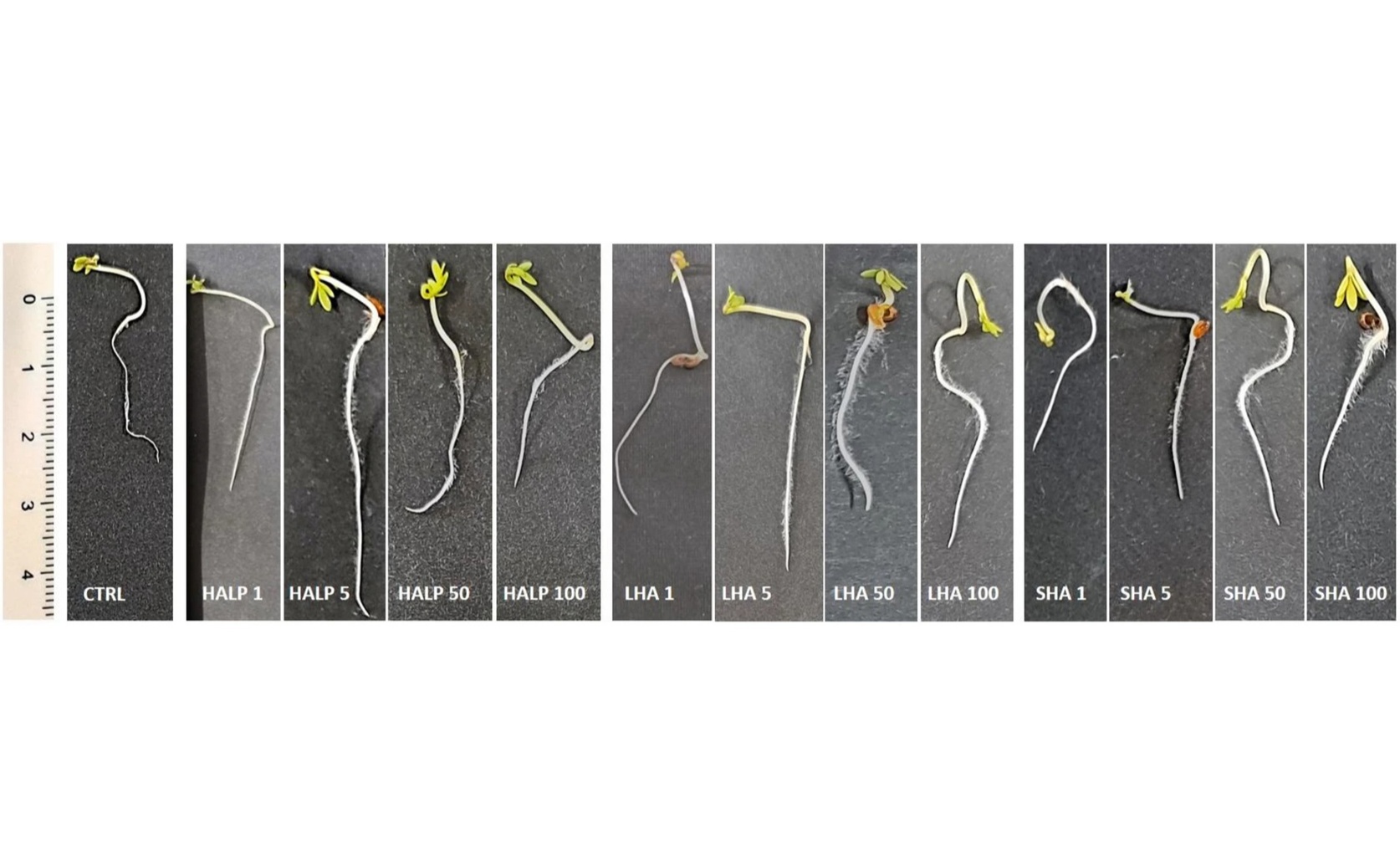
Treatment with soil-derived (SHA), lignite-derived (LHA), and synthetic (HALP) humic acids visibly enhanced root development and hair density in cress (Lepidium sativum) seedlings compared to the control, demonstrating that the optimal concentration for this biostimulatory effect depends on the humic acid's source.

Image adapted from: Vitti et al. / CC BY (Source)

Key Findings

  • The study by the University of Basilicata focused on how different sources and structures of humic acid affect the growth of garden cress
  • Both natural and synthetic humic acids positively influenced garden cress growth, but their effectiveness varied based on their source and structure
  • Natural humic acids (SHA and LHA) significantly improved root development and overall biomass production compared to the synthetic humic acid (HALP)
Humic acid (HA) has long been recognized for its beneficial effects on plant growth, but the precise mechanisms behind its bioactivity remain a topic of ongoing research. A recent study conducted by the University of Basilicata aimed to shed light on how different sources and structures of humic acid influence plant growth, specifically using Lepidium sativum (garden cress) as the model plant[1]. The researchers compared the biostimulatory effects of two natural humic acids derived from soil (SHA) and lignite (LHA) with a synthetic humic acid model (HALP) that has a known structure. Understanding the differences between these sources is crucial for optimizing HA use in agriculture and environmental management. Humic substances, which include humic acids, fulvic acids, and humin, are complex organic molecules found in soil and water. They are formed through the decomposition of plant and animal matter and play a significant role in soil fertility and plant health[2]. Recent advancements have allowed for the synthesis of artificial humic substances (A-HSs), which can be tailored for specific applications such as improving soil fertility and reducing environmental pollution[2]. The study found that both natural and synthetic humic acids positively affected the growth of garden cress, but their effectiveness varied based on their source and structure. SHA and LHA, being natural, contain a diverse range of organic compounds that interact with plant roots differently compared to the more uniform synthetic HALP. This diversity in natural HA can induce a eustress state in plants, a form of positive stress that enhances plant resilience and growth[3]. One of the key findings was that SHA and LHA significantly improved root development and overall biomass production in garden cress. This aligns with previous research showing that humic acids can act as chemical eustressors, triggering beneficial metabolic changes in plants[3]. For instance, humic acids can enhance the accumulation of essential nutrients and soluble sugars in plant tissues, leading to improved growth and stress resistance. Moreover, the study highlighted the role of humic acids in mitigating heavy metal stress. Previous research has demonstrated that humic substances can stabilize toxic metals like cadmium (Cd) in the soil, reducing their uptake by plants and thereby protecting plant health and food safety[4]. In this study, the application of humic acids likely contributed to a similar stabilization effect, although the primary focus was on growth promotion rather than heavy metal interaction. The synthetic HALP, while effective, showed a different mode of action compared to natural HAs. Its known structure allowed for more controlled experiments, providing insights into specific functional groups responsible for plant stimulation. However, the lack of diversity in synthetic HA might limit its effectiveness in complex soil environments where multiple interactions occur. In conclusion, the study by the University of Basilicata underscores the importance of understanding the source and structure of humic acids for their effective use in agriculture. Natural humic acids derived from soil and lignite offer a diverse array of benefits, including improved root development and enhanced stress resilience, making them valuable tools for sustainable agriculture. Synthetic humic acids, with their controlled structures, provide a complementary approach for targeted applications. Together, these findings contribute to a deeper understanding of how humic substances can be harnessed to support plant growth and environmental health.

AgricultureBiochemPlant Science

References

Main Study

1) Biostimulation of humic acids on Lepidium sativum L. regulated by their content of stable phenolic O⋅ radicals

Published 25th July, 2024

https://doi.org/10.1186/s40538-024-00613-w


Related Studies

2) Natural and artificial humic substances to manage minerals, ions, water, and soil microorganisms.

https://doi.org/10.1039/d0cs01363c


3) Humic acids induce a eustress state via photosynthesis and nitrogen metabolism leading to a root growth improvement in rice plants.

https://doi.org/10.1016/j.plaphy.2021.02.043


4) Humic + Fulvic acid mitigated Cd adverse effects on plant growth, physiology and biochemical properties of garden cress.

https://doi.org/10.1038/s41598-021-86991-9


Related Articles

An unhandled error has occurred. Reload 🗙