Understanding How Melons Absorb and Manage Phosphate Under Stress Conditions

Jenn Hoskins
24th July, 2024

Understanding How Melons Absorb and Manage Phosphate Under Stress Conditions

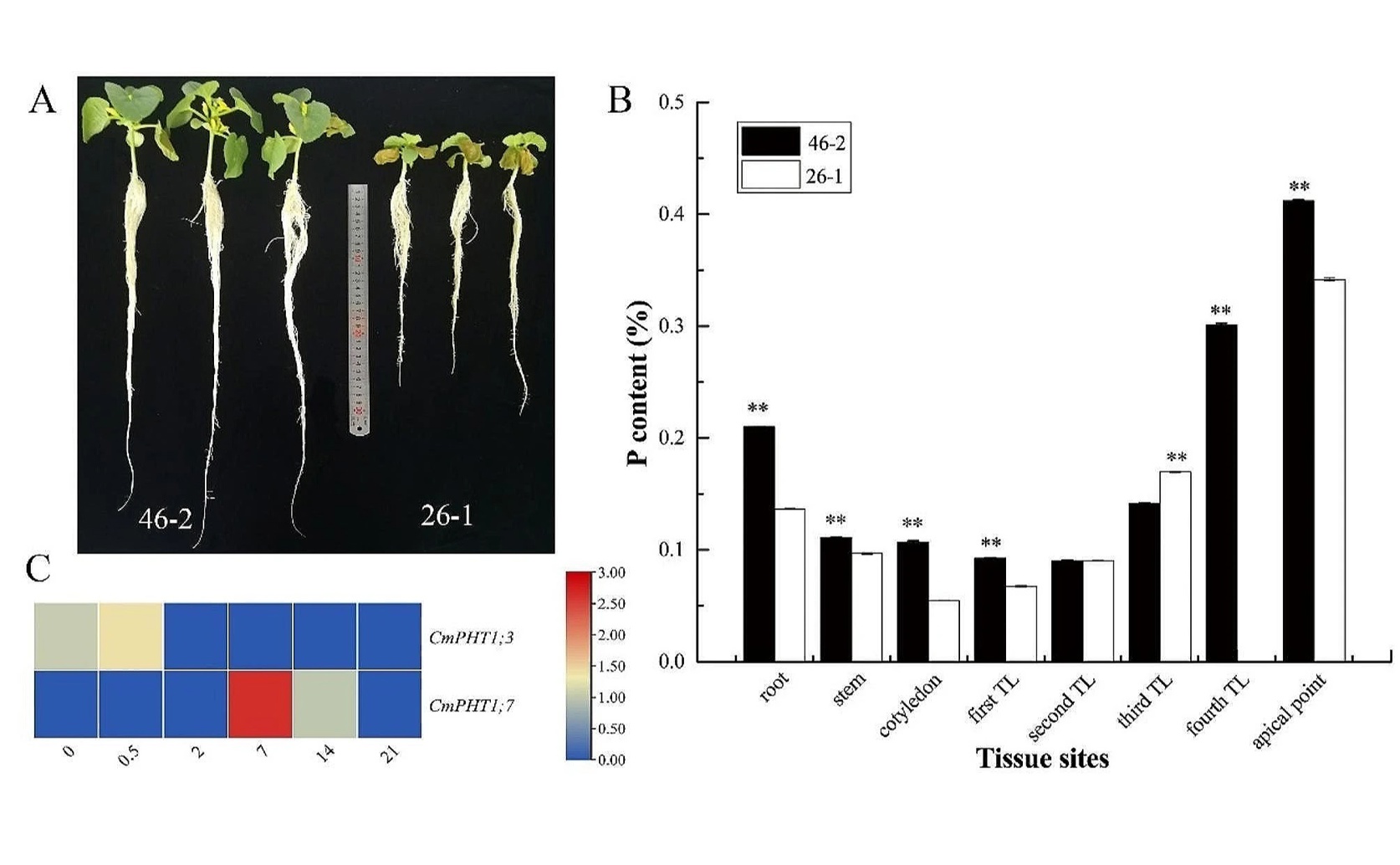
While a tolerant melon (Cucumis melo L.) cultivar exhibited better growth (a) and accumulated more phosphorus (b) under low-phosphate stress, the sensitive cultivar responded by more strongly upregulating the phosphate transporter genes CmPHT1;3 and CmPHT1;7 in its roots (c).

Image adapted from: Li et al. / CC BY (Source)

Key Findings

  • Researchers from Shanghai Jiao Tong University studied Pi transporters in melon to address phosphorus deficiency in agriculture
  • They identified seven PHT1 genes in melon and analyzed their expression under various stress conditions
  • Certain PHT1 genes were upregulated during Pi deficiency, suggesting they help the plant cope by enhancing Pi uptake efficiency
Phosphorus (P) deficiency is a significant issue affecting plant growth and agricultural productivity. Phosphate (Pi), a form of phosphorus, is crucial for various plant processes, including photosynthesis, respiration, and the synthesis of nucleic acids and proteins. However, many soils worldwide have suboptimal Pi levels, necessitating the extensive use of Pi-containing fertilizers. These fertilizers are often inefficient, polluting, and nonrenewable, prompting the need for more sustainable agricultural practices[2][3]. Recent research conducted by Shanghai Jiao Tong University has focused on addressing this problem by examining the PHT1 family of Pi transporters in melon (Cucumis melo L.)[1]. The study aims to identify and characterize these transporters, particularly their response patterns under various stress conditions, which has not been comprehensively done before. Pi transporters are proteins that facilitate the uptake of phosphate from the soil into plant roots. In many plants, these transporters are well-studied, but in melon, there has been a lack of detailed information. The PHT1 family of transporters plays a crucial role in the direct uptake of Pi by the plant’s own mechanisms, as opposed to indirect uptake, which involves symbiotic relationships with fungi[4]. Understanding these transporters in melon could lead to significant advancements in how we manage Pi deficiency in this crop. The study from Shanghai Jiao Tong University identified several PHT1 genes in melon and analyzed their expression patterns under different stress conditions, including Pi deficiency. The researchers found that certain PHT1 genes were upregulated, or increased in expression, when the plants experienced Pi deficiency. This upregulation suggests that these genes play a vital role in helping the plant cope with low Pi availability by enhancing Pi uptake efficiency. These findings build on previous research that has shown how plants adapt to Pi deficiency through complex signaling pathways and metabolic remodeling[2]. For example, plants often increase the expression of high-affinity Pi transporters and enzymes that scavenge and recycle Pi within the plant. By identifying which PHT1 genes are involved in these processes in melon, the study provides a foundation for developing melon varieties that are more efficient in Pi uptake and use. Moreover, improving Pi acquisition and use efficiency in crops is a crucial step towards reducing dependence on Pi fertilizers[3]. Strategies such as enhancing the ability of plant roots to acquire Pi and improving the remobilization of Pi within the plant are essential for sustainable agriculture. The identification of PHT1 genes in melon adds to our understanding of these strategies and offers potential targets for genetic manipulation to create more phosphorus-efficient crops. The study also highlights the importance of understanding both direct and indirect Pi uptake mechanisms. While direct uptake involves the plant’s own Pi transporters, indirect uptake relies on symbiotic relationships with fungi. Previous research has shown that the root-colonizing endophytic fungus Piriformospora indica can improve Pi nutrition in host plants under Pi-limiting conditions by using its high-affinity Pi transporter[4]. Understanding how these different mechanisms work together can provide a more comprehensive approach to managing Pi deficiency in crops. In summary, the research conducted by Shanghai Jiao Tong University has made significant strides in identifying and characterizing PHT1 genes in melon, particularly their response to Pi deficiency. These findings contribute to the broader understanding of how plants adapt to low Pi availability and offer potential pathways for developing more phosphorus-efficient crops. By building on previous studies and incorporating new insights, this research paves the way for more sustainable agricultural practices that could reduce the reliance on nonrenewable Pi fertilizers.

GeneticsBiochemPlant Science

References

Main Study

1) Characterization and stress-responsive regulation of CmPHT1 genes involved in phosphate uptake and transport in Melon (Cucumis melo L.)

Published 23rd July, 2024

https://doi.org/10.1186/s12870-024-05405-w


Related Studies

2) Recent insights into the metabolic adaptations of phosphorus-deprived plants.

https://doi.org/10.1093/jxb/eraa482


3) Molecular mechanisms underpinning phosphorus-use efficiency in rice.

https://doi.org/10.1111/pce.13191


4) Fungal association and utilization of phosphate by plants: success, limitations, and future prospects.

https://doi.org/10.3389/fmicb.2015.00984


Related Articles

An unhandled error has occurred. Reload 🗙