Understanding the genetic makeup of a wild Solomon’s seal plant

Jim Crocker
8th December, 2025

Understanding the genetic makeup of a wild Solomon’s seal plant

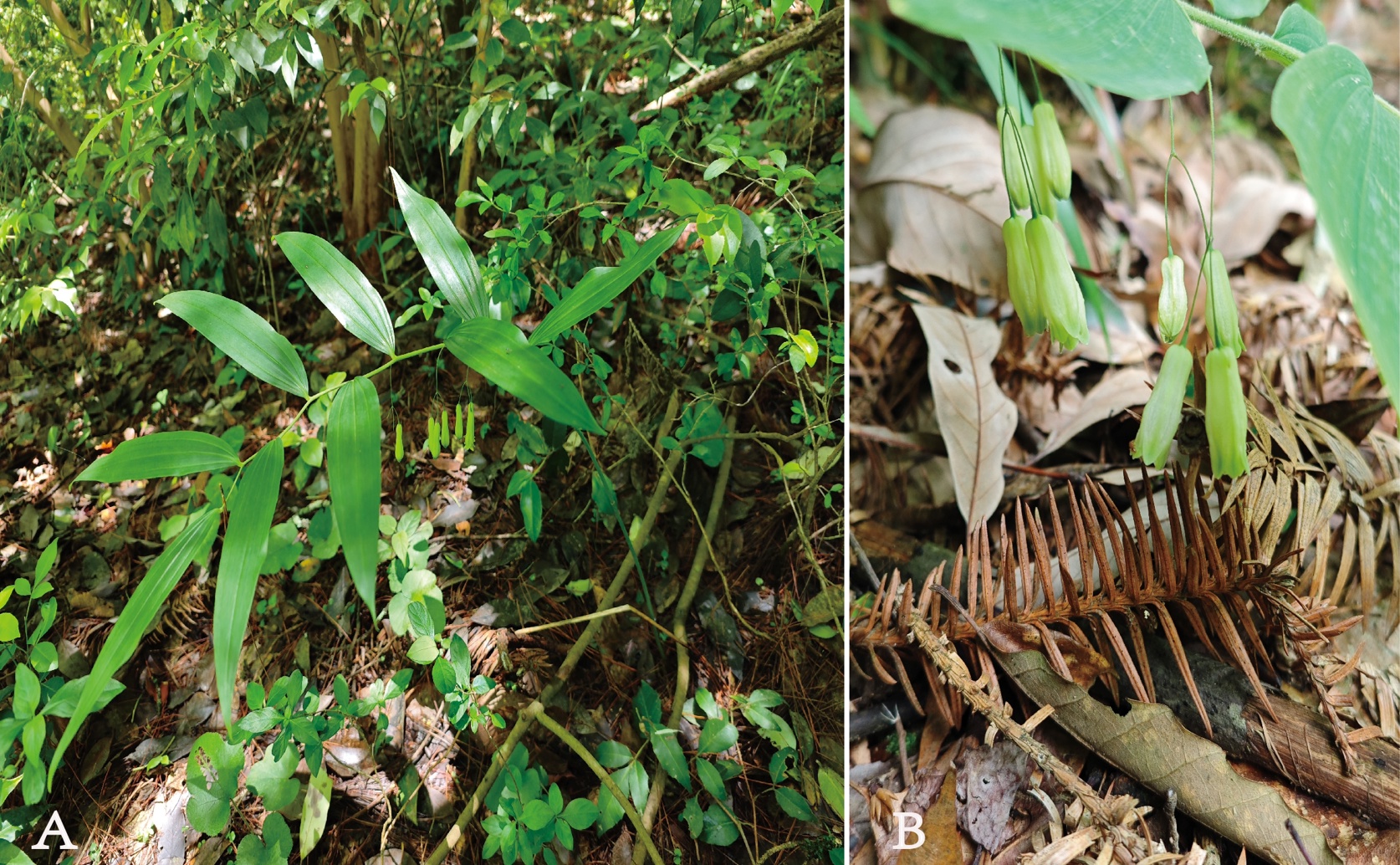
Photographs from study of Polygonatum sinopubescens (A) Habitat, (B) Inflorescence.

Image adapted from: Mo et al. / CC BY (Source)

Key Findings

  • This study analyzed the complete chloroplast genome of Polygonatum sinopubescens, a plant from Guizhou Province, China, to better understand its genetic makeup
  • Researchers found specific genes (ndhA, ycf2, accD, rbcL) were evolving rapidly, potentially helping the plant adapt to its environment
  • Phylogenetic analysis confirmed P. sinopubescens is closely related to P. filipes and supports a three-branch structure within the Polygonatum genus, aiding species identification
Polygonatum, a genus of perennial plants belonging to the Asparagaceae family, holds considerable importance both economically and medicinally. These plants, commonly known as Solomon’s seal, have a long history of use in traditional medicine, particularly in China, where the rhizome (underground stem) is valued for its purported anti-aging, anti-tumor, and immune-boosting properties[2][3]. However, identifying the correct species of Polygonatum can be challenging due to morphological similarities between different species, and even instances of adulteration – where less valuable plants are substituted for genuine Polygonatum rhizome[4]. This poses a risk to both product quality and consumer safety. Researchers from Tongren University, Tongren Polytechnic University, and the Nuclear Science and Technology Research Institute, IRAN, recently undertook a detailed analysis of the complete chloroplast genome of Polygonatum sinopubescens[1]. Chloroplasts are structures within plant cells responsible for photosynthesis, and their genome – the complete set of genetic instructions – provides valuable information about a plant’s evolutionary relationships and can be used for accurate species identification. The study aimed to understand the genetic structure of P. sinopubescens, how it differs from other Polygonatum species, and its place within the broader Polygonatum family tree. The chloroplast genome of P. sinopubescens was found to be 155,307 base pairs long, with a GC content of 37.68% (GC content refers to the percentage of the DNA sequence made up of the bases guanine and cytosine). This structure is typical for Polygonatum, consisting of a large single-copy region, a small single-copy region, and a pair of inverted repeats. The genome contains 112 genes – 78 coding for proteins, 30 for transfer RNA (tRNA), and 4 for ribosomal RNA (rRNA) – essential for the chloroplast’s function. The analysis also revealed patterns in the genetic code, including the presence of simple sequence repeats (SSRs) – short, repeating DNA sequences often used as genetic markers – and a preference for codons ending in A or T. Furthermore, the researchers identified nine regions of the genome that showed significant variation between different Polygonatum species. Importantly, they found that only a few genes – ndhA, ycf2, accD, and rbcL – were under positive selection, meaning these genes were evolving rapidly, potentially in response to environmental pressures. To determine the evolutionary relationships between P. sinopubescens and other Polygonatum species, the researchers performed phylogenetic analyses – essentially creating a family tree based on genetic data. These analyses confirmed that Polygonatum is a distinct, or ‘monophyletic’, group, and that it can be divided into three main branches. The study placed P. sinopubescens within the Polygonatum section, and found it to be most closely related to P. filipes. This research builds upon earlier work that highlighted the challenges of identifying Polygonatum species based on physical characteristics alone[4]. The use of DNA barcoding – using specific genes to identify species – was previously shown to be an effective method for distinguishing between Polygonatum and its substitutes, improving product quality and consumer safety. The detailed analysis of the complete chloroplast genome, as undertaken in this study, provides an even more robust and accurate tool for species identification and evolutionary studies. Previous research also established that the Himalaya-Hengduan Mountains (HHM) region is a key area for Polygonatum diversity, with over 50% of all species found there[5]. This study, by clarifying the phylogenetic relationships within the genus, contributes to a better understanding of how Polygonatum species diversified and spread across the Northern Hemisphere, potentially originating in the HHM region during the early Miocene epoch. The findings also support the idea that climatic changes and tectonic activity played a significant role in shaping the distribution of these plants.

GeneticsPlant ScienceEvolution

References

Main Study

1) Chloroplast genome analysis and phylogenetic position of Polygonatum sinopubescens and comparison with related species

Published 5th December, 2025

https://doi.org/10.1371/journal.pone.0338103


Related Studies

2) [Research progress in chemical constituents in plants of Polygonatum and their pharmacological effects].

Journal: Zhongguo Zhong yao za zhi = Zhongguo zhongyao zazhi = China journal of Chinese materia medica, Issue: Vol 44, Issue 10, May 2019


3) A Review of Polygonatum Mill. Genus: Its Taxonomy, Chemical Constituents, and Pharmacological Effect Due to Processing Changes.

https://doi.org/10.3390/molecules27154821


4) DNA barcoding for the efficient and accurate identification of medicinal polygonati rhizoma in China.

https://doi.org/10.1371/journal.pone.0201015


5) Out of the Himalaya-Hengduan Mountains: Phylogenomics, biogeography and diversification of Polygonatum Mill. (Asparagaceae) in the Northern Hemisphere.

https://doi.org/10.1016/j.ympev.2022.107431


Related Articles

An unhandled error has occurred. Reload 🗙