How MIG-21 Affects Gonad Movement Through Wnt and Netrin Pathways

Jim Crocker
16th September, 2025

How MIG-21 Affects Gonad Movement Through Wnt and Netrin Pathways

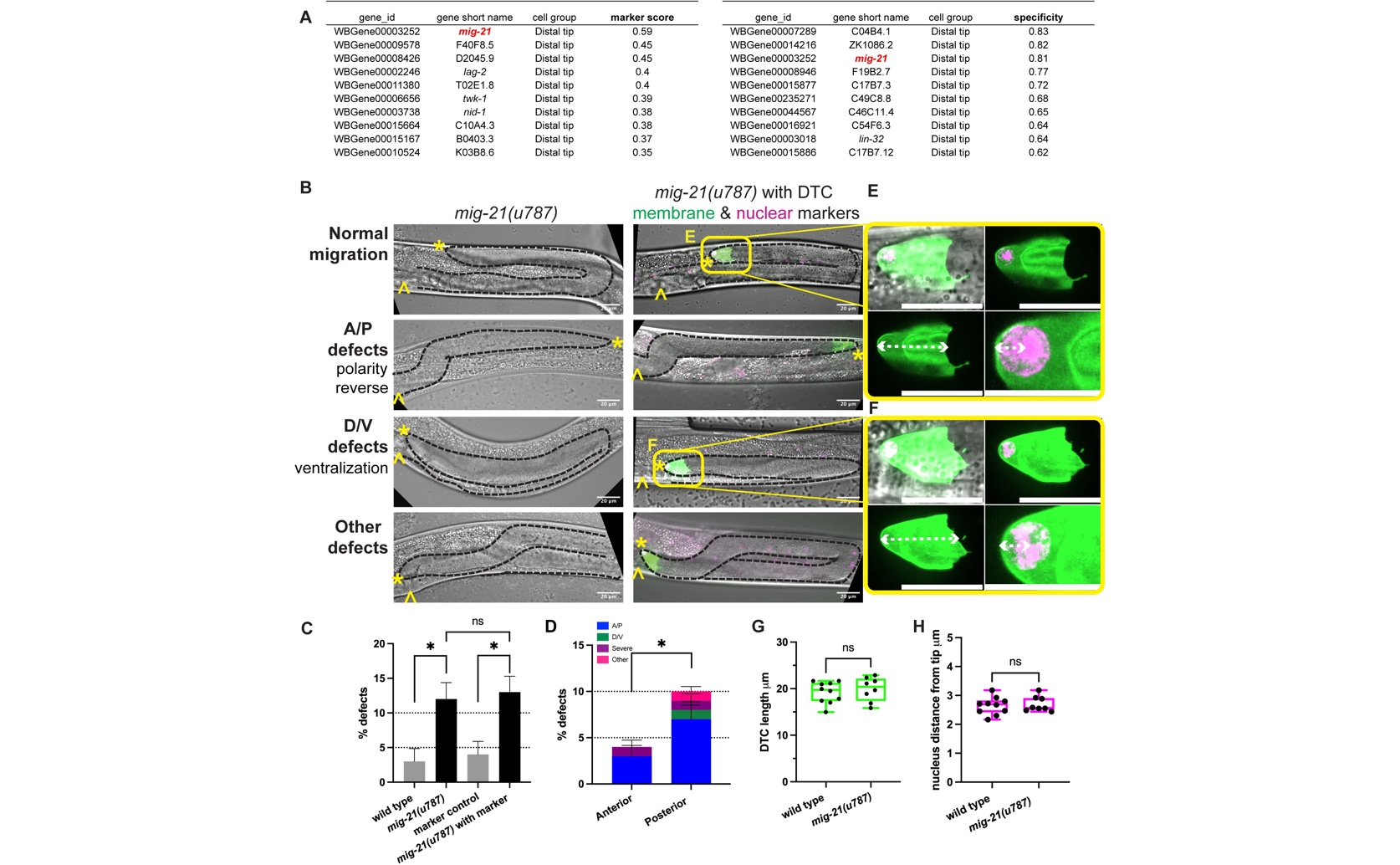
The gene mig-21 is identified as a specific marker for the Caenorhabditis elegans distal tip cell (a) and acts to regulate anterior-posterior migration polarity (b–d) without affecting cell structure or nuclear positioning (e–h).

Image adapted from: Li et al. / CC BY (Source)

Key Findings

  • In C. elegans, the mig-21 gene, previously unlinked to gonad development, plays a crucial role in germline stem cell migration
  • Loss of mig-21 function primarily disrupts anterior-posterior directional guidance of the distal tip cell (DTC), especially in the posterior gonad arm
  • mig-21 works alongside Wnt and Netrin signaling pathways to enhance their ability to direct DTC migration, rather than directly controlling cell movement
The development of organisms relies on cells moving to the correct locations and forming functional tissues. Understanding how this process is controlled is a central challenge in biology, particularly when considering organs like the gonad, which is responsible for reproduction. The gonad of the nematode worm Caenorhabditis elegans has long been a valuable model for studying cell migration and how stem cells are maintained, but its underlying genetic mechanisms were not fully understood. Researchers at the University of North Carolina at Chapel Hill, in collaboration with UNC Lineberger Comprehensive Cancer Center and the Centre National de la Recherche Scientifique (CNRS), have now used advanced techniques to uncover a previously unknown regulator of cell migration within this organ[1]. Traditionally, identifying the genes controlling complex processes like cell migration has involved systematically altering genes and observing the effects. However, this approach can be limited by redundancy – meaning multiple genes might perform similar functions, masking the effect of altering a single one. Recent advances in single-cell RNA-sequencing (scRNA-seq) offer a powerful alternative[2]. This technology allows scientists to measure the activity of every gene in individual cells, providing a detailed snapshot of their identity and function. This has led to the creation of comprehensive “atlases” of gene activity in various organisms[3], revealing previously unknown cell types and interactions. The study began with the analysis of an existing scRNA-seq dataset of adult C. elegans hermaphrodites. This analysis identified a gene called mig-21 as being highly active specifically in the distal tip cell (DTC), a crucial cell that leads the migration of germline stem cells within the gonad. Surprisingly, mig-21 hadn’t been previously linked to DTC migration, despite being known to play a role in cell migration in other developmental contexts. To investigate its function, the researchers used classical genetic techniques, RNA interference (RNAi) to reduce mig-21 activity, and live cell imaging to observe DTC behavior. They found that mig-21 doesn’t directly control the physical movement of the DTC, but instead works alongside two well-known signaling pathways: Wnt and Netrin. These pathways are critical for guiding cells to their correct destinations. The study revealed that mig-21 acts synergistically with Wnt and Netrin, enhancing their ability to direct the anteroposterior (front-to-back) and dorsoventral (top-to-bottom) phases of DTC migration. Further investigation showed that proteins known to interact with mig-21 in other cell types, such as PTP-3C, also play a role in DTC migration. This suggests a conserved mechanism of action for mig-21 across different tissues and developmental stages. Interestingly, despite being active in stationary adult DTCs, mig-21 doesn’t seem to be involved in stopping the migration process. Instead, it appears to maintain the DTC’s sensitivity to Wnt and Netrin signals, ensuring it remains responsive to its environment. The findings highlight the complexity of signaling integration in germline stem cell niche migration. The study also demonstrates the power of re-analyzing existing scRNA-seq datasets to uncover hidden genetic networks that were previously masked by traditional screening methods. As more single-cell transcriptomics studies are published[4], these datasets become increasingly valuable resources for biological discovery, allowing researchers to identify and characterize novel cell types and gene expression patterns.

GeneticsPlant ScienceEvolution

References

Main Study

1) MIG-21 interacts with Wnt and Netrin signaling in gonad migration in C. elegans

Published 15th September, 2025

https://doi.org/10.1371/journal.pgen.1011866


Related Studies

2) Review of single-cell RNA-seq data clustering for cell-type identification and characterization.

https://doi.org/10.1261/rna.078965.121


3) Whole-body gene expression atlas of an adult metazoan.

https://doi.org/10.1126/sciadv.adg0506


4) A curated database reveals trends in single-cell transcriptomics.

https://doi.org/10.1093/database/baaa073


Related Articles

An unhandled error has occurred. Reload 🗙