New films with cobalt boost food preservation and fight microbes

Jim Crocker
6th December, 2025

New films with cobalt boost food preservation and fight microbes

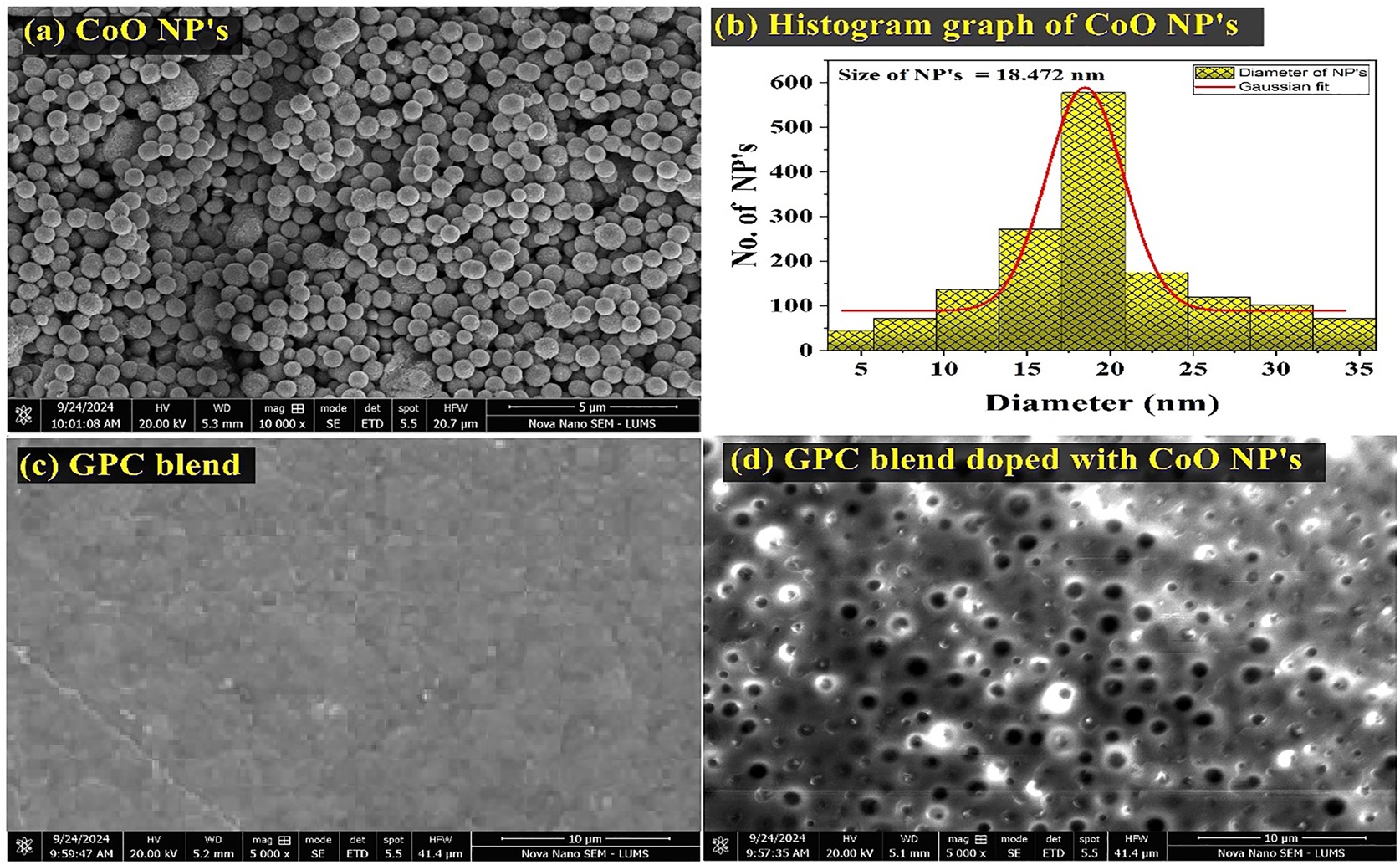
Scanning electron microscopy analysis confirms the successful fabrication of the nanocomposite, showing that the small, spherical cobalt oxide nanoparticles (a, b) are uniformly distributed throughout the smooth polymer matrix of the final film (d).

Image adapted from: Ali et al. / CC BY (Source)

Key Findings

  • Researchers in Pakistan created new food packaging films by combining gelatin, polyethylene glycol, and chitosan with cobalt oxide nanoparticles
  • Adding cobalt oxide nanoparticles up to 2.5% improved the films’ strength, flexibility, and ability to repel water, enhancing their protective qualities
  • These films effectively inhibited the growth of common foodborne bacteria like Staphylococcus aureus and Escherichia coli, and also prevented biofilm formation
Active food packaging is an increasingly important area of research, aiming to extend shelf life and reduce food waste. Traditional packaging materials often lack properties that can actively inhibit bacterial growth or respond to changes in the food environment. Researchers at Government College University Faisalabad[1] have been investigating new materials to address this need, focusing on combining natural polymers with nanoparticles to create films with enhanced protective qualities. The study focused on creating composite films using gelatin, polyethylene glycol (PEG), and chitosan, incorporating cobalt oxide nanoparticles (CoO-NPs). These materials were combined using a solution casting technique, involving mixing and sonicating the components – sonication uses sound waves to ensure even distribution of the nanoparticles. The resulting films were then thoroughly tested for their physical and chemical properties. Gelatin and chitosan are both biocompatible and biodegradable polymers, meaning they are safe for contact with food and can break down naturally[2]. However, they often lack the necessary strength and water resistance for effective packaging. Polyethylene glycol (PEG) was added to improve flexibility. Cobalt oxide nanoparticles were included for their known antibacterial and antioxidant properties. The researchers varied the concentration of CoO-NPs from 0.5% to 2.5% to determine the optimal amount for enhancing the film’s characteristics. Several techniques were used to analyze the films. FT-IR (Fourier-transform infrared spectroscopy) and XRD (X-ray diffraction) confirmed that the polymers and nanoparticles had interacted and formed a stable composite material. SEM (scanning electron microscopy) revealed the surface structure of the films, showing a smooth appearance. TGA (thermogravimetric analysis) and DMA (dynamic mechanical analysis) were used to assess thermal stability and flexibility – important factors for processing and maintaining film integrity. The results showed that adding CoO-NPs significantly improved the mechanical properties of the films. Tensile strength and flexibility increased with nanoparticle concentration, up to 2.5%. Interestingly, the films also became more water-repellent (hydrophobic) as the CoO-NP concentration increased, reducing moisture absorption and permeability. This is a crucial improvement, as water can promote bacterial growth and degrade food quality. Beyond physical properties, the films demonstrated significant antibacterial activity against both Staphylococcus aureus and Escherichia coli, two common foodborne pathogens. This builds on previous research demonstrating the antibacterial potential of similar biopolymer combinations[2]. The study also tested the films’ ability to prevent biofilm formation – a protective layer bacteria create that makes them more resistant to cleaning and antibiotics. The nanocomposite films were effective at inhibiting biofilm development. Furthermore, the films exhibited antioxidant properties, which can help prevent food spoilage caused by oxidation. The findings suggest these gelatin/PEG/chitosan films doped with cobalt oxide nanoparticles are promising candidates for active food packaging. The combination of increased strength, flexibility, reduced water permeability, and antibacterial/antioxidant properties could significantly extend the shelf life of food products. This research expands on earlier work investigating gelatin-chitosan based biomaterials[2], by incorporating cobalt oxide nanoparticles to enhance functionality. While[3] explored chromium sulfide-cobalt oxide nanocomposites for dye degradation and antibacterial purposes, this study focuses on integrating cobalt oxide directly into a food-grade polymer matrix for packaging applications. Similarly,[4] utilized metal oxides (CuO-NiO) within a hydrogel for pollutant reduction, demonstrating the potential of metal oxide nanoparticles in composite materials, although in a different context than food packaging.

NutritionBiotechBiochem

References

Main Study

1) Synthesis, antimicrobial, antioxidant studies of thermally stable nanocomposite films doped with CoO-NPs for active food packaging applications

Published 5th December, 2025

https://doi.org/10.1371/journal.pone.0338180


Related Studies

2) Antibacterial, Anti-Biofilm, and Anti-Inflammatory Properties of Gelatin-Chitosan-Moringa-Biopolymer-Based Wound Dressings towards Staphylococcus aureus and Escherichia coli.

https://doi.org/10.3390/ph17050545


3) Cr2S3-Co3O4 on polyethylene glycol-chitosan nanocomposites with enhanced ultraviolet light photocatalysis activity, antibacterial and antioxidant studies.

https://doi.org/10.1016/j.ijbiomac.2019.12.262


4) Metal nanocomposite supported on gelatin chitosan hydrogel as a catalyst for the removal of toxins.

https://doi.org/10.1038/s41598-025-08503-3


Related Articles

An unhandled error has occurred. Reload 🗙