Plant melanin helps protect flaxseed oil from spoilage

Jim Crocker
21st November, 2025

Plant melanin helps protect flaxseed oil from spoilage

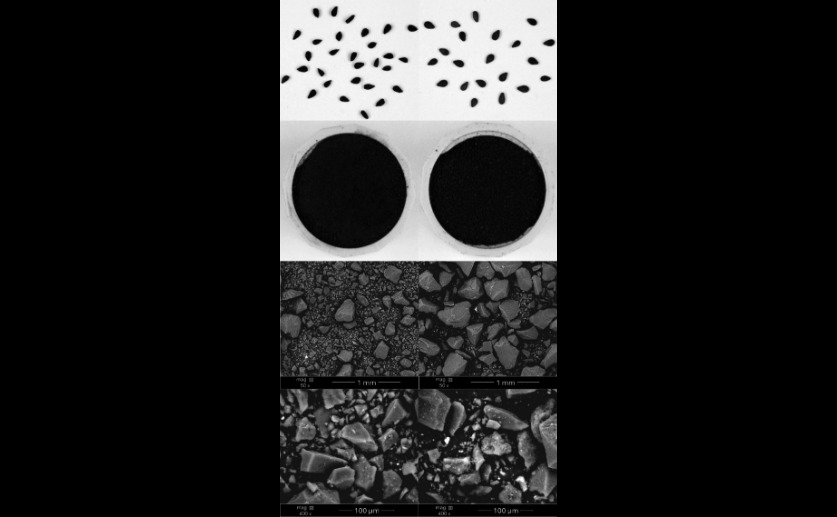
Macroscopic and SEM pictures of black cumin (left side) and black sesame (right side) isolated melanin.

Image adapted from: Dąbrowski et al. / CC BY (Source)

Key Findings

  • This study, conducted in Poland, investigated using melanin from black cumin and black sesame seeds to protect flaxseed oil during encapsulation
  • Black sesame melanin was more effective at preventing flaxseed oil oxidation under UV light and extending its initial stability compared to black cumin melanin
  • Adding melanin, particularly from black sesame seeds, slightly improved powder flowability and acted as both a light shield and antioxidant during flaxseed oil encapsulation
Flaxseed oil is a rich source of alpha-linolenic acid (ALA), a type of omega-3 fatty acid beneficial for health. However, ALA is highly prone to oxidation, a process that degrades the oil and reduces its nutritional value. Oxidation is triggered by exposure to oxygen, light, and heat. A common strategy to protect ALA is encapsulation – surrounding the oil with a protective coating. Researchers at the University of Warmia and Mazury in Olsztyn[1] investigated whether melanin extracted from black cumin and black sesame seeds could be used as part of this protective coating. The study focused on creating capsules containing flaxseed oil, using a process called spray-drying to create a powder form. Spray-drying involves turning a liquid emulsion into a dry powder by rapidly drying it with hot air. The researchers added varying amounts of melanin extract from either black cumin or black sesame to the coating material. They then assessed several characteristics of the resulting powders, including particle size, shape, how easily they flow, and crucially, their ability to prevent oxidation. Oxidation was measured using several methods. The Rancimat test measures how long it takes for oxidation to begin, providing an ‘induction period’ – a longer period indicates better stability. The DPPH and ABTS tests assess antioxidant capacity, which is the ability of a substance to neutralize free radicals that cause oxidation. Peroxide value and TBARS (thiobarbituric acid reactive substances) measure the amount of oxidation products formed after exposure to ultraviolet (UV) light, simulating sunlight exposure. The results showed that adding melanin generally didn’t significantly change the physical appearance of the powder capsules. However, it did slightly improve how easily the powder flowed. Most importantly, the study revealed differences between the two types of melanin. Black sesame melanin proved more effective at extending the induction period in the Rancimat test, meaning it provided greater initial protection against oxidation. It also reduced peroxide value by approximately 30% after UV irradiation compared to capsules without added melanin. Black cumin melanin, conversely, showed a stronger antioxidant capacity in the DPPH test. These findings build on existing knowledge about melanin’s protective properties. Melanin is a natural pigment found in many organisms, from humans to fungi and plants[2]. It’s known for its ability to absorb UV radiation and act as an antioxidant, scavenging damaging free radicals[3]. The study demonstrates that plant-derived melanin can be effectively incorporated into encapsulation materials to enhance the stability of sensitive oils like flaxseed oil. The different antioxidant activities observed between black cumin and black sesame melanin may relate to variations in their chemical composition[2]. Melanin isn’t a single molecule but a complex mixture of compounds, and the specific types of melanin (eumelanin, pheomelanin, etc.) can differ depending on the source and how they are produced[3]. The study suggests that black sesame melanin may be particularly effective at protecting against lipid oxidation, while black cumin melanin excels at neutralizing certain types of free radicals. The research confirms that plant melanin can function as both a light shield and an antioxidant within encapsulation materials, offering a natural way to preserve the quality and nutritional value of flaxseed oil. This has implications for the food industry, potentially leading to more stable and longer-lasting flaxseed oil products. Furthermore, the use of fungal melanin as a sunscreen component has already been demonstrated[4], suggesting a broader potential for melanin-based protective materials.

NutritionBiochemPlant Science

References

Main Study

1) Plant melanin as a microcapsule wall component for flaxseed oil oxidative stability improvement

Published 17th November, 2025

https://doi.org/10.1038/s41598-025-24023-6


Related Studies

2) Melanosomes: Biogenesis, Properties, and Evolution of an Ancient Organelle.

https://doi.org/10.1152/physrev.00059.2017


3) Unraveling the Structure and Function of Melanin through Synthesis.

https://doi.org/10.1021/jacs.0c12322


4) Fungal melanin as a biocompatible broad-spectrum sunscreen with high antioxidant activity.

https://doi.org/10.1039/d1ra02583j


Related Articles

An unhandled error has occurred. Reload 🗙