How tiny ocean plants sink when food is scarce

Jenn Hoskins
21st November, 2025

How tiny ocean plants sink when food is scarce

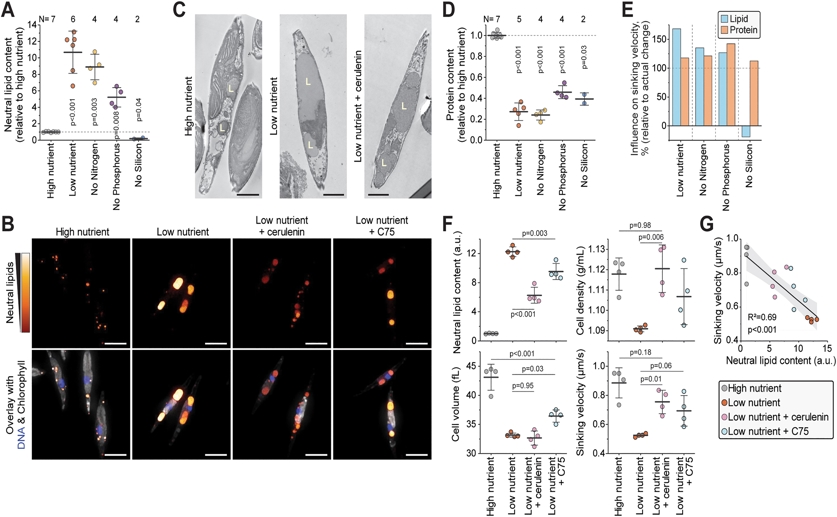
In the diatom Phaeodactylum tricornutum, starvation leads to a decrease in sinking velocity due to substantial accumulation of lipids and loss of proteins, as demonstrated by fluorescence microscopy, transmission electron microscopy, and computational modeling.

Image adapted from: Wu et al. / CC BY (Source)

Key Findings

  • This study, conducted at MIT and the University of Georgia, found most phytoplankton species sink faster when nutrients are scarce
  • The reason for increased sinking varies by species—some become denser, while others increase in volume, demonstrating adaptable strategies
  • Phytoplankton alter their internal composition—increasing starch or decreasing lipids—to control buoyancy and vertical positioning in the water
Phytoplankton, microscopic plant-like organisms, are fundamental to life on Earth. They produce roughly half of the oxygen we breathe and form the base of the marine food web. A key challenge for phytoplankton is obtaining both sunlight, which is plentiful near the ocean surface, and nutrients like nitrates and phosphates, which are more abundant in deeper, darker waters. This creates a vertical gradient where phytoplankton need to balance light capture with nutrient uptake. Traditionally, it was assumed most phytoplankton were at the mercy of ocean currents, passively drifting between these zones[2]. However, increasing evidence suggests many species actively migrate vertically to optimize their access to both resources. A recent study conducted by researchers at the Massachusetts Institute of Technology (MIT) and the University of Georgia[1] investigated how phytoplankton control their movement through the water column, specifically focusing on gravitational sinking – the natural tendency for cells to descend. The research aimed to understand the biophysical and molecular mechanisms that influence how quickly different phytoplankton species sink, and how this changes when nutrients are scarce. The study examined nine different species of pico- and nanoplankton – very small phytoplankton, measuring just a few micrometers in size. Researchers combined computer simulations with detailed measurements of cell characteristics like mass, volume, and composition. They grew the phytoplankton under both nutrient-rich and nutrient-limited (starved) conditions, then measured their sinking rates. The findings revealed that most species sank faster when starved, but the reason for this faster sinking varied considerably. For some, like Chaetoceros calcitrans, the increase in sinking speed was primarily due to an increase in cell density – essentially, the cells became heavier. In others, like Emiliania huxleyi, the change was driven by an increase in cell volume. This suggests that phytoplankton have evolved different strategies to regulate their sinking based on their species and the specific environmental conditions. Delving into the molecular level, the researchers found that changes in the contents of the cells, rather than water content, were the main driver of altered sinking rates. Specifically, the accumulation of starch – a form of stored energy – increased sinking in several green algae species. Conversely, the build-up of lipids (fats) decreased sinking in Phaeodactylum tricornutum. This is significant because it demonstrates that phytoplankton can actively alter their internal composition to fine-tune their buoyancy and control their vertical position. These findings build upon earlier work demonstrating that phytoplankton vertical migration can significantly contribute to overall ocean productivity[2]. That study suggested vertically cycling phytoplankton could be responsible for sustaining up to half of oceanic Net Primary Production (NPP) – the rate at which organic matter is created by plants. The current research helps explain how this migration is physically possible, revealing the mechanisms phytoplankton use to control their sinking. Furthermore, the study connects to observations of harmful algal blooms (HABs). Research has shown that some bloom-forming dinoflagellates actively migrate vertically to access nutrients, contributing to their exceptionally high biomass[3]. The ability of phytoplankton to regulate their sinking, as demonstrated in the MIT and University of Georgia study, provides a potential mechanism for understanding how these migrations occur and contribute to bloom formation. Global estimates of primary production, the foundation of the marine food web, consider the influence of light, nutrients, and temperature[4]. This new research adds another layer of complexity, highlighting the importance of phytoplankton’s ability to actively manage their position in the water column as a key factor influencing their growth and contribution to overall productivity. The study demonstrates that phytoplankton physiology isn’t simply a passive response to environmental conditions, but an active process of adaptation that allows them to thrive in a challenging environment.

EcologyPlant ScienceOceanography

References

Main Study

1) Diverse biophysical and molecular mechanisms drive phytoplankton sinking in response to starvation

Published 19th November, 2025

https://doi.org/10.1371/journal.pbio.3003508


Related Studies

2) Vertical migration by bulk phytoplankton sustains biodiversity and nutrient input to the surface ocean.

https://doi.org/10.1038/s41598-020-57890-2


3) Dinoflagellate vertical migration fuels an intense red tide.

https://doi.org/10.1073/pnas.2304590120


4) Primary production of the biosphere: integrating terrestrial and oceanic components.

Journal: Science (New York, N.Y.), Issue: Vol 281, Issue 5374, Jul 1998


Related Articles

An unhandled error has occurred. Reload 🗙