Deep-sea corals thrive alongside bacteria that convert sulfur into energy

Greg Howard
17th November, 2025

Deep-sea corals thrive alongside bacteria that convert sulfur into energy

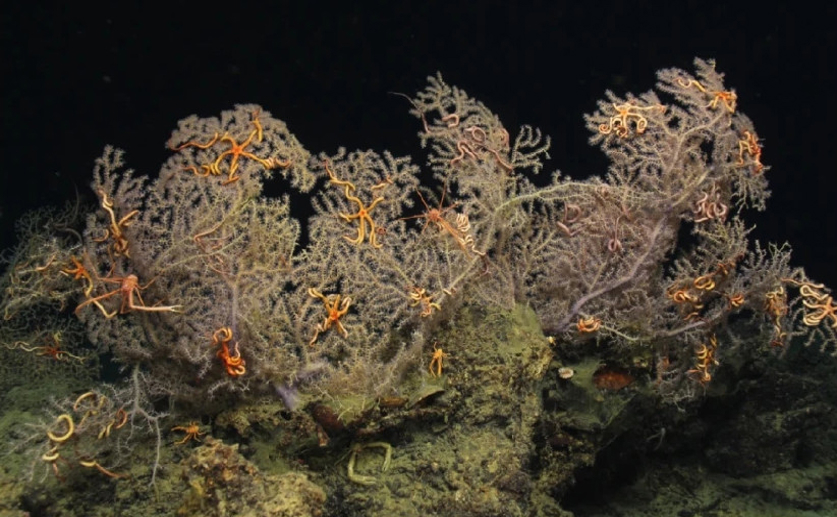
Deep-sea corals Paramuricea sp. B3 thrive alongside chemosynthetic communities, as shown in this image of a coral colony and associated fauna at the study site (AT357).

Image adapted from: Vohsen et al. / CC BY (Source)

Key Findings

  • Deep-sea corals near chemical-rich seafloor areas (cold seeps) commonly host specific bacteria from the Thioglobaceae family
  • These bacteria possess the genetic ability to create energy from sulfur and carbon, potentially providing nutrition to the corals
  • The abundance of these bacteria within corals correlates with the coral’s nutritional status, suggesting a symbiotic relationship where bacteria supplement the coral’s diet
Deep-sea corals are often found in challenging environments, and scientists are continually investigating how they thrive there. A key aspect of coral survival is their ability to form symbiotic relationships – close partnerships with other organisms. While coral symbiosis with algae is well-known, less is understood about corals forming partnerships with bacteria that obtain energy from chemicals, rather than sunlight. Researchers at Pennsylvania State University[1] have recently discovered widespread evidence of such a relationship between corals and sulfur-oxidizing bacteria near cold seeps – areas on the seafloor where chemically-rich fluids escape. The study focused on corals living near cold seeps, environments known to host unique communities of organisms that rely on chemosynthesis – a process where energy is derived from chemical reactions, rather than photosynthesis. These chemosynthetic communities often include mussels and tubeworms that harbor bacteria capable of oxidizing sulfur compounds[2]. The researchers investigated whether corals in these areas also hosted similar bacteria. Using a technique called metabarcoding, which identifies bacteria based on their genetic material, the team found that corals consistently harbored specific types of bacteria from the Thioglobaceae family. These bacteria were found in high numbers within the coral tissues, were absent in surrounding seawater, and rare in the sediment. This suggested a specific, close relationship between the bacteria and the corals, rather than a random association. Further analysis using metagenomics – studying the genetic material of the entire microbial community – and transcriptomics – studying which genes are actively being used – allowed the researchers to assemble the genome of one of these bacterial types. This genome revealed the bacteria possessed the genes necessary to oxidize sulfur and ‘fix’ carbon – converting inorganic carbon into organic molecules, essentially creating food. The researchers confirmed these genes were actually being used by the bacteria within the coral. Interestingly, the abundance of these bacteria within the coral tissue was negatively correlated with the isotopic composition of the coral itself. This suggests that the bacteria’s activity – producing organic carbon – was influencing the coral’s overall nutritional status. The study proposes that these bacteria may be providing the coral with supplemental nutrition, essential amino acids, or vitamins, particularly in the nutrient-poor deep-sea environment. This discovery expands on previous work showing how environmental factors, such as depth and proximity to seeps, influence species distribution in deep-sea ecosystems[3][4]. The earlier research highlighted how certain coral species were associated with specific depths and seep activity, suggesting niche specialization. This new study builds on that by identifying a potential mechanism – a symbiotic relationship with chemosynthetic bacteria – that allows corals to thrive in these challenging seep environments. Similarly, the discovery of new coral species near methane seeps off the coast of Costa Rica[5] further emphasizes the importance of these environments for coral biodiversity, and this new study provides a potential explanation for how these corals are able to survive in such locations. The findings suggest that the influence of chemosynthetic environments may be more extensive than previously thought, and that corals may be more connected to these ecosystems than previously understood. This is the first documented evidence of this type of chemoautotrophic symbiosis in corals, opening up new avenues for research into the complex interactions within deep-sea communities.

EcologyOceanographyMarine Biology

References

Main Study

1) Deep-sea corals near cold seeps associate with sulfur-oxidizing chemoautotrophs in the family Ca. Thioglobaceae

Published 13th November, 2025

https://doi.org/10.1186/s40168-025-02254-z


Related Studies

2) Cold seep epifaunal communities on the Hikurangi margin, New Zealand: composition, succession, and vulnerability to human activities.

https://doi.org/10.1371/journal.pone.0076869


3) Niche divergence by deep-sea octocorals in the genus Callogorgia across the continental slope of the Gulf of Mexico.

https://doi.org/10.1111/mec.12370


4) Exploration of the Canyon-Incised Continental Margin of the Northeastern United States Reveals Dynamic Habitats and Diverse Communities.

https://doi.org/10.1371/journal.pone.0139904


5) New records of Swiftia (Cnidaria, Anthozoa, Octocorallia) from off the Pacific Costa Rican margin, including a new species from methane seeps.

https://doi.org/10.11646/zootaxa.4671.3.6


Related Articles

An unhandled error has occurred. Reload 🗙