
Climate Change Alters Feeding Areas for Highly Migratory Species
Jenn Hoskins
12th May, 2025


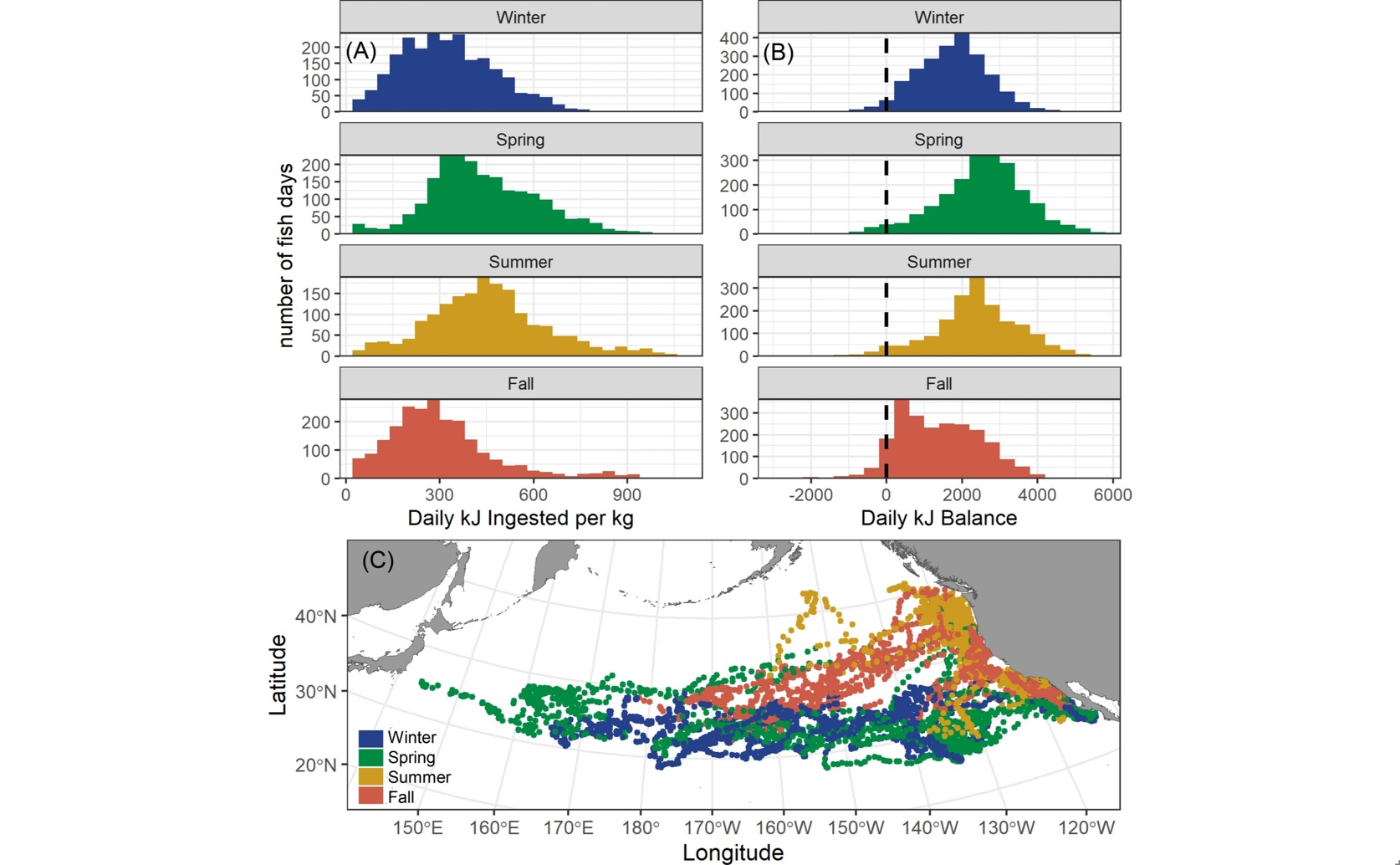
Data from tagged juvenile albacore (Thunnus alalunga) reveal that extensive migrations across the North Pacific (C) facilitate peak energy ingestion (A) and positive net energy balances (B) primarily during the productive spring and summer seasons.
Key Findings
- *North Pacific Study:* Warming oceans are shrinking some tuna habitats but creating new, productive colder areas for juvenile albacore tuna
- *Migration Shifts:* Tuna may move towards coastal areas with better food resources as offshore regions become less suitable
- *Advanced Modeling:* The new approach, which includes energy use and feeding opportunities, provides more accurate predictions of tuna movements under climate change
EcologyOceanographyMarine Biology
References
Main Study
1) Climate change impacts to foraging seascapes for a highly migratory top predator
Published 9th May, 2025
https://doi.org/10.1186/s40462-025-00558-1
Related Studies
2) Emerging Perspectives on Resource Tracking and Animal Movement Ecology.
3) Memory and resource tracking drive blue whale migrations.
4) Temperature effects on metabolic rate of juvenile Pacific bluefin tuna Thunnus orientalis.
Journal: The Journal of experimental biology, Issue: Vol 210, Issue Pt 23, Dec 2007
5) A shallow scattering layer structures the energy seascape of an open ocean predator.
Related Articles
 10th March, 2024 | Jim Crocker