Changing Ocean Plant Communities Across Boundaries

Jenn Hoskins
7th June, 2025

Changing Ocean Plant Communities Across Boundaries

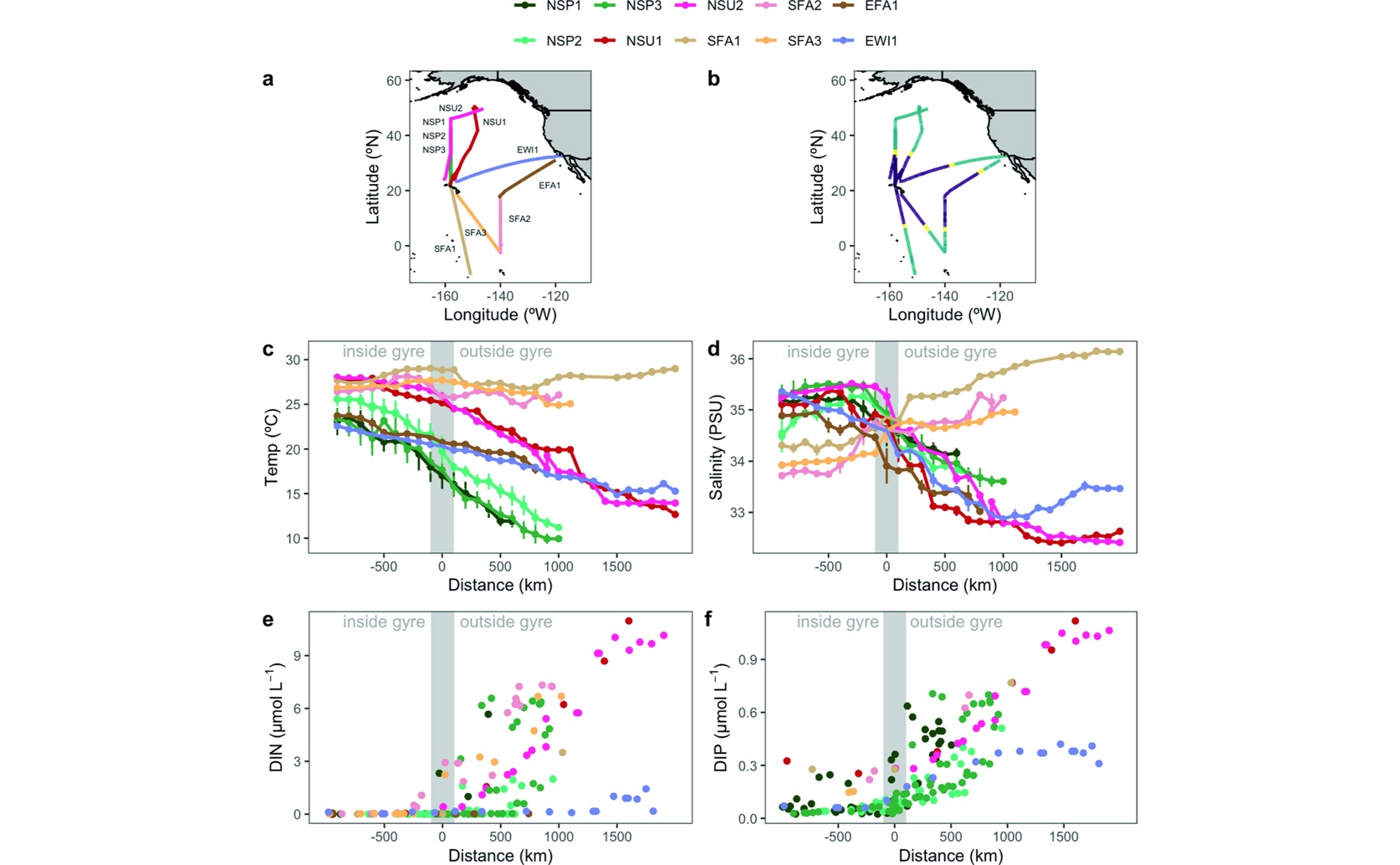
Oceanographic surveys crossing the North Pacific Subtropical Gyre boundary (a, d) reveal a distinct environmental transition defined by shifts in salinity (b) and temperature (c), and a dramatic increase in dissolved inorganic nitrogen (e) and phosphorus (f) concentrations outside the oligotrophic gyre.

Image adapted from: Winter et al. / CC BY (Source)

Key Findings

  • Conducted in the North Pacific Subtropical Gyre and nearby areas, the study shows that tiny marine plants shift as nutrients and temperature vary
  • In nutrient-poor gyre waters, small Prochlorococcus thrive and grow faster, while richer areas favor larger phytoplankton types
  • Even small changes in temperature and nutrients at gyre boundaries can significantly alter marine food webs and carbon capture
[1] A recent study led by researchers from the University of Washington and Texas A&M University has expanded our understanding of how environmental factors shape tiny marine organisms known as phytoplankton. These microscopic plants play a central role in marine food webs and global biogeochemical cycles by capturing carbon and supporting ocean life. The study focused on the boundaries of the North Pacific Subtropical Gyre (NPSG) to examine how variations in nutrient availability and temperature affect the size distribution and composition of phytoplankton communities smaller than 5 micrometers. Phytoplankton are not uniformly distributed throughout the ocean. Instead, their community structure—the variety of different types present—can change significantly with environmental conditions. Within the NPSG, conditions are generally low in nutrients (a state referred to as oligotrophic), favoring species that are highly efficient at using scarce resources. The study found that the cyanobacterium Prochlorococcus dominates within the gyre, attaining biomass levels between 3.2 and 13.1 micrograms of carbon per liter and displaying higher growth rates within the gyre compared to areas outside. In contrast, when moving away from the gyre into regions with higher nutrient levels, the community shifts toward larger phytoplankton types, specifically nanoeukaryotes and picoeukaryotes. These larger cells become more pronounced contributors to total biomass as nutrient concentrations increase by nearly two orders of magnitude. To explore these patterns, the study employed high-resolution, underway flow cytometry data collected during eight oceanographic cruises between 2016 and 2021. Flow cytometry is a method that rapidly counts and characterizes individual cells as water flows through a sensor. This technique allowed the researchers to continuously monitor changes in phytoplankton abundance and cell properties across vast areas, combining real-time measurements with traditional sampling methods. In this way, the study built on previous work that used similar continuous technology, like the SeaFlow instrument described in earlier research[2], to gain a finer picture of phytoplankton spatial and temporal dynamics. Understanding the processes driving phytoplankton community structure is key to deciphering broader ecosystem functioning. In this study, nutrient availability and water temperature emerged as primary factors determining which phytoplankton types thrive. Within the nutrient-poor gyre, Prochlorococcus dominates due to its efficiency in such environments—a finding that aligns with earlier research highlighting how small-sized phytoplankton are particularly adapted to stable, oligotrophic conditions[3]. In addition, the study observed that as conditions shift toward higher nutrient levels outside the gyre, there is a clear transition toward larger phytoplankton such as nanoeukaryotes, which are better suited to rapidly utilize increased nutrient supplies. This observation resonates with insights from previous studies of transition zones between oceanic regions, where nonlinear interactions between physical gradients and biological processes create sharp ecological boundaries[4]. Aside from nutrient-driven shifts, another interesting outcome was the relatively low abundance of Synechococcus, a type of cyanobacterium that in theory might be expected to increase in nutrient-rich regions. This suggests that factors beyond simple nutrient availability, such as grazing by other organisms, could be influencing distribution patterns. Earlier work has shown that predator–prey interactions, particularly those that follow daily light and dark cycles, can synchronize predator activity with phytoplankton production[5]. Such grazing pressures may partially explain why Synechococcus remains less abundant even when nutrients are not limiting, highlighting the complex interplay between resource competition and biological interactions in structuring marine microbial communities. By tying together high-resolution observational data with established ecological theories, the study offers new insights into the role of environmental gradients in determining phytoplankton community composition. The findings emphasize that even small-scale changes in temperature and nutrient availability can lead to significant shifts in the makeup of phytoplankton populations. These shifts, in turn, have broader implications. For example, changes in community structure influence the efficiency of carbon capture and the stability of marine food webs. As the climate continues to change, with ocean warming and altered nutrient regimes, such insights will be crucial for predicting how marine ecosystems may respond. Overall, the study underscores the importance of integrating advanced observational techniques with ecological modeling to better understand marine ecosystems. By comparing regions within and outside the NPSG, the researchers were able to show how nutrient limitation and temperature variability govern the size and growth rates of key phytoplankton players. In doing so, the work not only reinforces ideas from past studies[3][4] but also challenges some previous assumptions about species distribution, as evidenced by the unexpected behavior of Synechococcus[5]. The careful balance of continuous, high-resolution data with contextual understanding of oceanographic processes marks a significant advance in marine ecology research.

EcologyOceanographyMarine Biology

References

Main Study

1) Shifts in phytoplankton community structure across oceanic boundaries

Published 5th June, 2025

https://doi.org/10.1371/journal.pone.0324466


Related Studies

2) SeaFlow data v1, high-resolution abundance, size and biomass of small phytoplankton in the North Pacific.

https://doi.org/10.1038/s41597-019-0292-2


3) Mechanisms shaping size structure and functional diversity of phytoplankton communities in the ocean.

https://doi.org/10.1038/srep08918


4) Moving ecological and biogeochemical transitions across the North Pacific.

https://doi.org/10.1002/lno.11763


5) Light-driven synchrony of Prochlorococcus growth and mortality in the subtropical Pacific gyre.

https://doi.org/10.1073/pnas.1424279112


Related Articles

An unhandled error has occurred. Reload 🗙