What desert toads eat reveals how they stay poisonous

Jim Crocker
12th November, 2025

What desert toads eat reveals how they stay poisonous

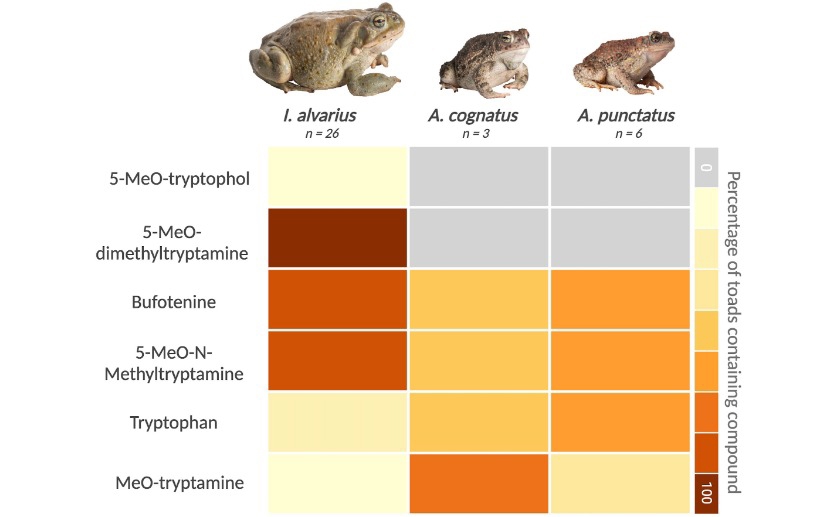
Figure from study shows that all Incilius alvarius tested secreted 5-MeO-DMT, alongside other tryptophan derivatives also found in the secretions of Anaxyrus cognatus and Anaxyrus punctatus.

Image adapted from: Luccioni et al. / CC BY (Source)

Key Findings

  • This study, focused on Sonoran Desert toads in Arizona, confirmed all tested toads consistently produce high levels of 5-MeO-DMT
  • Researchers found the toads’ diet—similar across species—doesn’t explain the unique 5-MeO-DMT production, suggesting it’s not from food
  • The study indicates the toad likely creates 5-MeO-DMT internally or through a symbiotic relationship, rather than obtaining it from its prey
The Sonoran Desert toad, scientifically known as Incilius alvarius, is unique among animals for its production of 5-MeO-DMT, a potent psychedelic compound. This toad secretes the substance as a defense mechanism, but the origin of this chemical has been a long-standing mystery. Animals employ various strategies for chemical defense, including creating the compounds themselves, obtaining them through their diet, or benefiting from chemicals produced by symbiotic microorganisms[2]. Researchers from Stanford University, the US Fish and Wildlife Forensics Laboratory, and Universidade Federal de Goias investigated whether the toad’s diet was the source of 5-MeO-DMT[1]. The study focused on wild I. alvarius populations and other toad species living in the same areas – both natural desert habitats and urbanized environments around Tucson, Arizona. The researchers analyzed secretions from the toads’ toxin glands and meticulously examined their diets. The key finding was that all I. alvarius toads consistently secreted high levels of 5-MeO-DMT, while none of the other toad species tested did. This immediately suggested that the Sonoran Desert toad possesses a unique capability. To determine if diet played a role, the researchers compared the food consumed by I. alvarius with that of the other toad species. They found that the diets were broadly similar, meaning I. alvarius wasn’t specifically seeking out food items containing the psychedelic compound. There were minor differences in diet between toads living in natural versus urban areas, but these were not substantial enough to explain the consistent production of 5-MeO-DMT. This outcome supports the idea that the toad either manufactures 5-MeO-DMT internally or relies on a symbiotic relationship with microorganisms to produce it. The concept of animals utilizing symbiotic bacteria for chemical defense isn’t new[3]. For example, some Drosophila flies harbor Spiroplasma bacteria that protect them from parasitic wasps and nematodes, with the bacteria producing toxins that target the parasite’s ribosomes. Similarly, poison frogs accumulate toxins from their arthropod prey, altering protein abundance in their bodies to manage the toxins[4]. The recent discovery that animals can produce complex molecules, even those typically associated with microbial metabolism, further strengthens the possibility of an internal or symbiotic origin for 5-MeO-DMT[5]. Researchers have found that animals possess pathways for creating compounds like polyketides, often previously thought to be exclusively produced by bacteria. These pathways can even be acquired from bacteria through horizontal gene transfer, or represent previously unknown animal biochemistry. The study therefore suggests that the Sonoran Desert toad’s ability to produce 5-MeO-DMT is likely a result of its own internal biochemistry or a partnership with microorganisms, rather than simply what it eats. The investigation highlights the “biosynthetic dark matter” within animals, suggesting a vast, unexplored potential for novel chemical compounds and metabolic processes.

NutritionEcologyAnimal Science

References

Main Study

1) Diet and chemical defenses of the Sonoran Desert toad

Published 10th November, 2025

https://doi.org/10.1371/journal.pone.0335661


Related Studies

2) The biosynthetic diversity of the animal world.

https://doi.org/10.1074/jbc.REV119.006130


3) Generality of toxins in defensive symbiosis: Ribosome-inactivating proteins and defense against parasitic wasps in Drosophila.

https://doi.org/10.1371/journal.ppat.1006431


4) Rapid toxin sequestration modifies poison frog physiology.

https://doi.org/10.1242/jeb.230342


5) Animal biosynthesis of complex polyketides in a photosynthetic partnership.

https://doi.org/10.1038/s41467-020-16376-5


Related Articles

An unhandled error has occurred. Reload 🗙