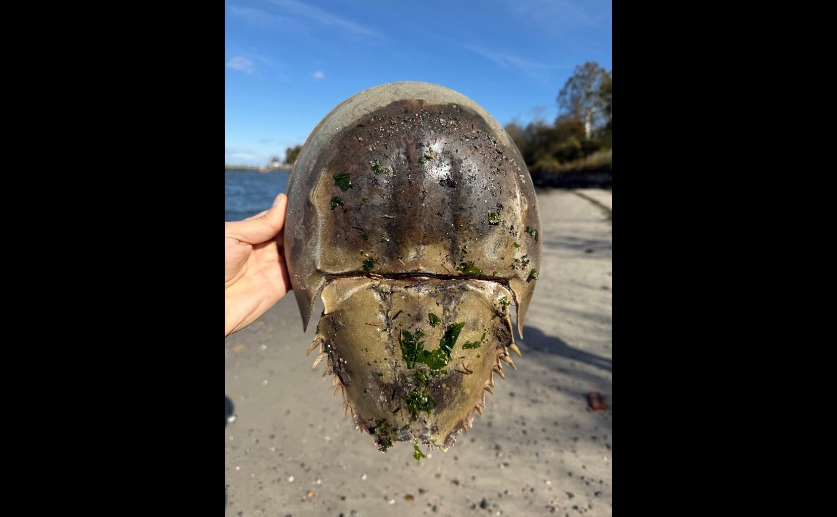
Rising sea levels threaten Florida horseshoe crab breeding grounds

Jim Crocker
7th November, 2025

Rising sea levels threaten Florida horseshoe crab breeding grounds

Horseshoe Crab (Limulus polyphemus)

Photographer: Nick Tobler / CC BY (Source)

Key Findings

  • In Florida’s Pinellas and Brevard counties, horseshoe crab spawning activity primarily occurred near sheltered tidal flats and fine- to medium-grain sand beaches
  • Sea level rise is predicted to cause substantial habitat loss for horseshoe crabs, with mangroves and tidal flats facing the most significant declines by 2100
  • Hardened shorelines may limit natural beach movement, impacting horseshoe crab spawning as rising sea levels inundate adjacent sandy patches they use for nesting
Coastal ecosystems are facing increasing threats from sea level rise (SLR), impacting the wildlife that depend on them for survival. Many species rely on specific coastal habitats for breeding and raising their young, making them particularly vulnerable to habitat loss. The American Horseshoe Crab (Limulus polyphemus) is one such species, needing particular environmental conditions for successful egg development. A recent study by researchers at Florida Fish & Wildlife Conservation Commission[1] investigated the characteristics of horseshoe crab spawning habitats in two Florida counties – Pinellas and Brevard – and predicted future habitat loss under various SLR scenarios. The study focused on identifying the types of coastal habitats where horseshoe crabs were observed spawning. To do this, researchers created a defined area along the shoreline in each county, 0.6 meters wide, and categorized the different habitat types within it. They then used projections of SLR for the years 2040, 2070, and 2100 to estimate how much of each habitat type would be lost or transformed. The findings revealed distinct habitat preferences in the two counties. In Pinellas County, spawning activity was primarily associated with sheltered tidal flats and mangrove forests. In Brevard County, horseshoe crabs were more commonly found spawning on fine- to medium-grain sand beaches and in mangrove forests. This difference highlights the adaptability of the species, but also points to specific vulnerabilities. The projections of habitat loss were concerning. Even in the near-term scenario of 2040, changes in habitat area were predicted. However, the most significant losses were projected by 2100. In Pinellas County, the study estimated that 96.3% of mangroves and 87.4% of sheltered tidal flats within the surveyed shoreline areas would be lost or altered. Brevard County faced similar, if not more drastic, projections, with 98% of fine- to medium-grain sand beaches and 94.8% of mangroves predicted to disappear or change by 2100. These findings build upon earlier research examining the factors influencing horseshoe crab distribution and survival. For example,[2] demonstrated that horseshoe crab presence along the Gulf of Mexico coast is linked to factors like distance from freshwater discharge and land cover types, particularly bare land and estuarine wetlands. The current study complements this by identifying specific habitat types within those broader land cover classifications that are critical for spawning in Florida. Furthermore, the importance of mangroves identified in this study aligns with the broader understanding of their role as vital coastal nurseries and buffers. The predicted loss of mangroves is particularly alarming given their ability to provide protection against storm surges and erosion, as demonstrated by research on living shorelines[3]. The loss of these habitats will not only affect horseshoe crabs but will also exacerbate coastal vulnerability to other environmental stressors. The study also considered the impact of salinity and temperature on horseshoe crab development, as detailed in[4]. While the embryos and larvae can tolerate a range of salinity levels, extreme conditions can negatively impact survival. The projected habitat changes due to SLR, including potential shifts in salinity and increased temperatures, could further stress horseshoe crab populations, especially during the vulnerable early developmental stages. The methodology employed by the Florida Fish & Wildlife Conservation Commission researchers – utilizing ArcGIS Pro and SLR scenarios – provides a valuable framework for assessing the impacts of climate change on coastal species. The use of high-resolution LiDAR data, as highlighted in[5], is crucial for accurate predictions of habitat loss and informs adaptation planning. The study’s focus on spatial information and quantitative data allows for targeted conservation efforts and prioritization of adaptation strategies.

WildlifeEcologyMarine Biology

References

Main Study

1) Potential implications of rising sea level on American Horseshoe Crab (Limulus polyphemus) spawning beaches in two Florida counties

Published 5th November, 2025

https://doi.org/10.1371/journal.pone.0333812


Related Studies

2) Environmental factors and occurrence of horseshoe crabs in the northcentral Gulf of Mexico.

https://doi.org/10.1371/journal.pone.0243478


3) Living shorelines enhanced the resilience of saltmarshes to Hurricane Matthew (2016).

https://doi.org/10.1002/eap.1722


4) Survival and development of horseshoe crab (Limulus polyphemus) embryos and larvae in hypersaline conditions.

Journal: The Biological bulletin, Issue: Vol 206, Issue 2, Apr 2004


5) Modeled Sea Level Rise Impacts on Coastal Ecosystems at Six Major Estuaries on Florida's Gulf Coast: Implications for Adaptation Planning.

https://doi.org/10.1371/journal.pone.0132079


Related Articles

An unhandled error has occurred. Reload 🗙