Fungal protein helps cells merge, maintaining stability during growth

Jim Crocker
11th October, 2025

Fungal protein helps cells merge, maintaining stability during growth

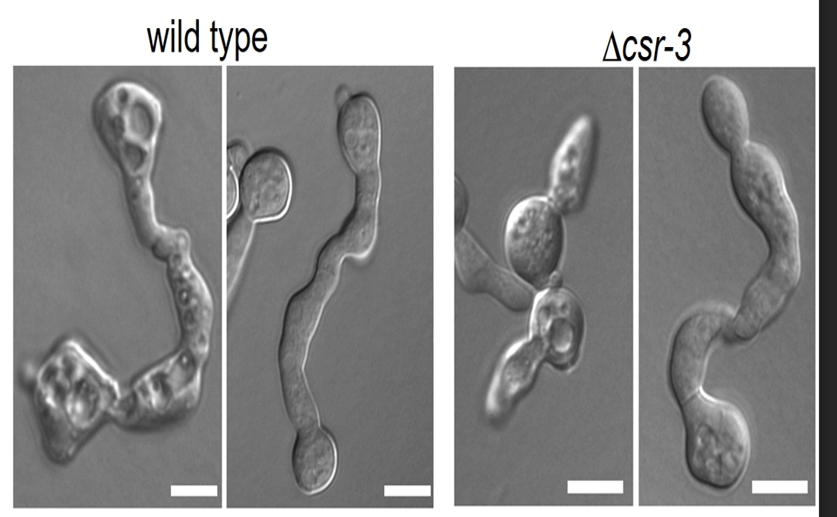
Lysed germling pairs of the wild type strain and the Δcsr-3 mutant are characterized by a vacuolized appearance (left) in contrast to successfully fused pairs (right). Scale bars: 5 μm

Image adapted from: Herzog et al. / CC BY (Source)

Key Findings

  • In the model fungus Neurospora crassa, CSR-3 accumulates at cell-cell contact sites during fusion
  • Without CSR-3, fungal cells experience instability during fusion, leading to rupture and death, especially with low calcium
  • CSR-3 interacts with CHS-2, a chitin synthase, suggesting it regulates cell wall synthesis to stabilize fusion pores
Fungi rely on cell fusion for growth, reproduction, and adapting to their environment. This process, where two fungal cells combine into one, is essential for their survival, but presents a significant challenge: how to join cells without causing them to rupture or die. The cell wall, a rigid outer layer protecting fungal cells, must be broken down locally to allow fusion, but this breakdown needs careful control. While scientists have learned much about how fungal cells find each other and initiate contact[2][3], the precise steps that stabilize the newly formed connection – the fusion pore – have remained largely unclear. Researchers at Technische Universität Braunschweig and Oregon State University[1] have now identified a protein called CSR-3 as a key player in this process. CSR-3, found in the model fungus Neurospora crassa, accumulates specifically at the point where cells are fusing. The study demonstrated that without CSR-3, the fusion process becomes unstable, leading to cell rupture and death, particularly when calcium levels are low. This suggests CSR-3 is crucial for maintaining the integrity of the cell wall during fusion. To understand how CSR-3 works, the researchers investigated what happens when it’s absent. They found that cells lacking CSR-3 experienced increased lysis – the bursting of cells – after fusion. This was improved by increasing the external osmotic pressure, suggesting a defect in the cell wall. Further investigation revealed that CSR-3 isn’t just important for fusion; it also plays a role in other processes involving cell wall maintenance, including the formation of internal walls (septa) within the fungus, plugging pores in these walls, and responding to environmental stresses. These findings point to a broader role for CSR-3 in managing the fungus’s cell wall. The study further pinpointed how CSR-3 functions. It discovered that CSR-3 interacts with another protein, CHS-2, a chitin synthase. Chitin is a major component of the fungal cell wall, and CHS-2 is responsible for its production. This suggests CSR-3 regulates CHS-2, controlling cell wall synthesis at the fusion site. This connection supports the idea that rebuilding the cell wall is critical during fusion pore formation. Interestingly, the research also linked CSR-3 to a signaling pathway known as the MAP kinase pathway, specifically the MAK-1 kinase. This pathway is known to be involved in detecting and responding to cell wall damage. The researchers found that CSR-3’s activity depends on this pathway, and that modifications to CSR-3 itself, specifically its phosphorylation, affect its function. Phosphorylation is a common way cells regulate proteins, turning them on or off. This indicates that cell wall integrity signaling is directly involved in the later stages of cell fusion. Previous studies have shown the complexity of hyphal fusion, with distinct stages of pre-contact, contact, and post-fusion[4]. The research highlighted that fusion-competent hyphae exhibit remote sensing and growth redirection to facilitate contact. builds on this by revealing the molecular mechanisms at play during the post-contact stage, demonstrating that CSR-3 is essential for stabilizing the fusion pore. Furthermore, the earlier observation of a “cell dialog” between fusing cells[3] is complemented by the discovery of CSR-3’s role in coordinating cell wall remodeling, suggesting this dialog likely involves signaling pathways that regulate CSR-3 activity. The exploratory polarization observed in crowded environments[2] may be driven by the need to find fusion partners with appropriate signaling capabilities to activate CSR-3 and ensure successful fusion.

GeneticsPlant ScienceMycology

References

Main Study

1) The chitin synthase regulator CSR-3 promotes cellular integrity during cell-cell fusion in the filamentous ascomycete fungus Neurospora crassa

Published 10th October, 2025

https://doi.org/10.1371/journal.pgen.1011891


Related Studies

2) Chemotropism and Cell-Cell Fusion in Fungi.

https://doi.org/10.1128/mmbr.00165-21


3) Signal exchange and integration during self-fusion in filamentous fungi.

https://doi.org/10.1016/j.semcdb.2016.03.016


4) Live-cell imaging of vegetative hyphal fusion in Neurospora crassa.

Journal: Fungal genetics and biology : FG & B, Issue: Vol 37, Issue 1, Oct 2002


Related Articles

An unhandled error has occurred. Reload 🗙