Skin bacteria from amphibians can fight plant diseases and reduce spoilage

Jenn Hoskins
3rd October, 2025

Skin bacteria from amphibians can fight plant diseases and reduce spoilage

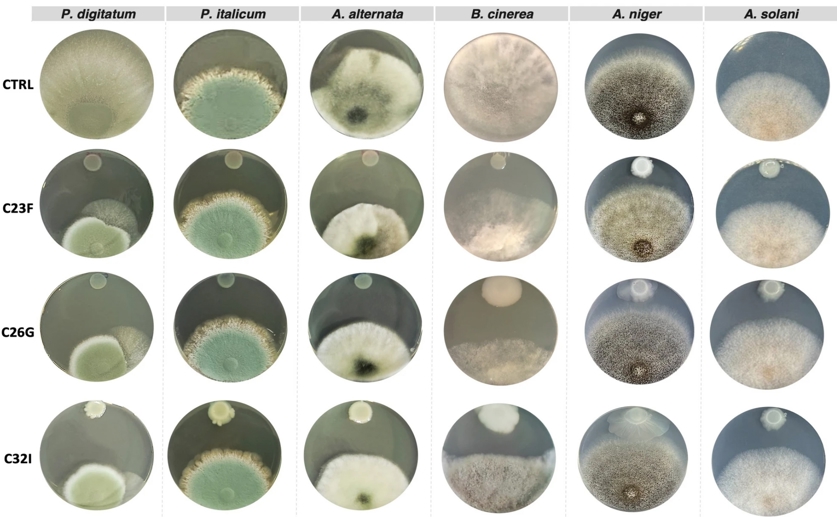
This grid from the study shows how bacterial isolates from frog skin (C23F, C26G, C32I) create a visible zone of inhibition against various fungal pathogens (labeled across the top). CTRL has no isolate.

Image adapted from: Gutiérrez-Pavón et al. / CC BY (Source)

Key Findings

  • Bacteria from the skin of Craugastor fitzingeri frogs, studied at Universidad Nacional Autónoma de México, show promise in fighting postharvest fruit diseases
  • These frog skin bacteria effectively slowed or stopped the growth of several common fruit-spoiling fungi like Penicillium digitatum and Alternaria alternata in lab tests
  • Applying these bacteria to citrus, tomato, and blueberry fruits reduced disease caused by Penicillium digitatum, Alternaria alternata, and Botrytis cinerea during trials
Postharvest diseases are a major problem for the agricultural industry, causing significant fruit losses after harvest due to fungal infections. Traditionally, chemical fungicides have been used to combat these infections, but their use is increasingly limited due to the development of fungicide-resistant fungi and concerns about their impact on human health and the environment. This has led to a search for alternative, more sustainable solutions, such as biological control agents (BCAs) – using naturally occurring organisms to suppress fungal growth[2]. Researchers at Universidad Nacional Autónoma de México (UNAM) have been investigating the potential of bacteria found on the skin of frogs as a source of new BCAs[1]. Previous work by the same team identified bacteria from frog skin that could inhibit the growth of Botrytis cinerea, a common postharvest fungal pathogen. Building on this, the current study focused on three bacterial isolates obtained from the skin of Craugastor fitzingeri frogs, aiming to determine their effectiveness against a range of postharvest fungal pathogens. The study began with laboratory experiments, termed ‘dual culture assays’, where the bacterial isolates were grown alongside several important fungal pathogens, including Penicillium digitatum and Penicillium italicum (common causes of citrus mold), Alternaria alternata and Alternaria solani, and Aspergillus niger. The results showed a strong inhibitory effect of the bacteria on the growth of all these fungi. To understand how the bacteria were inhibiting the fungal growth, the researchers further investigated two mechanisms: bacterial filtrates (BFs) – liquids containing compounds released by the bacteria – and volatile organic compounds (VOCs) – gases produced by the bacteria. Both BFs and VOCs were found to effectively delay or suppress fungal development in laboratory settings. To determine whether these laboratory results translated into real-world effectiveness, the researchers conducted experiments on actual fruits – citrus, tomato, and blueberry. Treatments with either bacterial cell suspensions (live bacteria) or BFs significantly reduced the incidence of disease caused by Penicillium digitatum, Alternaria alternata, and Botrytis cinerea. However, the bacteria showed no inhibitory effect against Geotrichum citri-aurantii, Fusarium sp., Fusarium oxysporum, or Phytophthora capsici. This suggests that the bacteria are not a ‘one-size-fits-all’ solution and have a degree of specificity in which fungi they can effectively control. This specificity is an important finding. While broad-spectrum control is desirable, targeted control can be more efficient and reduce the potential for disrupting beneficial microbial communities. The study’s findings align with earlier research highlighting the complex interactions between fungi and bacteria in postharvest disease development[3]. For example, the successful use of Bacillus subtilis JK-14 to control peach diseases demonstrates the potential of bacterial antagonists, and the study also showed that this bacterium increased antioxidant enzyme activity in peaches, providing a potential mechanism for its protective effect. The research also builds on work identifying ‘killer yeasts’ as potential biocontrol agents[4][5]. These yeasts produce compounds that inhibit fungal growth, and the UNAM study suggests that frog skin bacteria may be employing similar mechanisms, through the production of BFs and VOCs. Importantly, the UNAM research identifies a novel source for BCAs – the skin of frogs – which has been largely unexplored until now. The study demonstrates the potential of these frog skin-associated bacteria for the sustainable management of postharvest diseases in fruits, offering a promising alternative to chemical treatments.

EcologyPlant ScienceMycology

References

Main Study

1) Bacteria from the Amphibian Skin Inhibit the Growth of Phytopathogenic Fungi and Control Postharvest Rots

Published 30th September, 2025

https://doi.org/10.1007/s00248-025-02611-3


Related Studies

2) Molecular basis of pathogenesis of postharvest pathogenic Fungi and control strategy in fruits: progress and prospect.

https://doi.org/10.1186/s43897-021-00004-x


3) Identification of the Fungal Pathogens of Postharvest Disease on Peach Fruits and the Control Mechanisms of Bacillus subtilis JK-14.

https://doi.org/10.3390/toxins11060322


4) Killer Yeasts for the Biological Control of Postharvest Fungal Crop Diseases.

https://doi.org/10.3390/microorganisms8111680


5) Native Killer Yeasts as Biocontrol Agents of Postharvest Fungal Diseases in Lemons.

https://doi.org/10.1371/journal.pone.0165590


Related Articles

An unhandled error has occurred. Reload 🗙