Early life stages of the Blue-Eye Cichlid offer clues to fish development

Jenn Hoskins
7th October, 2025

Early life stages of the Blue-Eye Cichlid offer clues to fish development

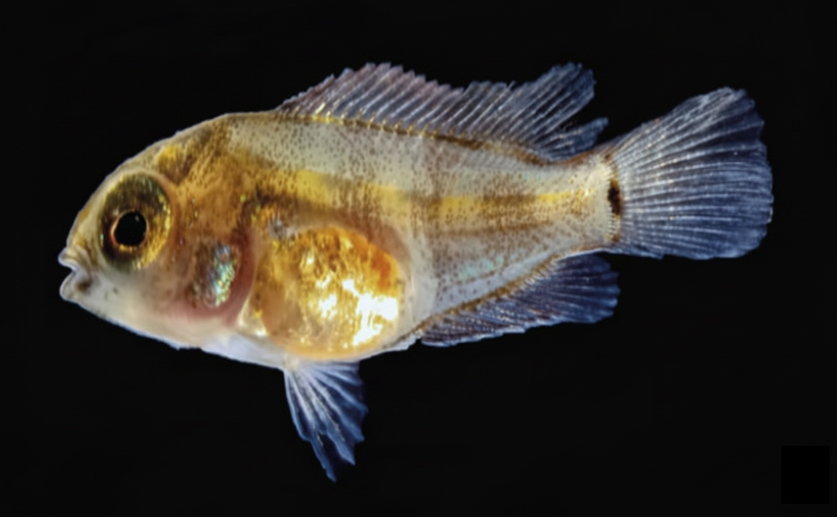
At 16 days post-hatching, the Blue-eyed cichlid (Cryptoheros spilurus) has completed its transformation into a juvenile, featuring fully developed fins and a distinct pigmentation pattern.

Image adapted from: Contreras‐Tapia et al. / CC BY (Source)

Key Findings

  • This study documented the early development of blue-eye cichlid (Cryptoheros spilurus) from hatching to 16 days post-hatching in Mexico, providing a baseline for future research
  • C. spilurus larvae rapidly develop key structures like cement glands, eyes, and a mouth, enabling early feeding and attachment to substrates
  • Cranial features, including head length and mouth size, grew at a faster rate than the trunk and tail, prioritizing feeding and sensing abilities during development
The cichlid family of fishes are renowned for their remarkable diversity, particularly in their feeding adaptations and associated head shapes. This diversity has made them a key group for understanding how evolution shapes physical form[2]. However, much of the research has focused on African cichlids, leaving a gap in our knowledge of how development and adaptation occur in Middle American species. Researchers at Universidad Autónoma Metropolitana (UAM) recently addressed this gap with a detailed study of Cryptoheros spilurus, a substrate-breeding cichlid from Middle America[1]. The aim was to document the sequence of developmental changes from hatching to 16 days post-hatching (dph), providing a baseline for future comparative studies. The study began with observing eggs laid on rocky surfaces, which were approximately 1.65 mm in diameter and hatched asynchronously, meaning not all at once, between 52 and 54 hours after fertilization. Newly hatched C. spilurus larvae were small, around 4.7 mm long, with a prominent yolk sac providing initial nourishment, a simple finfold (an early version of the fins), a straight notochord (the supporting rod of the body), and underdeveloped eyes. Using scanning electron microscopy, the team identified early signs of key structures, including cement glands, olfactory pits (involved in smell), and optic primordia (the beginnings of the eyes). Cement glands, previously observed in other cichlid species, were documented in detail throughout their development, noting their eventual regression by 7 dph. This detailed chronology adds to our understanding of their role in early cichlid life stages. Crucially, cranial development was found to be rapid. Pigmentation began within the first day, alongside eye formation, and the mouth, teeth, and taste buds developed by 6 dph. Fin development followed a clear sequence, with pectoral fins appearing first and enabling initial movement, followed by the progressive emergence of caudal (tail), dorsal (back), anal, and pelvic fins, all completed by 16 dph. Pigmentation patterns also changed over time, starting with a simple stripe along the underside and evolving into the unique species-specific patterns characteristic of C. spilurus. By 16 dph, the fish had completed metamorphosis, reaching a length of approximately 13.2 mm. The researchers also used a technique called allometric analysis to examine how different body parts grew relative to each other. This revealed that structures essential for feeding and sensing – like head length, snout length, and mouth size – grew at a faster rate than the trunk and tail. This 'prolonged positive allometry' suggests these features are prioritized during the transition to active foraging. This study is particularly significant because it provides a detailed developmental timeline for a Middle American cichlid species. As highlighted in[2], cichlid jaws are regulated by a relatively small number of genes with major effects, and these genes are organized into modules that evolve under strong selection. The findings of contribute to this understanding by showing how these developmental processes unfold in C. spilurus. The observed prioritization of feeding and sensory structures during development aligns with the idea of ‘morphological modularity’ – where different body parts can evolve independently to suit specific ecological needs. Furthermore, the study’s focus on early development is crucial for understanding heterochrony – changes in the timing of developmental events. Variations in the timing of these events can lead to significant differences in adult form. The detailed baseline data provided by will be invaluable for future research exploring developmental plasticity – the ability of an organism to alter its development in response to environmental conditions – and diversification in Neotropical cichlids.

EcologyAnimal ScienceEvolution

References

Main Study

1) The Early Development of the Blue‐Eye Cichlid, Cryptoheros spilurus (Cichliformes: Cichlidae)

Published 4th October, 2025

https://doi.org/10.1111/ede.70019


Related Studies

2) Genetic and developmental basis of cichlid trophic diversity.

Journal: Heredity, Issue: Vol 97, Issue 3, Sep 2006


Related Articles

An unhandled error has occurred. Reload 🗙