Distinct Genetic Groups but Similar Appearance in Tornier’s Cat Snake

Jenn Hoskins
28th February, 2025

Distinct Genetic Groups but Similar Appearance in Tornier’s Cat Snake

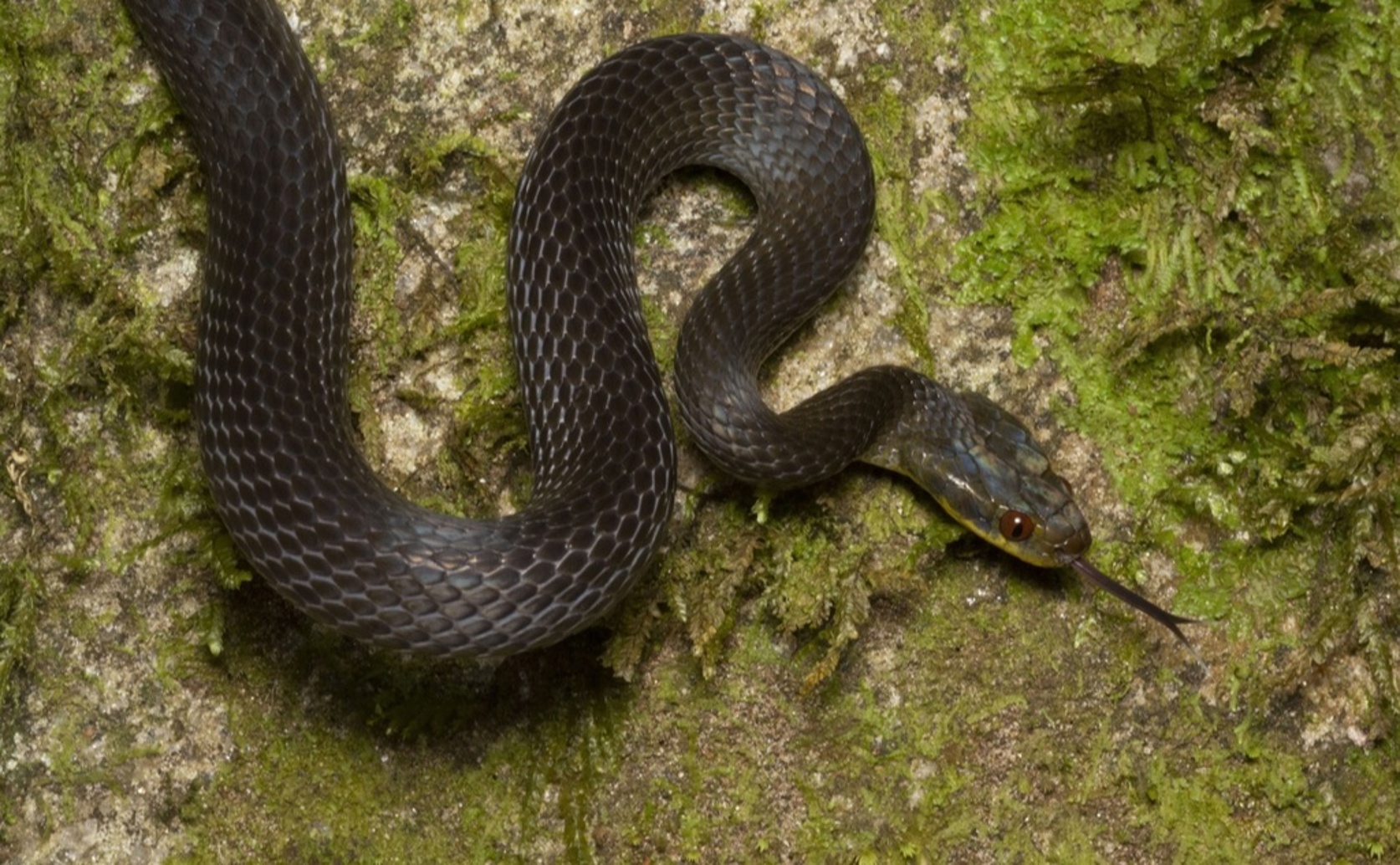
Tornier's cat snake (Crotaphopeltis tornieri)

Photo adapted from: John Lyakurwa / CC BY (Source)

Key Findings

  • In Tanzania's Eastern Arc Mountains, Tornier's cat snakes look similar across isolated forests
  • Genetically, snakes from different mountains are highly distinct, indicating long-term separation
  • These genetic differences suggest Tornier's cat snake may actually include multiple hidden species
The Eastern Arc Mountain (EAM) forests in Tanzania are renowned for their high levels of endemism, meaning many species found there are unique to the region. These forests are often referred to as "sky islands" because they are isolated from each other by lower, drier landscapes. This isolation has led to speciation, where species evolve independently on different mountain blocks. However, not all species follow this pattern. Tornier's cat snake (Crotaphopeltis tornieri) is one such species that inhabits multiple isolated mountain rainforests, seemingly defying the typical pattern of isolation-driven speciation. Researchers at the University of Copenhagen, Denmark, conducted a study[1] to understand why Tornier's cat snake is found across various isolated mountain blocks despite the challenging arid savannah landscape that separates these habitats. The study aimed to determine whether the widespread distribution of C. tornieri is due to recent dispersal events or if the species has maintained a consistent morphology despite long periods of isolation. To investigate this, the team examined the scale patterns of 218 individuals of C. tornieri and sequenced the mitochondrial genomes of 80 individuals from eight different mountain blocks across the EAM and the Southern Highlands of Tanzania (SHT). Morphological analysis revealed that, except for populations in the Usambara Mountains, there were no significant differences in scale characters among the populations. This suggested that the snakes maintained a similar physical appearance across different regions. In contrast, genetic analysis showed a high level of divergence between the populations. On average, the mitochondrial genomes differed by more than 12%, with the cytB and COI genes showing interpopulation genetic distances of up to 28.5% and 15.1%, respectively. Phylogenetic analyses using Bayesian coalescent and maximum-likelihood methods revealed distinct clades, or genetic groups, corresponding to each mountain block. The divergence times were estimated to be around 21 million years for the split between the EAM and SHT populations and between 1.4 to 5.4 million years for splits within the EAM. These findings indicate that the different populations of C. tornieri have been isolated for a long time, leading to significant genetic differentiation. Despite this long-term isolation, the snakes have retained a largely unchanged morphology, resulting in the recognition of only one species. When the researchers included related species, C. degeni and C. hotamboeia, in their phylogenetic analysis, they discovered that C. tornieri is paraphyletic. This means that what is currently recognized as C. tornieri may actually consist of multiple distinct species that have not yet been formally described. This study builds on previous research[2] which highlighted the role of pre-Quaternary speciation processes and environmental stability in creating high biodiversity in the EAM. The discovery of significant genetic divergence within a morphologically conserved species like C. tornieri supports the idea that old isolation events have played a crucial role in the region's evolutionary history. Additionally, the presence of lowland micro-refugia during the Pleistocene, as suggested by earlier studies, may have contributed to the survival and diversification of species in this area[2]. The findings from the University of Copenhagen study have important implications for our understanding of evolution in the EAM. They suggest that there may be more hidden diversity within what is currently recognized as single species, driven by long-term geographic isolation. This challenges the traditional view based solely on morphology and highlights the importance of genetic studies in uncovering the true extent of biodiversity. Moreover, the study underscores the need for a taxonomic revision of the Crotaphopeltis genus. Recognizing the distinct genetic lineages within C. tornieri could lead to the identification of new species, enhancing our knowledge of the region's biodiversity. This is particularly important for conservation efforts, as understanding the genetic diversity and distinctiveness of populations can inform strategies to protect these unique species in the face of ongoing environmental changes. Overall, the research conducted by the University of Copenhagen team provides valuable insights into the evolutionary processes shaping the biodiversity of the Eastern Arc Mountains. By revealing significant genetic differentiation within a morphologically similar species, the study highlights the complex history of speciation and the potential for undiscovered diversity in one of Tanzania's most biodiverse regions.

EcologyAnimal ScienceEvolution

References

Main Study

1) Deeply Diverged but Morphologically Conserved Lineages in Tornier's Cat Snake (Crotaphopeltis tornieri) of the Eastern Arc Mountains

Published 25th February, 2025

https://doi.org/10.1002/ece3.70452


Related Studies

2) Why do tropical mountains support exceptionally high biodiversity? The Eastern Arc mountains and the drivers of Saintpaulia diversity.

https://doi.org/10.1371/journal.pone.0048908


Related Articles

An unhandled error has occurred. Reload 🗙