How Horses React to Threats and What Affects Their Responses

Jim Crocker
5th February, 2025

How Horses React to Threats and What Affects Their Responses

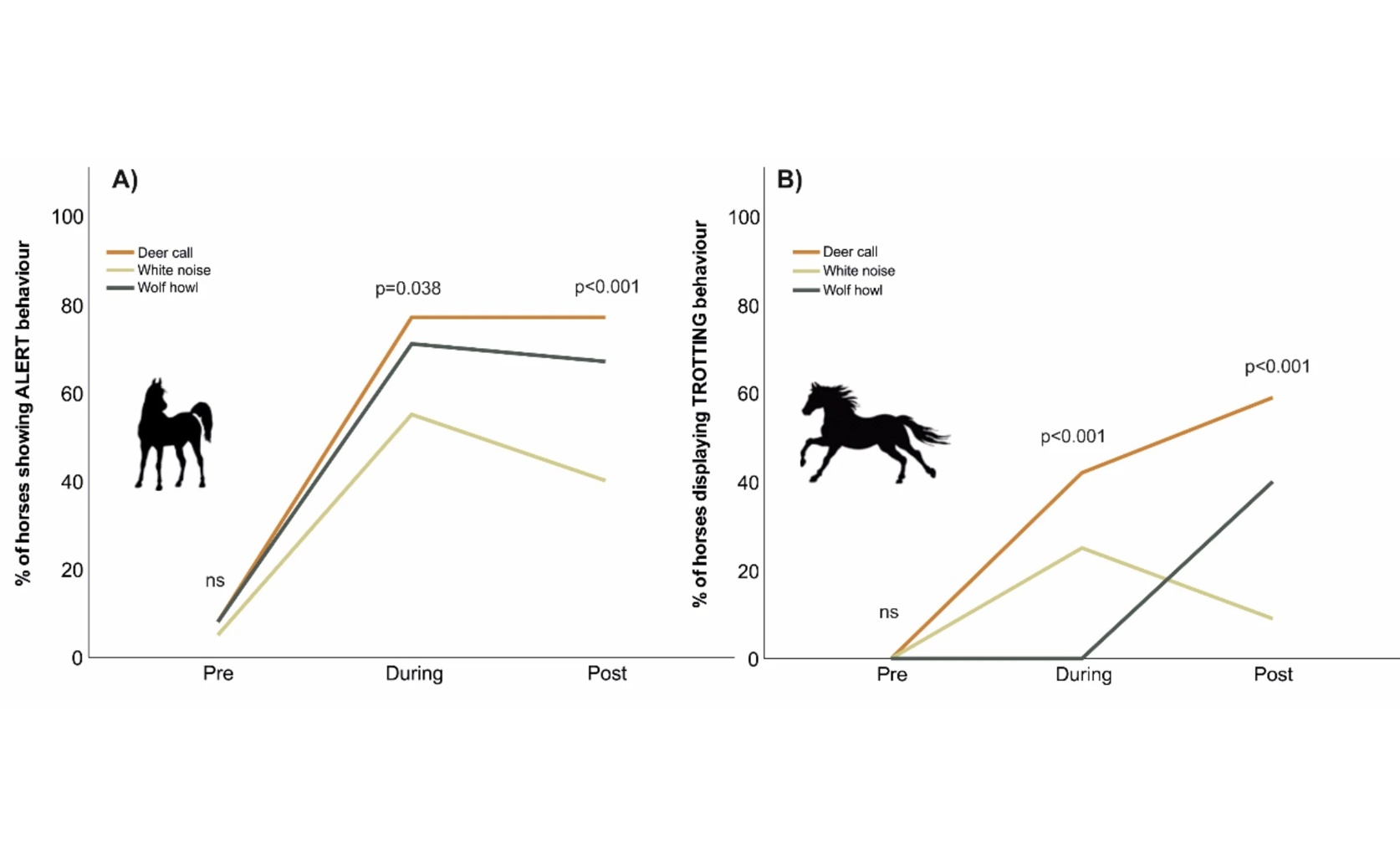
Percentage of horses showing (A) alert and (B) trotting behaviour along the experiment.

Image adapted from: Bercy et al. / CC BY (Source)

Key Findings

  • A study in the Czech Republic found that semi-feral Exmoor ponies respond to predator cues, such as wolf howls, by showing alert behaviors like vigilance and grouping
  • Over 70% of the ponies reacted to predator sounds, suggesting they retain innate antipredator instincts despite their domesticated origins
  • Environmental factors like weather and time of day influenced the ponies' responses, highlighting the complexity of behavior in rewilding scenarios
Rewilding initiatives are increasingly recognized as critical for restoring biodiversity and ecosystem balance. A key aspect of these efforts involves the reintroduction of large ungulates, such as horses, whose grazing significantly shapes ecosystems. However, the success of such reintroductions depends on whether these animals retain essential survival behaviors, particularly antipredator responses, in the presence of expanding predator populations like wolves. A recent study by researchers at the Czech University of Life Sciences Prague[1] investigated whether semi-feral Exmoor ponies, a domesticated horse breed, exhibit appropriate antipredator behaviors when exposed to predator cues. This research addresses a critical knowledge gap in understanding how domestic-origin species adapt to rewilding conditions and predator interactions. The study involved a playback experiment in which 97 semi-feral Exmoor ponies were exposed to recorded wolf howls, deer rut calls, and static noise as a control. Researchers observed the ponies' alert behaviors—such as heightened vigilance and grouping patterns—while accounting for variables like herd size, sex, time of day, weather, and environmental factors. Over 70% of the ponies demonstrated alert responses to both wolf and deer calls, with distinct reactions compared to the control noise. Although the magnitude of responses to wolf and deer calls did not differ significantly, the study showed that ponies could differentiate between these sounds. This suggests that they retain some innate memory of predator cues, a promising sign for rewilding efforts. The findings align with earlier research showing that prey species can adapt to the presence of predators, even after periods of predator absence. For example, a study on predator-naive moose in Scandinavia and North America found that prey species could develop appropriate responses to recolonizing predators within a single generation[2]. Similarly, the Exmoor ponies' ability to recognize and react to wolf howls indicates that domesticated or semi-feral animals may still possess latent antipredator behaviors, which could be reactivated in the right ecological context. The study also highlights the importance of external factors in shaping behavioral responses. Weather conditions, time of day, and environmental settings significantly influenced the ponies' alertness, underscoring the need for careful consideration of these variables in future research. This finding echoes conclusions from research on Przewalski's horses in Mongolia, which demonstrated that weather and environmental conditions heavily influence behavioral patterns, including feeding, locomotion, and social interactions[3]. Such insights emphasize the complexity of animal behavior in rewilding scenarios and the necessity of tailoring management strategies to specific ecological and climatic conditions. Moreover, this research contributes to a growing body of work on predator-prey dynamics in rewilding contexts. A conceptual framework on eco-evolutionary experience has proposed that prey species' ability to recognize and respond to predator cues depends on their historical interactions with those predators[4]. The Exmoor ponies' reactions to wolf howls suggest that, despite their domesticated origins, they may retain enough evolutionary memory to adapt to predator presence. This supports the idea that rewilding efforts involving domestic-origin species can succeed if these animals are given time and space to reacquaint themselves with natural threats. The study also addresses a broader issue in antipredator behavior research: inconsistent results and a lack of standardization. By carefully controlling for external variables and using a robust experimental design, the researchers provide a clearer picture of how semi-feral horses respond to predator cues. This methodological rigor sets a precedent for future studies, which must account for factors like habituation effects and environmental variability to produce reliable findings. In summary, this research from the Czech University of Life Sciences Prague demonstrates that semi-feral Exmoor ponies exhibit significant alert behaviors in response to predator cues, suggesting they retain innate antipredator instincts. These findings have important implications for rewilding efforts, indicating that domestic-origin species can adapt to predator-rich environments under the right conditions. By building on earlier studies of predator-prey dynamics[2][4] and the influence of environmental factors on behavior[3], this study provides a valuable foundation for improving rewilding strategies and ensuring the long-term success of biodiversity restoration projects.

EcologyAnimal ScienceEvolution

References

Main Study

1) Antipredator behaviour in semi-feral horses: innate response and the influence of external factors.

Published 4th February, 2025

https://doi.org/10.1007/s10071-025-01933-6


Related Studies

2) Recolonizing carnivores and naïve prey: conservation lessons from Pleistocene extinctions.

Journal: Science (New York, N.Y.), Issue: Vol 291, Issue 5506, Feb 2001


3) Influence of weather on the behaviour of reintroduced Przewalski's horses in the Great Gobi B Strictly Protected Area (Mongolia): implications for conservation.

https://doi.org/10.1186/s40850-022-00130-z


4) Predicting Predator Recognition in a Changing World.

https://doi.org/10.1016/j.tree.2017.10.009


Related Articles

An unhandled error has occurred. Reload 🗙