Costs of Reduced Breeding Success Across Generations in Yellow Finches

Greg Howard
15th September, 2025

Costs of Reduced Breeding Success Across Generations in Yellow Finches

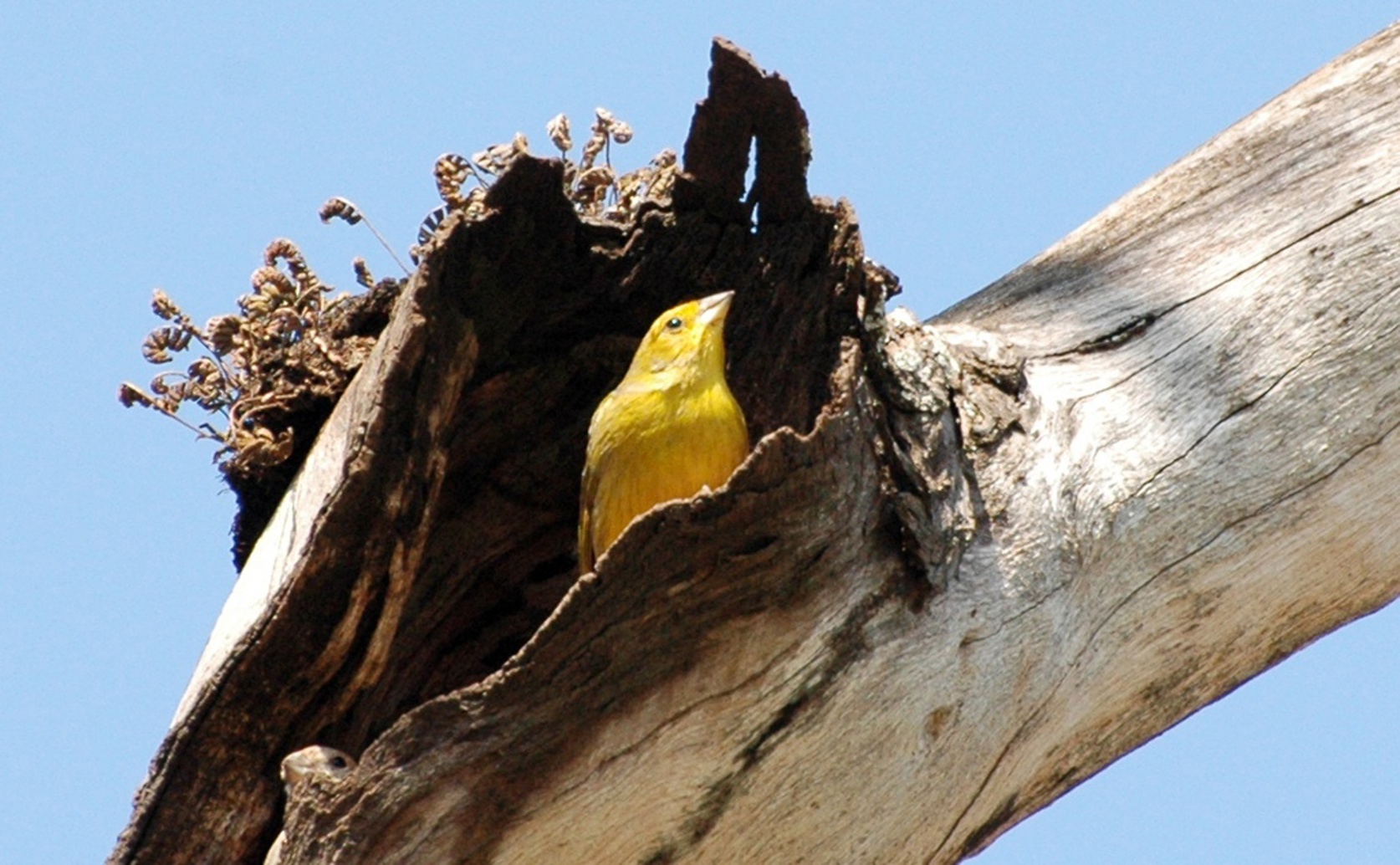
Saffron Finch (Sicalis flaveola)

Photo adapted from: Gustavo Cattivelli Caruso / CC BY (Source)

Key Findings

  • This study, conducted in Argentina with Saffron Finches, investigated how male age impacts parental care
  • Handicapped female finches paired with younger males reduced brooding time and lost weight, indicating they bore a greater cost of raising young
  • Despite experimental handicaps, neither male nor female finches altered feeding rates, but younger males paired with handicapped females experienced slower nestling growth and lighter fledglings
Life history theory predicts that animals face trade-offs between investing in current reproduction versus their own survival, and between current and future reproductive efforts. Essentially, there’s a limit to how much energy an animal can expend, and allocating more to one area often means less available for another. A recent study by researchers at Universidad de Buenos Aires, Universidad Nacional de Misiones, CONICET, and Newcastle University[1] investigated these trade-offs in Saffron Finches ( Sicalis flaveola), a small bird species where males change colour with age – younger males are drab, while older males are bright yellow. The study focused on whether these finches adhere to the expected trade-offs, specifically examining parental care and reproductive success in relation to male age. Previous work with Saffron Finches in artificial nest-box environments had surprisingly shown that both young, less colourful males and older, brighter males provide similar levels of parental care and achieve roughly the same reproductive success. This finding was somewhat unexpected, as one might anticipate older, more experienced males to be more efficient parents. To explore this further, the researchers conducted an experiment involving ‘handicapping’ birds by clipping three primary flight feathers (remiges) from both males and females of different age classes. This manipulation was designed to reduce their ability to forage efficiently, thereby forcing them to expend more energy on parental care. The study compared several groups: control pairs with no handicaps, handicapped males paired with non-handicapped females, handicapped females paired with either handicapped or non-handicapped males of both ages, and so on. A range of measurements were taken, including changes in adult weight, feeding rates, the duration of brooding (sitting on the nest to keep eggs warm), nest temperature, return rates to the nest, offspring growth rate, final offspring weight, time spent at the nest, and the proportion of chicks successfully fledging (leaving the nest). The results were quite revealing. Contrary to expectations, neither the handicapped males nor the handicapped females altered their feeding rates. This suggests that the birds were unable or unwilling to compensate for the increased energetic demands imposed by the handicap by simply increasing their foraging effort. However, significant costs were observed for handicapped females paired with second-year (younger) males. These females exhibited shorter brooding bouts, experienced greater weight loss, and their offspring grew more slowly and fledged at a lighter weight. This suggests that when lower-quality females are paired with younger males, they are forced to bear a disproportionate burden of parental care. The findings indicate that these females may be maximizing their reproductive success under suboptimal conditions – essentially, they are doing the best they can with a less capable partner. This ties into broader concepts of sexual conflict, where males and females may have different optimal strategies for reproduction[2]. The study by[2] demonstrated that conflict over parental care is common in birds and is often driven by mating opportunities, with both sexes adjusting their care based on the potential for finding alternative mates. Interestingly, the study also builds upon research highlighting the energetic demands of brooding[3]. In many bird species, only the female provides warmth to the chicks, as altricial young (those born helpless and requiring extensive parental care) are ectothermic and rely on external heat sources for development. The study by[3] showed that females actively monitor their surroundings for their mate’s presence, anticipating his return with food and adjusting their foraging behavior accordingly. The observed weight loss in the handicapped females of could be linked to this, as they were forced to spend more time foraging to compensate for the reduced provisioning by their mates, and potentially less time monitoring for their return. Furthermore, the importance of nest microclimate on nestling development, as demonstrated in blue tits[4], provides context for the slower growth rates observed in the offspring of handicapped females. While the study by did not directly measure temperature, the reduced brooding time could have resulted in suboptimal nest temperatures, potentially contributing to the slower growth rates and lighter fledglings. In conclusion, the research by provides valuable insight into the complexities of parental care trade-offs in Saffron Finches. While previous studies suggested little difference in parental care between males of different ages, this new work reveals that the costs of pairing with a lower-quality mate are borne disproportionately by the female, particularly in the context of limited resources.

EcologyAnimal ScienceEvolution

References

Main Study

1) Intra- and intergenerational costs of handicapping in the Saffron Finch (Sicalis flaveola), a thraupid with delayed plumage maturation

Published 12th September, 2025

https://doi.org/10.1371/journal.pone.0331227


Related Studies

2) Parental conflict in birds: comparative analyses of offspring development, ecology and mating opportunities.

Journal: Proceedings. Biological sciences, Issue: Vol 275, Issue 1632, Feb 2008


3) Female birds monitor the activity of their mates while brooding nest-bound young.

https://doi.org/10.1007/s10071-020-01453-5


4) Incubation temperature affects growth and energy metabolism in blue tit nestlings.

https://doi.org/10.1086/662172


Related Articles

An unhandled error has occurred. Reload 🗙