Age and source of a large ancient wooden structure from the Mitchell site

Greg Howard
5th October, 2025

Age and source of a large ancient wooden structure from the Mitchell site

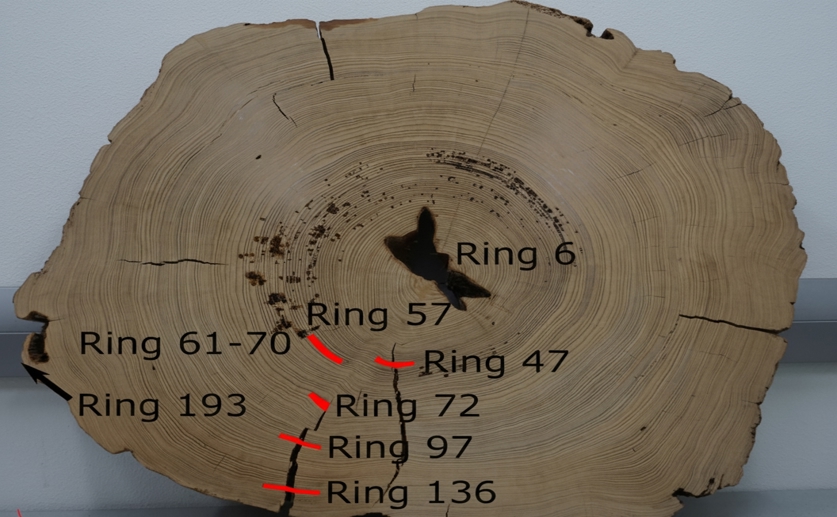
Illustration of the Mitchell Log's cross-section, showing the locations within the tree-ring sequence from which samples were taken for radiocarbon (¹⁴C) dating.

Image adapted from: Kessler et al. / CC BY (Source)

Key Findings

  • Located near Collinsville, Illinois, Cahokia was a major urban center around 1050-1350 CE, and this study focuses on a large wooden marker post from the site
  • Precise dating of the Mitchell Log, a marker post, revealed it was felled around 1124 CE, a period of relative climate stability
  • The wood for the Mitchell Log did not come from local sources, originating at least 180 kilometers away, indicating extensive trade or logistical networks during Cahokia’s peak
Cahokia, located near modern-day Collinsville, Illinois, was a major urban center that flourished between 1050 and 1350 CE, representing the largest prehistoric population center north of Mesoamerica. Understanding the rise and fall of Cahokia is a complex undertaking, as multiple factors likely contributed to its development and eventual abandonment. A key challenge for archaeologists has been establishing a precise timeline of significant events – when major construction projects occurred, and how far-reaching Cahokia’s influence truly was. This is difficult because dating methods for many archaeological materials aren’t precise enough to pinpoint events with high accuracy. Researchers from the University of Arizona recently focused on large wooden posts found at Cahokia, known as marker posts[1]. These posts were used in public ceremonies and construction, and some were made from wood sourced from distant locations, suggesting extensive trade or logistical networks. The team analyzed the largest known marker post, called the Mitchell Log, to gain insights into Cahokia’s history. The primary method used was radiocarbon dating – a technique that uses the decay of a radioactive carbon isotope (carbon-14) to estimate the age of organic materials. However, a unique aspect of this study was the use of a specific cosmic event recorded in tree rings. Cosmic rays interact with the atmosphere, producing carbon-14, and major solar events leave distinct signatures in tree-ring growth patterns. By identifying this signature in the Mitchell Log’s wood, the researchers were able to refine the radiocarbon dating and determine the felling date of the tree with exceptional precision: around 1124 CE. In addition to dating, the researchers analyzed the strontium isotope ratios within the wood. Strontium is a chemical element present in rocks and soil, and its isotopic composition varies geographically. By comparing the strontium ratios in the Mitchell Log to those found in soils across the region, they could determine where the tree had grown. The results showed the wood did not come from local sources; instead, it originated at least 180 kilometers away. This indicates a significant investment in transporting a large tree over a considerable distance. This research builds upon earlier work that highlighted the importance of climate in Cahokia’s trajectory[2][3][4]. Studies using fecal stanol data, oxygen isotope analysis, and paleoenvironmental records suggest that periods of flooding and drought significantly impacted Cahokia’s population and sociopolitical structure. Specifically, flooding of the Mississippi River and warm-season droughts around 1150 CE are thought to have created stress for the inhabitants[2]. Simultaneously, research reconstructing regional precipitation patterns indicated wet conditions during the Medieval Climate Anomaly (950-1250 CE) facilitated maize agriculture and population growth, while drier conditions between 1250-1350 CE corresponded with socio-political instability and abandonment[3]. The dating of the Mitchell Log to 1124 CE is crucial because it provides a firm historical point during a period of relative climate stability and before the onset of the more severe droughts identified in previous studies[2][3]. The fact that a large, exotic log was felled and used at this time suggests that Cahokia was at the peak of its power and influence, capable of organizing the long-distance transport of substantial materials. The discovery also raises questions about the thousands of other marker posts found at the site – where did they come from, and what does their distribution tell us about Cahokia’s reach and connections? The timing of the Mitchell Log’s felling, coupled with its distant origin, suggests that Cahokia’s influence extended far beyond its immediate surroundings, and that the polity possessed the organizational capacity to manage complex logistical operations.

EcologyPlant Science

References

Main Study

1) Age and origin of a Cahokian wooden monument at the Mitchell site, Illinois, USA

Published 3rd October, 2025

https://doi.org/10.1371/journal.pone.0333783


Related Studies

2) Fecal stanols show simultaneous flooding and seasonal precipitation change correlate with Cahokia's population decline.

https://doi.org/10.1073/pnas.1809400116


3) Midcontinental Native American population dynamics and late Holocene hydroclimate extremes.

https://doi.org/10.1038/srep41628


4) Cahokia's emergence and decline coincided with shifts of flood frequency on the Mississippi River.

https://doi.org/10.1073/pnas.1501904112


Related Articles

An unhandled error has occurred. Reload 🗙